Israel eyes peace talks despite attack
JERUSALEM - Israel signaled a willingness yesterday to move ahead with peace talks despite a deadly attack on a Jewish seminary in Jerusalem. But a U.S.-backed Egyptian initiative for a cease-fire between Israel and Hamas appeared to be in trouble because of the violence, which shattered four years of relative calm in the holy city.
JERUSALEM - Israel signaled a willingness yesterday to move ahead with peace talks despite a deadly attack on a Jewish seminary in Jerusalem. But a U.S.-backed Egyptian initiative for a cease-fire between Israel and Hamas appeared to be in trouble because of the violence, which shattered four years of relative calm in the holy city.
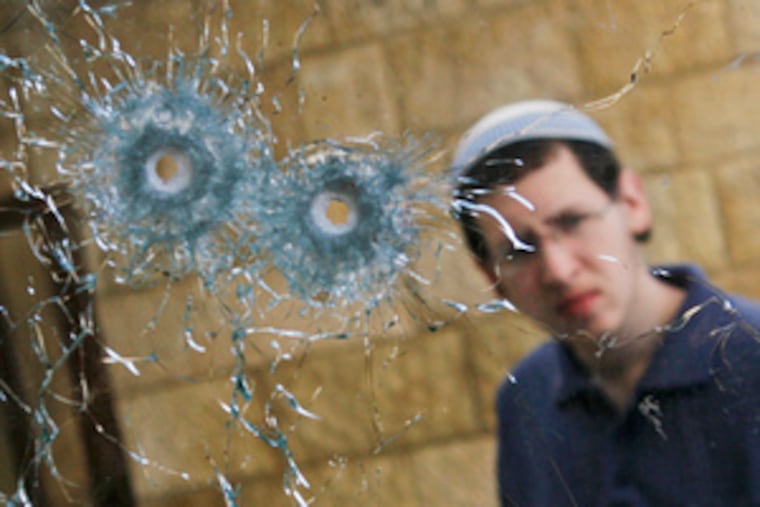
Outside the bullet-scarred seminary, thousands of mourners marched in funeral processions yesterday for the eight young students gunned down by a 25-year-old Palestinian from East Jerusalem whose family said he had been distraught over recent carnage in the Gaza Strip.
A rabbi at the seminary, which is a flagship of Israel's West Bank settlement movement, recited Hebrew psalms that the crowd repeated. The bodies were taken away for burial. One of the dead students was 26; the rest were between 15 and 19, including Avraham David Moses, 16, an American whose parents moved to Israel in the 1990s.
Concerned about more violence, Israel slapped a closure on the West Bank and kept men under 45 from praying at Jerusalem's main mosque. And in a possible sign that it suspected Lebanese guerrillas could have been involved, Israel sent warplanes over Beirut, according to a Lebanese security official. Israel's army declined comment.
Despite the bloodshed, an Israeli official said his country would not cut off peace talks with the moderate Palestinian leadership - an apparent nod to U.S. insistence that extremist violence not be allowed to derail efforts to forge a deal by year's end.
Israel will push ahead with the talks "so as not to punish moderate Palestinians for actions by people who are not just our enemies but theirs as well," the official said, speaking on condition of anonymity because the government had yet to make a formal announcement.
A second time
It was the second time in a month that Israel chose not to halt talks after an attack. When a Palestinian suicide bomber struck in the town of Dimona on Feb. 4, killing one woman and wounding 11 people, Israeli and Palestinian officials went ahead with a planned negotiating session.
Palestinian Authority President Mahmoud Abbas briefly suspended peace talks this week after more than 120 Palestinians had been killed in an Israeli campaign against Palestinian rocket launchers in Gaza. Abbas later backed down under pressure from Secretary of State Condoleezza Rice.
Egypt, backed by the United States, is exploring a truce deal between Israel and Hamas that would stop rocket fire on Israel in exchange for an end to Israeli attacks on extremists and the resumption of trade and travel from Gaza, where border crossings have been closed since Hamas violently seized control of the coastal strip in June.
Extremists from Hamas and Islamic Jihad traveled from Gaza to the northern Egyptian city of el-Arish on Thursday to confer with senior Egyptian intelligence officials on a truce. Assistant Secretary of State David Welch also was in Egypt.
Mourning tent
The diplomacy appeared to reflect a growing understanding that a peace deal between Israel and Abbas' moderate government based in the West Bank will simply not be possible as long as Hamas is playing the role of spoiler in Gaza.
However, the latest violence undermined cease-fire hopes - and raised the possibility of more harsh Israeli action in Gaza, especially if Hamas indeed was behind the seminary attack.
Relatives of Alaa Abu Dheim, of East Jerusalem, said he had carried out the attack. The family set up a mourning tent, and both Hamas and Hezbollah flags hung outside it. Neighbors said he had been a driver for the seminary.
It was not clear whether any group had provided backing for the shooting. Israeli TV stations said security officials believed Abu Dheim might have acted alone.
However, it is virtually impossible for a Palestinian resident of Jerusalem to obtain a weapon legally, raising the likelihood that Abu Dheim received some assistance. Israel annexed East Jerusalem after the 1967 Mideast War, and Arab residents enjoy freedom of movement in Israel, unlike Palestinians in the West Bank and Gaza.
Hamas radio had said yesterday that the group took responsibility, but it later retracted the assertion. Abu Obeida, a spokesman for Hamas' military wing, said the group was not yet taking official responsibility for the attack, adding to the confusion.
A previously unknown, Lebanese-based group, the Martyrs of Imad Mughniyeh - after a senior Hezbollah commander killed in Syria last month - claimed responsibility, the al-Manar satellite TV station reported. But the claim could not be independently confirmed. Hezbollah has blamed Israel for Mughniyeh's killing and vowed revenge.
Abu Dheim's relatives said they did not know of his plot but were not surprised. He had been transfixed recently by the bloodshed in Gaza, and "he told me he wasn't able to sleep because of the grief," said his sister, Iman Abu Dheim.
Relatives described Abu Dheim as intensely religious but said he was not a member of an extremist group. Family members said several relatives had been taken for questioning by Israeli police.
Israeli Public Security Minister Avi Dichter said Arab residents of East Jerusalem who had been involved in extremist activity should be expelled to the West Bank, a move that would strip them of their rights.