Comparing area hospitals' heart surgeries
More heart bypass patients died at three area hospitals than experts expected in 2006, according to a report due out today from the Pennsylvania Health Care Cost Containment Council.
More heart bypass patients died at three area hospitals than experts expected in 2006, according to a report due out today from the Pennsylvania Health Care Cost Containment Council.
One or two fewer deaths at Hahnemann University Hospital in Center City, Crozer-Chester Medical Center in Upland, and Mercy Fitzgerald Hospital in Darby, however, and those hospitals would have done as well as the 19 other heart hospitals in the five-county Philadelphia area.
In a similar effort, New Jersey regulators yesterday announced another, less definitive analysis of its hospitals, and found that Lourdes Medical Center of Burlington County scored in the bottom half of hospitals nationally in processes known to promote good care in four key areas, such as pneumonia and heart attack.
Officials in both states said care is improving thanks in part to public reporting.
In Pennsylvania, 1.8 percent of bypass patients died during their hospital stay in 2006, a 54 percent drop since 1990, according to the Cost Containment Council's latest - and possibly last - cardiac surgery report. It examined 11,022 bypass cases and 5,611 heart-valve procedures statewide in 2006.
Death rates also fell for valve patients compared with 2005, the first time those open-heart procedures were studied. And 30-day readmissions for complications were down for both types of operations.
Still, 13 percent of bypass patients - and nearly one in five receiving heart-valve surgery - needed to return to the hospital for care within 30 days.
The council, which has issued 125 reports on the cost and quality of care in Pennsylvania since 1986, could close this fall due to a political battle between Gov. Rendell and Senate Republicans.
The agency has been operating under an executive order since this summer, when the two sides were unable to reach an agreement on reauthorizing the agency.
The council, which has a $5 million budget, is recognized nationally for its research. Now other states are following the council's lead and publicly reporting on the quality of care.
Yesterday, New Jersey's annual hospital report card detailed performance in four areas - treatment of heart attacks, heart failure, pneumonia, as well as prevention of surgical-site infections.
The report by the state Department of Health and Senior Services was not as thorough as the Pennsylvania study. It did not examine how well patients fared.
Instead the New Jersey report examined how well 74 hospitals did at meeting "best practices" in 23 specific treatments, ranging from giving aspirin to heart-attack patients when they arrive at the hospital to giving appropriate antibiotics to patients within an hour of surgery.
New Jersey Health Commissioner Heather Howard said the report showed that the quality of care by Garden State hospitals exceeded the national average in 17 measures and fell below the norm in three areas.
"The overall performance of New Jersey hospitals continues to improve," Howard said.
Wendy A. Marano, spokeswoman for the Lourdes Health System, said the Burlington hospital's numbers were "lower than we would like"but noted it was making "steady improvement over time."
She said part of the problem was failing to properly document the treatment provided.
Included in the report were assessments of the 11 general hospitals in Burlington, Camden and Gloucester Counties as well as Deborah Heart & Lung Center in Browns Mills, N.J., which specializes in cardiac care.
David R. Kreider, the Cost Containment Council's chairman and a vice president at the Pennsylvania Chamber of Business and Industry, praised the state's hospitals, doctors and other health-care workers for the drop in death rates and readmissions even as he gave a pitch for politicians in Harrisburg to save the embattled agency.
The improvement in patient outcomes "is more evidence that the process of public reporting works," he said in a statement.
Such reports pressure administrators and surgeons to examine their results, said P.J. Brennan, chief medical officer of the University of Pennsylvania Health System.
"It holds us accountable," Brennan said. "It holds up a mirror to health care and provides a window to the public to see in."
The Hospital of the University of Pennsylvania (HUP) performed as expected for heart and valve surgery, the state report said.
Andrew S. Wechsler, head of cardiothorasic surgery at Hahnemann, said, "The adverse outcomes did occur and it stimulated us all to take a look at the program."
He said the hospital didn't do a good enough job documenting how sick its patients were.
Eric D. Dobkin, vice president for quality and patient safety at the Crozer Keystone Health System, said in a statement that Crozer-Chester's 2006 results were an aberration, and the hospital was working to "look for opportunities to ensure that we deliver excellent care."
Also in a statement, Mercy Fitzgerald said it examines every case to ensure its patients get the best possible care.
The report shows that the number of bypass surgeries continued to decline in 2006, down 7 percent from 2005. Surgeries are falling because doctors are more often using less-invasive stents, or tiny mesh scaffolding, to prop open arteries.
At the same time, the number of hospitals offering lucrative heart surgery has doubled since 1996, raising questions about cost and quality. Experts say that busier programs tend to produce better outcomes.
Only four hospitals in the region's Pennsylvania counties did more than 180 bypasses in 2006 – Lankenau Hospital in Wynnewood, Frankford Hospitals in Philadelphia, St. Mary Medical Center in Bucks County, and Presbyterian Medical Center in West Philadelphia.
The federal Medicare program paid a state average of $30,425 for bypasses and $43,960 for valves.
Unlike the crowded field of bypass surgery, a handful of surgeons and hospitals - HUP, Presbyterian, Lankenau and Abington Memorial Hospital - dominated valve procedures.
Abington was the only hospital to have fewer than expected 30-day readmissions for valve surgeries.
One of those patients yesterday was Mark Christopher.
He had no idea that Abington's Paul V. Addonizio was among the busiest valve surgeons in the state when he arrived at the hospital.
Like many patients, he trusted his cardiologist's recommendation, and liked that the surgeon "has some familiarity with fishing and with God. Those are two important things to me."
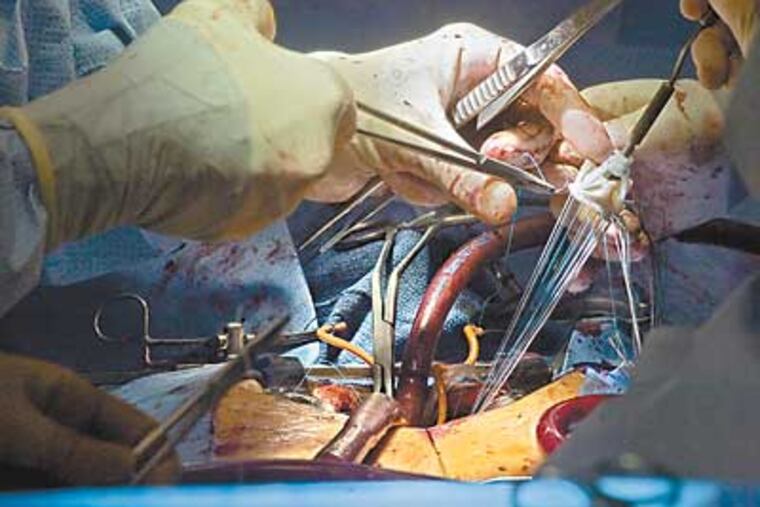
Still, Christopher, 53, was scared as he prepared for the surgery to implant a new aortic heart valve.
Because of Christopher's relatively young age and the severity of his heart problems, Addonizio said the case was complex.
"So far he's doing fine," the surgeon said shortly after the surgery was finished.
Links to reports on hospital quality in Pennsylvania
and New Jersey: http://go.philly.com/healthEndText