Judicial aide's firing: Nothing 'personal'?
For eight years, Ralph DiFronzo served Common Pleas Judge John Chiovero as the judge's "personal." He did "everything from getting [the judge's] first cup of coffee" to "picking up his dry cleaning" to driving the judge to doctors' appointments to doing some of his banking, DiFronzo says.
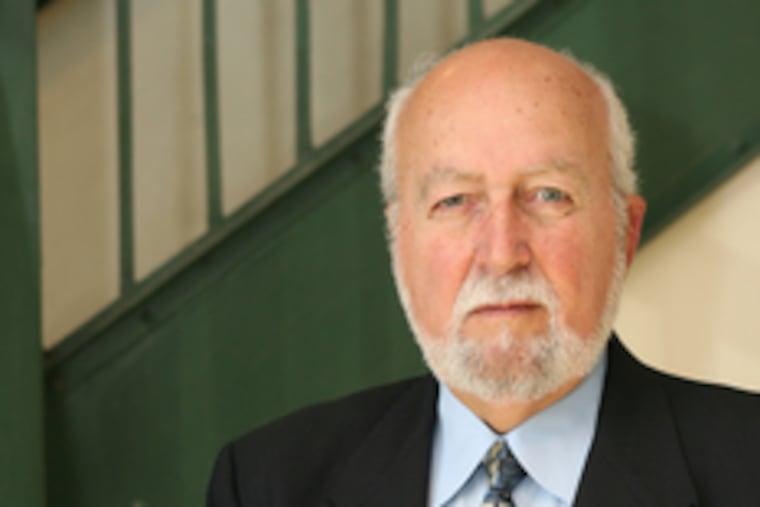
For eight years, Ralph DiFronzo served Common Pleas Judge John Chiovero as the judge's "personal."
He did "everything from getting [the judge's] first cup of coffee" to "picking up his dry cleaning" to driving the judge to doctors' appointments to doing some of his banking, DiFronzo says.
In the courtroom, DiFronzo helped the judge prepare for hearings and acted as a liaison between attorneys and the judge.
DiFronzo also was married to the judge's sister, Marietta Crimi, a relationship that began before DiFronzo started working for the judge.
Since those years, much has changed.
Most recently, DiFronzo filed a federal lawsuit against Chiovero, alleging that the judge trumped up false criminal charges against him two years ago and used his position to get DiFronzo fired from his court job.
"I want people who have power over other people to know you just can't take a personal, vindictive attitude toward some people and do them harm," says DiFronzo, 68, when asked why he filed the lawsuit. "I want to be compensated for all the expenses I've had to incur."
He says he wants to be compensated for having been locked up in a police holding cell for more than two days in August 2006 following his arrest on theft and forgery charges brought by the judge, for the salary and benefits he would have received if he had continued working for the First Judicial District and for medical expenses he incurred from the emotional and physical toll that the criminal allegations had had on him.
Reached by phone last month, the now-retired Chiovero, 81, said: "I don't have anything at all to say about that nonsense."
However, Chiovero's attorney, Fortunato "Fred" Perri Jr., said: "The plaintiff's allegations are absurd. We categorically deny the allegations and I'm confident that at the end of the day, the plaintiff will have an extremely difficult time proving any of these ridiculous allegations in the courtroom."
He said that Chiovero "has been a dedicated and well-respected member of the bench for decades."
Perri's Center City firm, McMonagle, Perri, McHugh & Mischak, last month filed a motion to dismiss the suit in federal court contending that the "patently frivolous lawsuit . . . has no place in the federal courts, or any court for that matter."
A relationship gone sour
DiFronzo served as the judge's "personal" from June 1996 to around May 2004.
He says that on the day that he told the judge that he was seeking a divorce from Crimi, the judge fired him as his personal, and told him to report to the general pool of Common Pleas court officers.
DiFronzo worked as an aide for other judges until January 2005, when a deputy court administrator told him that he was fired from his job.
More than a year later, in 2006, Chiovero, then a sitting judge, initiated a criminal complaint against DiFronzo.
The complaint alleged that his former judicial aide had stolen more than $15,000 from Chiovero, Crimi and Crimi's daughter, Jennifer, from 2000 to 2002, by signing their names on about 35 checks and depositing them into a joint account that DiFronzo and his then-wife shared.
DiFronzo was held for trial on theft and forgery charges after a preliminary hearing, but the District Attorney's Office withdrew the charges last November, and the case did not go to trial.
Cathie Abookire, spokeswoman for the D.A.'s Office, explained in an e-mail statement why the prosecution was withdrawn: "There were so many questionable aspects to this case that the District Attorney's Office concluded that it lacked prosecutorial merit."
A source close to the case said that the prosecution withdrew the charges after a handwriting analysis ordered at the end of the preliminary hearing showed that the judge had signed some of the checks in question, contradicting his testimony at the preliminary hearing.
It was "nothing more exciting than they caught him [the judge] in a lie," the source contended.
Malicious prosecution?
The lawsuit contends that the judge solicited the participation of his sister, Marietta, and his niece, Jennifer Crimi, in bringing criminal charges against DiFronzo as part of a vendetta.
"By this conspiracy, they intended vengeance for his action of leaving his marriage with Marietta Crimi, and causing perceived embarrassment to the Chiovero family," it says.
The suit, filed in September, seeks a jury trial and more than $150,000 in damages.
It initially named Marietta and Jennifer Crimi as co-defendants, but DiFronzo's civil attorney, Brian E. Appel, has since removed the two women as co-defendants to simplify the case.
The charges brought against DiFronzo involved mostly interest or dividend checks that had been mailed to DiFronzo and Crimi's New Jersey home from a Salomon Smith Barney account.
At the December 2006 preliminary hearing, Chiovero testified that he opened the brokerage account under Marietta and Jennifer Crimi's names, then changed it to his and his sister's names.
Chiovero testified that on Dec. 13, 2002- a year and a half before DiFronzo's firing as the judge's personal and nearly four years before the judge filed criminal charges - he discovered that three checks totaling $753.53 had been mailed out. He said when he asked DiFronzo, then his personal and brother-in-law, about this, DiFronzo said that he would check with Marietta over the weekend. On that Monday, DiFronzo came into work and gave the judge a personal check for the $753.53, saying that he had deposited them into his own account "by mistake," the judge testified.
Afterward, the judge said that he reviewed his past statements, and noticed that other checks had also been issued.
The judge testified that he had not endorsed the checks, had not given DiFronzo permission to sign his name and did not give anyone permission to deposit those checks.
Marietta Crimi - who, during the preliminary hearing, was still married to, but estranged from, DiFronzo - testified that she did not review any of the Smith Barney mail that had come to their house. Instead, she said, she gave such documents to DiFronzo to pass on to her brother.
When she reviewed the checks in court, she testified that for the most part, her name was not signed by her, and in a few cases, she was "not sure."
Jennifer Crimi similarly testified that she had not given DiFronzo permission to sign her name on the checks nor did she give him permission to deposit those checks.
The suit contends that a police handwriting examiner who later analyzed the signatures found that "several of the signatures identified under oath by John Chiovero, Marietta Crimi and Jennifer Crimi as forgeries, were in fact their own signatures and not forgeries."
DiFronzo, during the recent interview with Appel, his civil attorney, doesn't deny signing some of those checks. But he says that he had permission from the judge and his then-wife to endorse their names, and says he had permission from the judge to sign Jennifer Crimi's name when she was not available.
He said that with the Smith Barney checks, the judge at times would ask him to deposit them in a joint account held by DiFronzo and his wife, and to withdraw money to give to the judge, to Jennifer, or to reimburse himself for the judge's bills, which DiFronzo had paid with his own money.
He and his lawyer declined to comment on the judge's testimony about the $753.53.
Fired from his job
On Jan. 28, 2005, DiFronzo was fired from his general court-officer job by a deputy court adminstrator. According to the suit: "The reason given was that he had provided 'false and incomplete information on his employment application concerning prior criminal convictions.' "
David C. Lawrence, court administrator for the First Judicial District, said only that DiFronzo had been "discharged for cause." He said that he could not release any more information because of the ongoing lawsuit.
The suit, amended this month, says that DiFronzo on his 1996 job application for the position in Judge Chiovero's chambers, had disclosed only one criminal conviction, which was a felony, with the judge's knowledge.
The suit contends, without explicitly saying so, that months after firing DiFronzo as his personal, the judge had disclosed further information to the court administration about DiFronzo's past criminal history, knowing that, by so doing, DiFronzo would lose his job.
In the interview, DiFronzo said that the one conviction that he had disclosed on his application was a federal drug-related charge from a 1979 arrest when he was part of a conspiracy to distribute cocaine.
But he also admitted in the interview that he'd pleaded guilty in New Jersey on a state drug case around that same time.
DiFronzo also apparently had other past criminal convictions, including theft by deception.
Camden County Superior Court records show that he pleaded guilty to theft by deception and related offenses in the early 1980s.
When asked if DiFronzo had previously been arrested on theft-related charges prior to the judge's accusations, DiFronzo was directed by Appel not to comment during the interview.
Despite his past, DiFronzo maintains that he did nothing wrong with regard to the Smith Barney and other checks and is steadfast in his assertion that the judge falsely accused him.
"No," DiFronzo emphatically says when asked if any of the checks were deposited on the sly for his own benefit. *