Police face big change in Phila.
In his first week on the job, Police Commissioner Charles H. Ramsey indicated that more officers were needed on uniformed patrols, and he signaled to the department's captains that he wants to assign the best commanders to the city's most crime-infested districts.
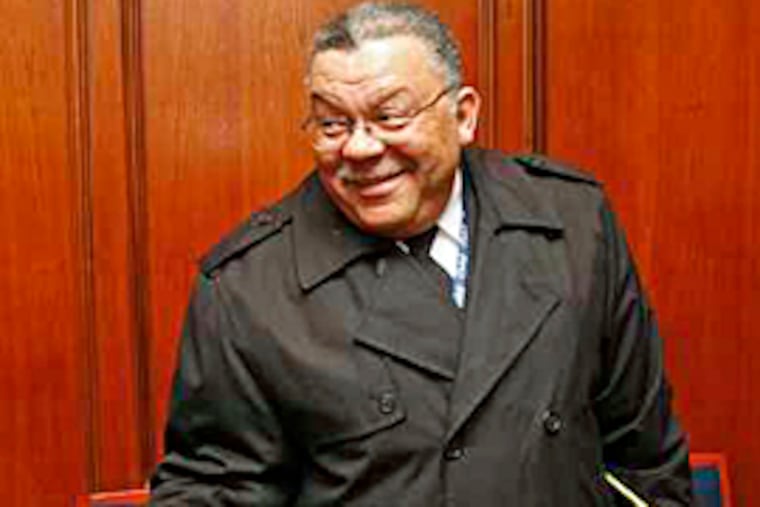
In his first week on the job, Police Commissioner Charles H. Ramsey indicated that more officers were needed on uniformed patrols, and he signaled to the department's captains that he wants to assign the best commanders to the city's most crime-infested districts.
One of the most significant changes will take place this morning out of public view. Ramsey has ordered his top commanders, including some district captains, to begin attending 90-minute meetings each morning to review the previous night's crime trends.
"We'll begin Monday meeting with the top command - senior commanders, deputy commissioners - on a daily basis to kind of give everybody a broader view of what's going on in the city, not just their little piece of it," Ramsey said in an interview Friday in his office, where the bookcases were bare but his desk was already cluttered with reports.
As word spread last week of the morning meetings, some commanders privately groaned about the new workload. The meetings, first slated to begin at 7:30 a.m., were rescheduled to start an hour later to accommodate the commanders.
Most of the initial changes in the department's operations last week were largely cosmetic: Mayor Nutter declared a symbolic "crime emergency" after he was sworn in Monday, and the commissioner vowed to increase the department's visibility by wearing a uniform and driving a marked squad car himself.
But behind the scenes, the former Washington police chief is sending signals that big changes are in store.
The coming weeks are likely to include many long workdays for Ramsey's command staff: In addition to the morning meetings, the commissioner has scheduled six nightly meetings across the city to gather public comment before he completes his crime-fighting plan, which he promised to deliver to Nutter on Jan. 30. The first meeting is scheduled for 7 tonight at South Philadelphia High School.
"If this is going to be a plan that's comprehensive, you certainly can't leave your customers out," he said.
Ramsey disclosed that the crime emergency was unlikely to involve any special police powers or suspension of the department's labor contract with officers, as Ramsey did four times during his nine years in Washington.
"If that's needed, then it's something that I would make in a recommendation at a future date to the mayor to see whether or not that's something he would be willing to do," Ramsey said. "But I think there are things that we can do short of that at first to see how effective that would be, short of calling a state of emergency."
During the election campaign, Nutter promised to declare an emergency that would allow the city to suspend rights in crime-infested neighborhoods, including limiting outdoor public gatherings, halting vehicle movements through some neighborhoods, and expanding curfews. None of those extra powers were mentioned in Nutter's executive order.
Though declining to go into some details, Ramsey said he already had identified one of the department's "biggest problems": Officers are scattered too thinly in the city's 23 police districts.
"Officers are going all over their districts answering calls for service, not being able to maintain any kind of meaningful sector integrity, which means you need more bodies out there," he said. He wants more officers to become familiar with their districts, "knowing who are the good folks, knowing the troublemakers, the hot spots in the area, and all those kinds of things."
But with no immediate plans to increase the size of the 6,700-member force, Ramsey will have to look to his existing staff to supply more officers for the streets. He said he had made no decisions about which units might be disbanded or reduced.
"If we need more people in uniform patrol, where do we take them from? And what are the consequences if we move people from one place to another?" he asked.
Ramsey said he did not anticipate "massive redeployments." He also said he probably would change some of his top commanders, but downplayed the need for the kind of wholesale change he imposed in Washington, where he reconfigured the entire command structure within a few years of taking over.
"There are some little tweaks here and there that I see probably need to be made, but we have good people here, and that's the key, the people, more than anything," he said.
While Ramsey is preparing his report for Nutter, he is also tending to some personal business. He spent the weekend in Washington preparing to move to a house he and his wife, Sylvia, are buying in West Mount Airy.
Ramsey, who has spent much of the last two months in Philadelphia preparing for the new assignment, made several visible symbolic changes last week that signal a new direction for the department.
Though former Commissioner Sylvester M. Johnson favored wearing business suits and driving an unmarked Crown Victoria, Ramsey has donned a uniform and drives a marked police cruiser prominently labeled "Car 1."
"I like being a policeman. I'm not ashamed of it, don't hide from it," said Ramsey, who was sworn in Monday, after Nutter's inauguration.
For Ramsey, the uniform sends a message to the public, as well as to the force, that the department will be more visible under his watch. He said he would like to see more officers wearing their uniforms, other than detectives and undercover officers.
"People need to see us and know that we're out there," he said. "This is part of this whole idea of the perception of crime, the perception of the lack of police presence."
Ramsey said perceptions and visibility were a big part of policing. One of his edicts in Washington was to order squad cars to patrol with their roof lights flashing, which drew attention to the police (some officers griped that it also alerted criminals). After some complained that the flashing lights on routine patrol were too startling, the department switched to steady white roof lights.
Ramsey also said he would encourage the department to embrace technological change, and promised to upgrade the department's Web site so the public can research crime statistics in their own neighborhoods.
"You can't get every new toy that comes out," he said. "But you can do what you can to keep abreast of those tools that will be of most use to you."
Some improvements already were rising to the surface ahead of the commissioner's arrival.
In December, the department's Crime Information Center started beaming recently obtained warrant information - including suspects' photos - to the mobile laptops of district patrol officers, Capt. Dennis Salkowski said.
Since the practice started, police have arrested 16 people, including a suspected armed robber apprehended Jan. 2 outside his home a mere 45 minutes after the information was sent out.
"If you get these criminals off the street, it prevents them from committing another crime," said Joyce Fineberg, a civilian employee who suggested the more aggressive approach.
Ramsey wants such practices to become more widespread.
"The technology is here; we just have to make sure we're making use of it," he said. "Getting technology is one thing, making sure people understand the capabilities of the technology and use it on a daily basis as part of the routine is another."
Talk to the Commissioner
Here are the dates, times and places for Commissioner Ramsey's public meetings:
Today, 7 p.m. - South Philadelphia High School, South Broad Street and Snyder Avenue.
Tomorrow, 7 p.m. - Lincoln High School, Rhawn and Rowland Streets.
Wednesday, 7 p.m. - Stetson High School, B Street and Allegheny Avenue.
Thursday, 7 p.m. - William Penn High School, 1333 N. Broad St.
Jan. 22, 7 p.m. - Pinn Memorial Baptist Church, 2251 N. 54th St.
Jan. 23, 7 p.m. - Martin Luther King High School, Stenton Avenue and Haines Street.
EndText