Black Clinton delegates facing a dilemma
WHERE DO local African-American political leaders committed to Sen. Hillary Clinton for president stand? To use a phrase in circulation lately, between Barack and a hard place.
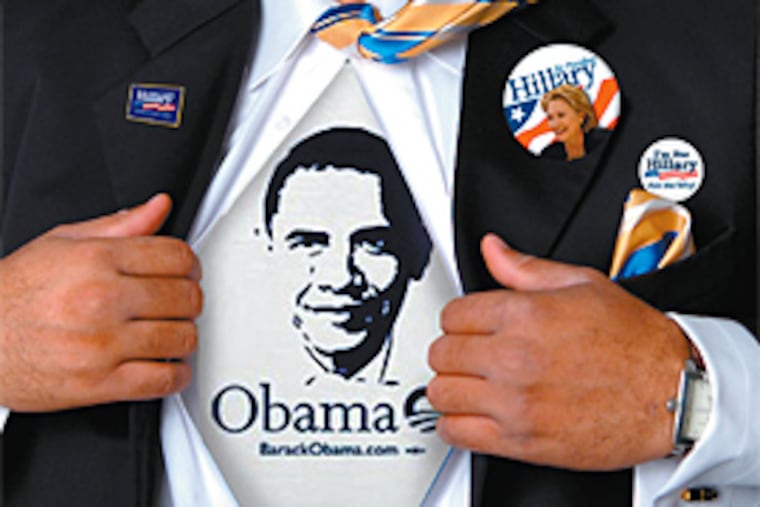
WHERE DO local African-American political leaders committed to Sen. Hillary Clinton for president stand?
To use a phrase in circulation lately, between Barack and a hard place.
As enthusiasm over Illinois Sen. Barack Obama builds in black communities, early supporters of Clinton are increasingly being second-guessed, and superdelegates - party insiders guaranteed a convention slot without pledging to a specific candidate - in particular are being urged to switch.
"The pressure is enormous," said Sunday Sun publisher and Philadelphia NAACP president Jerry Mondesire. "It's almost like you're a traitor to the black cause in many camps if you don't wave the Obama flag. It's on black radio, in churches, on the street."
Mondesire is running as a Clinton delegate in the April 22 Pennsylvania primary, something that everyone around him seems to question.
"My own kids have complained I'm not out there pushing for Barack," Mondesire said.
Many say the debate in local black political circles now is friendly and good-natured, but it could become edgier if Clinton survives today's primaries and Pennsylvania becomes a seven-week battleground for the Democratic nomination.
Pressure on Black Clinton supporters has gotten national attention in recent weeks with the defection of several African-American superdelegates to Obama, most prominently U.S. Rep. John Lewis of Georgia.
Campaigning in Philadelphia last week, former President Bill Clinton said Lewis was harassed by Obama supporters.
"You know what happened down there, and the way they treated him," Clinton said. "It was awful. I love him. He's a great man. He wound up getting an opponent [in the Democratic primary] because of his long friendship and support of Hillary."
Two African-American New Jersey superdelegates switched from Clinton to Obama last month - Camden state Sen. Dana Redd, and Montclair Democratic National Committee member Christine Samuels.
The one African-American superdelegate for Clinton in Pennsylvania, Pittsburgh community activist and DNC member Evelyn Richardson, said in an interview Saturday she's staying with Clinton.
"I'm with her 'til the fat lady sings," Richardson said, adding that she hasn't been getting pressure to switch because "they know they can't influence me."
Philadelphia state Sen. Anthony Hardy Williams, who supports Obama, said the superdelegates most subject to pressure have been those, particularly in Congress, who are up for re-election this year.
The pro-Obama group ColorOfChange.org urges followers to write black congressional representatives who are "threatening to undermine the voice of the voters they represent" by supporting Clinton.
Philadelphia's most prominent African-American supporter of Clinton, Mayor Nutter, said he hasn't been asked to change his mind, and won't.
"When I endorse someone, when I say I'm supporting someone, I maintain my support," Nutter said, adding a thought about racial identity and politics.
"The media coverage and the assumption that the African-American community is a monolithic community that just votes on one issue and on issues of race has to be disputed," Nutter said.
For some black Clinton supporters, the impetus to switch may come less from strong-arming by Obama supporters than the positive appeal of a campaign that appears to transcend traditional politics.
New Jersey superdelegate Christine Samuels said she resents the notion that someone else changed her mind about Clinton.
Samuels, a longtime school system secretary, said she was moved by Obama's message of equal opportunity and the enthusiasm of his young followers.
"That inspired me, the young people I saw at his rallies and caucuses," Samuels said. "I said 'this is great, this is their time.' "
Mondesire admits he's also been impressed with the pull Obama has on young voters, like his son Joseph, a college student.
"This is the first campaign he's ever been active in that I didn't drag him into," Mondesire said.
Mondesire said he signed up to run as a Clinton delegate in the April primary because he wanted to get to the national convention in Chicago.
While he said he has some questions about Obama's record and experience, he hasn't decided which candidate he'll vote for April 22.
Sen. Williams said he doesn't hear harsh criticism of Clintonites among Obama supporters in the black community.
"Most of us who are on the [Obama] train are laughing at our friends who aren't," Williams said, "but it's not malicious. It's really teasing."
The tone could change if the Clinton and Obama campaigns storm into Pennsylvania for a seven-week battle, looking to rally every minister, community activist, and elected official they can to their cause.
"The tension would grow then," Williams said, but he said the debate will remain civil unless one of the campaigns or a surrogate makes inflammatory statements.
"If it gets uncivil," Williams said, "it will be because of politics, not gender or race." *
Staff writer Catherine Lucey contributed to this story.