MOMENTS AFTER his birth, Gary Chilutti was left for dead. Fifty-seven years later, the sadness of that fact pales in comparison to what happened next:
He was found, he was loved instantly and he was wanted desperately by two wonderful couples before finally being adopted by a third wonderful couple.
"I hit the jackpot with my parents," says Chilutti. "I couldn't have asked for better people. But learning about all this," he says, sifting through photos of one of the couples who'd hoped to adopt him long ago, "is just incredible."
All adoptees have a birth story, whether it's known to them or not. Some are content to let the past remain buried. Some try and fail to fill in the gaps of their earliest days. And some learn incredible things.
This is Chilutti's story.
What he didn't know
"I always knew I was adopted," says Chilutti, a boyish, 57-year-old social-services consultant and filmmaker who lives in Media with his wife, Marianne, and daughter Maya. "But I was only idly curious about my birth parents. I had a storybook childhood. My parents were great. So were my grandparents and aunts and uncles. My family was my family."
All of them thought they knew Chilutti's story: He'd been born Lawrence Edward Graham and was left, swaddled in a blanket, in a pew at the Cathedral Basilica of Ss. Peter and Paul. He spent time in foster care before being adopted by Ernie and Lucille Chilutti of Ardsley, a childless couple who'd tried for years to conceive.
Recently, Chilutti realized that each year on his birthday he thinks about his birth mother and wonders if she's alive, if she's thinking of him.
"She must've been so scared, to leave me in a church," says Chilutti, whose parents are now deceased. "I wanted to let her know I'm OK. I wanted to thank her."
He typed his birth name into public-record search engines, to no avail. So he asked Catholic Social Services, which has his adoption records, for help. A staffer handed over the entire file. There was no need to redact private information about Chilutti's birth parents, a staffer said, since there was none.
Tearing through the file, Chilutti was stunned to learn that the story of his birth was not true.
He hadn't been left in a cathedral pew, swaddled in a clean blanket, obviously meant to be found. He'd been left under a car in an alley behind St. George's Greek Orthodox Church on South 8th Street near Spruce.
He was wrapped tightly inside newspapers spotted with blood and meconium (a newborn's first bowel movement). His umbilical cord was still attached.
A man named George Vraimopoulos was walking his dog on the evening of Sept. 4, 1956, when the dog came upon the bundle of newspapers and wouldn't leave it alone.
According to the file, Vraimopoulos discovered the baby and called police, who rushed the newborn to Pennsylvania Hospital. He was transferred in fine health to the old Philadelphia General Hospital. A case worker named him Lawrence Edward Graham, apropos of nothing Chilutti could discern in the file.
"No wonder I couldn't find my name in public records," he says.
He was placed in foster care with a couple named Regis and Marie Lehnerd, of Yeadon, Pa. Chilutti knew he'd been in foster care. He just never knew how deeply he'd been cared for.
According to the file, the Lehnerds asked often about adopting Lawrence, "a nice looking baby with a nice shaped head and nice features," who was "a very good baby," a good eater and sleeper. The Lehnerds provided a "good, comfortable home . . . one in which any child should receive all the love and care a child needs to make him a well-adjusted adult."
Later, Lawrence is described as toothless, chubby and happy, always "clean and fresh." Marie Lehnerd is praised as "an unusually fine type of woman" who "loves this baby dearly and is giving him all the love and care he needs."
While the Lehnerds hoped to keep Lawrence, an unexpected move out of the area forced them to return him to state care, since the baby's development needed to be monitored locally. So Lawrence was adopted by the Chiluttis on April 4, 1957.
"This was so much more than I'd ever known," says Chilutti, who shared the file with his childhood buddy, Gerry Barnes, a school teacher. Barnes headed to the library, where he searched newspaper archives for any mention of a baby abandoned behind St. George's.
"My phone rings," says Chilutti, "and Gerry says, 'Are you sitting down? Because I'm looking at a photo of you!' Turns out I was on the front page of the Daily News on Sept. 6, 1956."
The story tells how Vraimopoulos found Chilutti to be "the cutest thing I ever saw." And how nurses at Philadelphia General Hospital were so taken with the foundling's "Confederate gray" eyes that they dubbed him "Little Jeff Davis"- for Confederacy leader Jefferson Davis.
Barnes had other news. While public records showed that Vraimopoulos was deceased, his sister-in-law, Christina Vraimopoulos, now 87, was still alive and living in Upper Darby. Barnes had called her and, yes, she wanted to meet Chilutti, whom she remembered clearly.
"And guess what?" Barnes said. "She said George and his wife wanted to adopt you."
Filling in the gaps
"Oh, honey, George and Lena thought you were a gift from God," Christina Vraimopoulos tells Chilutti five days later, as they share coffee and cake in her Upper Darby home, which sits next to Vraim Funeral Home on State Road.
Founded by her late husband, John (brother of George), the funeral home is run by her grandsons (the name Vraimopoulos has been shortened to Vraim).
"George and Lena couldn't have children, and they wanted them so badly," says Vraimopoulos, who tells Chilutti to call her "YaYa," Greek for "grandma."
She moves slowly but her wits are as sharp as the tines on the cake forks. "When George brought you home, he told everyone, 'We're keeping this baby.' "
Chilutti interrupts her.
"Wait - George brought me home?" he asks. The newspaper had said George found the baby during a morning walk on Sept. 5 and called police.
Not true, YaYa says. George discovered the baby the night before and rushed him back to the South 9th Street apartment where he and Lena lived, above the one his parents occupied. They tied off the baby's umbilical cord, bathed him and rubbed him with olive oil to protect his skin. YaYa, who lived nearby with John and their kids, brought over clothes, a bassinet and baby formula.
"We were so excited," she says. "George's mom said, 'This baby is a gift!' George wanted to keep you, but John said, 'You can't just keep a baby! The mother could tell police you kidnapped him!' So we kept you overnight. The next day George called the police. Then he and Lena tried to adopt you."
Officially, George and Lena were refused adoption because their apartment was deemed too small and, at age 42, they were too old. But YaYa believes that the snooty and cruel case worker rejected George and Lena because they were of modest means.
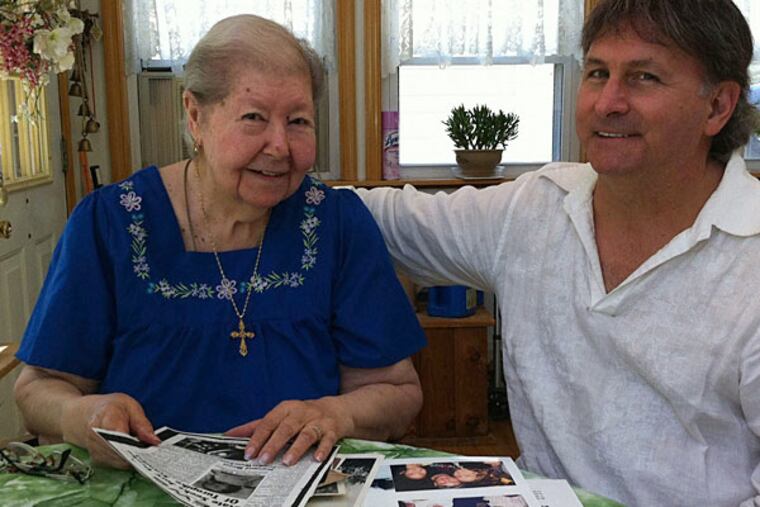
"We always wondered about you," she said, rubbing Chilutti's arm as she shows him old photos of George and Lena, long gone. "We hoped you found a good life. And you did, right?"
Yes, says Chilutti, he sure did. He shows her photos of his wife and daughter, talks about his parents' devotion. What is overwhelming, he says, is realizing how different life would've been had he been adopted by George and Lena, or by the Lehnerds (whom, public records show, are deceased, though Chilutti hopes to track down their family members, to thank them).
Chilutti is overwhelmed by the knowledge that he wouldn't be here if George Vraimopoulos hadn't saved his life 57 years ago. "I wish George were alive, so I could thank him," he tells YaYa, who has made Chilutti promise to return with his wife and daughter so she can meet the people who, under other circumstances, might've been family.
YaYa regards him for a moment, asks if he attends a church. Not really, he tells her. That's OK, she says. Go find a church, any church that has candles.
"Light a candle and just talk to George," she says gently. "Tellhim thank you. He'll hear you."
Phone: 215-854-2217
On Twitter: @RonniePhilly
Blog: ph.ly/RonnieBlog