Billing a dead man
There is a sidewalk hazard on the 9500 block of Hilspach Street in Bustleton that has proved difficult to get fixed.
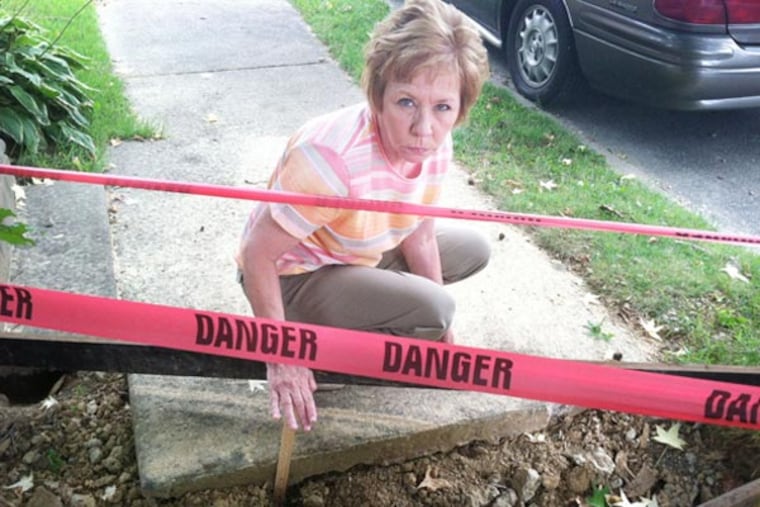
THERE IS A sidewalk hazard on the 9500 block of Hilspach Street in Bustleton that has proved difficult to get fixed.
The broken sidewalk is difficult to get fixed because repairs are the responsibility of the owner of the property, and the owner is deceased.
Maybe dead men can vote in Philadelphia, but they don't respond to payment demands made by the city. This story is about a true deadbeat.
The busted sidewalk points to a larger problem that we will get to in a minute.
The hazardous sidewalk at 9503A Hilspach St. was brought to my attention by Carol Wendell, who lives across the street on the tidy block and has tried everything she can think of to get the repairs made. The portion of the busted sidewalk in front of 9503B, across a breezeway from 9503A, was fixed by the owner, who is happily still alive.
Not so for the owner of 9503A, Paul Rayesky, who died at 71 in 1996. The sidewalk has been a problem for several years after tree roots made it buckle, says Wendell.
Repairs completed by the live owner created a drop-off about 7 inches deep between new and old, creating a tripping hazard, or worse, Wendell says.
"If someone's walking down the street with a baby carriage and they don't see it, the carriage can turn over," she says. "A child on a bike can go flying in the air."
To prevent that, her husband, Ken, set up a barricade around the hazard - caution tape, boards nailed to a tree and an orange and white hazard barrier.
Wendell says she called 3-1-1, the Streets Department and her councilman, Bryan J. O'Neil, who all said their hands are tied.
Street Commissioner David Perri tells me "there is no mechanism for the city to do the sidewalk work and bill the homeowner."
Then there's that larger problem. No one's been paying real-estate taxes on 9503A since 1997, and the city is now owed $75,633.64.
There's more. Every so often, CLIP comes around to cut the grass, pull the weeds and clear the trash. CLIP stands for Community Life Improvement Program and is in the managing director's office. It's a good way to prevent neighborhood eyesores, and Deputy Managing Director Tom Conway says an average visit costs a couple of hundred dollars. The homeowner is then billed and 9503A owes more than $1,800, but that bill goes to the dead-letter office.
We return to the 75 large the dead man owes the city.
How can so big a debt be allowed to pile up?
There has been an effort to collect. Over the 17 years of nonpayment, the GRB Collection Agency was engaged for five years, but had no better luck collecting from a dead man.
How can the city let this slide for 17 years? The city (responding in the voice of mayoral spokesman Mark McDonald) says the Revenue Department and GRB "shared this case over the years."
Sometimes "sharing" is bad. It works against accountability. It makes me wonder how many live deadbeats are thumbing their noses at the city.
Translating the rest of McDonald's statement from governmentese into English, the system was mired in mud, we're working to fix it.
"We expect the property to go to sheriff sale in March."
Yaaaay!
In the meantime, while Perri applauds the homeowner at 9503B for doing the right thing, he'll have to tell the owner that his contractor should have paved "a sloped transition between the two sidewalk levels," adding he will send out a letter to that effect.
"If all involved are reasonable and coolheaded, we can solve this problem quickly with minimal additional cost," Perri says.
This being Philly, that's a big "if."
Phone: 215-854-5977
On Twitter: @StuBykofsky
Blog: ph.ly/BykoColumns: ph.ly/StuBykofsky