House Republicans accuse top psychology group of antisemitism
Since taking control of the House in 2023, Republicans have held hearings on antisemitism aimed at academia and progressive institutions.
Republicans are stepping up efforts to portray the American Psychological Association as an institution riddled with antisemitism just weeks after a Department of Education committee recommended putting the brakes on the organization’s accrediting power.
In a scathing report released Thursday, House Republicans blamed the organization for “troubling leadership failures” they say have alienated Jewish members and undermined confidence in the association’s ability to set standards within the field. The report is the latest attempt to scrutinize the ideology of the APA, the leading scientific and professional organization representing psychologists in the United States.
The APA has nearly 200,000 members and provides accreditation to more than 1,300 training programs, including doctoral internships and postdoctoral residencies.
Since taking control of the House in 2023, Republicans have held hearings on antisemitism aimed at academia and progressive institutions. Some critics have argued that the Trump administration has weaponized claims of antisemitism against these long-standing targets of conservatives.
The report, issued by the House Education and Workforce Committee, concluded that anti-Jewish sentiment “has manifested across the association’s resolutions, listservs, newsletters, publications, and conferences.” It cited “radical activist-academics” who have promoted ideology that “demonizes Israel, minimizes Hamas terrorism and portrays Jews as white oppressors.”
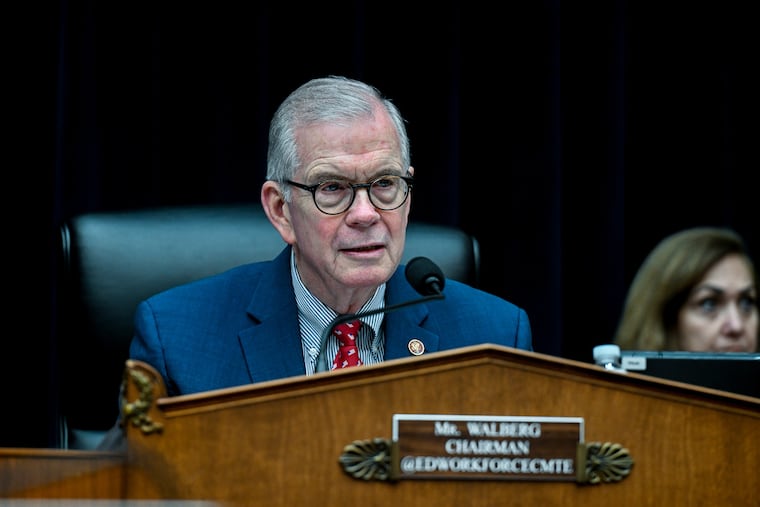
The committee, led by Rep. Tim Walberg (R., Mich.), began investigating the APA in December. The report details emails sent to public listservs in the days after the Hamas-led attack on Oct. 7, 2023, as well as internal discussions among association leadership deliberating how to publicly respond.
On Friday, Wendi S. Williams, the APA president, said in a statement that the organization “unequivocally condemns antisemitism in all its forms.”
“We don’t agree with the report,” Williams said. She added, “Since these concerns were first brought to APA’s attention, APA has taken meaningful steps to ensure that Jewish members, like all members, can participate fully and safely in the organization and the profession.”
Proponents of the report applauded the confirmation of complaints long aired by some Jewish psychologists, while others argued that it purposely conflates criticism of Israel with antisemitism.
The report cited numerous excerpts from documents in concluding that the APA promoted a climate of antisemitism. These included listserv emails in the days after the Oct. 7 attack from some association members who argued that Hamas was “protecting civilians” and deserved “kudos.” It cited a newsletter in which the APA’s community psychology division described the attack using language like “uprising.” It detailed pushback against Jewish members who wanted to form an official ethnic subgroup — similar to existing groups for Arab, Asian American, and Black psychologists — including arguments that Jews had “benefited from white privilege.”
The House Republicans’ report also criticized a revised APA resolution on antisemitism, approved in February, suggesting that the new language diluted the word’s meaning.
Some groups representing Jewish psychologists and Jewish Americans celebrated the report.
“This report confirms the extent of antisemitism within the APA as well as the failure of leadership within that association to deal with it,” said Kenneth L. Marcus, the chair and CEO of the Brandeis Center, a nonprofit focused on combating antisemitism. For years, he said, the Brandeis Center has “gotten reports of antisemitism from mental health professionals, from students of psychology, and from patients.”
In June, after Marcus’ group filed a complaint accusing the APA of marginalizing Jewish and Israeli psychologists, the Department of Health and Human Services’ Office for Civil Rights opened a federal civil rights investigation into the organization.
But the report also reflected bitter divides, including among the Jewish members of the APA, over how to define antisemitism.
Roy J. Eidelson, who is Jewish and a former president of the APA’s Society for the Study of Peace, Conflict, and Violence, said he disagreed with the report’s contention that antisemitism had spread throughout the organization.
Antisemitism is discrimination, prejudice, and hostility toward Jews, he argued. “It is not criticism of Israel or Israel’s actions, and it is not support for Palestinian rights,” he said.
The report called Eidelson one of the association’s “most vocal antizionist members,” citing an essay he wrote about the “weaponization of antisemitism” and noting that it was praised in 2025 by the APA president at the time, Debra Kawahara.
Eidelson said the essay was intended to describe “false charges of antisemitism” used to discredit those who had criticized the attacks on Palestinian civilians in the Gaza Strip as genocidal acts. “It’s a real frustration to me and to many Jews like me,” he said.
A related fight unfolded over the APA’s 2026 change to its public position statement on antisemitism. Its 2007 resolution stated that antisemitism “may be asserted in the context of discourse regarding the actions of the Government of Israel.” The new resolution stated that “it is antisemitic to hold Jews collectively responsible for the actions of the state of Israel; to require Jews to publicly condemn Israel; to assume that Jews are more loyal to Israel than to their home countries; and to deny Jews in Israel/Palestine the right to exist and flourish as Jews on the basis of legal equality.” It also added a definition of the “weaponization” of antisemitism: “the manipulative or bad faith invocation of accusations to silence legitimate criticism, scholarship, or activism.”
The House report contended that the new resolution “greenlights” antisemitism.
Jonah Rubin, the senior manager for campus organizing at Jewish Voice for Peace, a leftist grassroots organization, which wrote a letter to the APA supporting the resolution change, said congressional investigations into universities and the APA were “worsening antisemitism, not combating it effectively, and this committee doesn’t care.”
In September, the Education Department’s National Advisory Committee on Institutional Quality and Integrity recommended that the department suspend the association’s commission on accreditation for 12 months, citing a “pervasive culture of antisemitism.”
Aaron Joyce, the APA’s head of accreditation, said in a statement last month that suspending accreditation would have severe consequences, including reduced funding for many accredited psychology programs that would make it more difficult for students to meet state licensure requirements.
This article originally appeared in the New York Times.