'It was apocalyptic,' officer says of building collapse
More than two years after the building collapse, Philadelphia Police Detective Paul Guercio still seemed in shock as he described arriving at 22d and Market Streets.
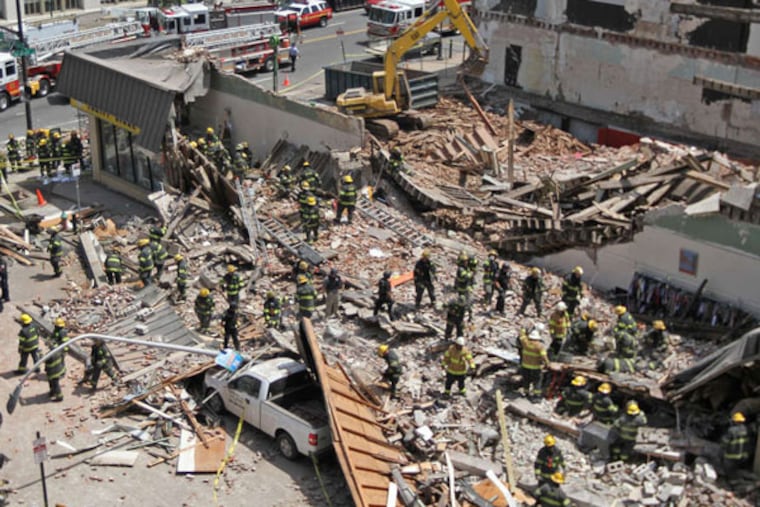
More than two years after the building collapse, Philadelphia Police Detective Paul Guercio still seemed in shock as he described arriving at 22d and Market Streets.
"I rounded the corner, and that's when I saw it. Oh, my God, it was apocalyptic," Guercio told a Philadelphia jury Thursday about the scene just around 10:50 a.m. on June 5, 2013.
Guercio is the first witness to testify in the murder trial of the demolition contractor accused in the Center City building collapse that killed six and hurt 13. He described walking west from 21st Street on Market:
There on the corner was the familiar entrance to the Salvation Army thrift store. But when he hit 22d Street, the store was just a corner facade standing before a block-long pile of debris that extended into the street and covered some cars.
"I ran onto the pile and tried to help people," Guercio testified. "You could hear, 'Help me,' but you didn't know where they were."
Griffin Campbell, 51, a Hunting Park contractor who was demolishing a series of buildings in the 2100 block of Market, is charged with six counts of third-degree murder - one for each victim - and 12 counts of reckless endangerment and one count of aggravated assault for those injured.
Guercio testified how he stayed at the site until 2 a.m., after the last injured person was rescued - and told of the frantic search to learn how many people might be buried under rubble.
Guercio also narrated videos of the demolition and collapse of the four-story Hoagie City building at 2136-38 Market and photos of the six people found under the debris.
City Treasurer Nancy Winkler and her husband, Jay Bryan, whose 24-year-old daughter, Anne Bryan, was killed - looked away when the photo of the young woman, covered in dust and curled in a fetal position, appeared on screen.
Campbell has pleaded not guilty to the charges, and his lawyer, William D. Hobson, told the jury in his opening statement Wednesday that Campbell was a scapegoat for the property's owner, Richard Basciano, and city building inspection officials.
Throughout Thursday's trial session, witnesses referred to a 1/32d-scale model of the buildings in the demolition and collapse placed on a table before the jurors. There, in miniature detail, was the four-story Hoagie City building and the adjacent one-story Salvation Army store that was crushed when an unsupported three-story party wall fell on it.
The trial resumes Friday with more questioning of Plato A. Marinakos Jr., the architect hired by Basciano and his STB Properties to monitor the razing of a half-dozen buildings in the 2100 and 2200 blocks of Market.
Marinakos, who is testifying under a grant of immunity, picked Campbell's low bid of $112,000 for demolishing the buildings to prepare for a complex of two apartment towers mixed with retail and commercial tenants.
Marinakos said he liked Campbell, had used him before, and considered him a "demolition expert."
Questioned by Assistant District Attorney Edward Cameron, Marinakos also told the jury Campbell had sole contractual responsibility for the way in which he demolished the buildings and for ensuring public safety.
Prosecutors maintain that Campbell caused the collapse by trying to maximize the salvage value of wood joists and beams inside the Hoagie City building - leaving three stories of masonry wall unsupported.
Marinakos said Campbell's contract entitled him to salvage but said Campbell never told him he was demolishing 2136-38 Market by removing the inside joists and beams.
"You can't have a wall not tied into a floor that is taller than one story," Marinakos said. "It could fall over if some force is exerted on it."
Marinakos also denied a claim made by Hobson that he took a $5,000 kickback from Campbell for awarding him the contract.
Only Campbell and the excavator operator he hired, Sean Benschop, 44, of North Philadelphia, were criminally charged by the grand jury that investigated the collapse for two years.
Benschop pleaded guilty July 21 to six counts of involuntary manslaughter - one for each person killed - 12 counts of reckless endangerment for 12 people injured, and one count of aggravated assault for the injuries sustained by a woman who was buried for 13 hours and lost both legs.
Benschop also pleaded guilty to conspiracy and causing a catastrophe in a deal in which prosecutors agreed to seek a prison term of 10 to 20 years.
Campbell has maintained his innocence and on Sept. 21 rejected the same deal offered to Benschop - despite facing the possibility of life in prison without parole if the jury finds him guilty of more than one count of third-degree murder.
215-854-2985 @joeslobo
www.philly.com/crimeandpunishment