I-95 reopens
After round-the-clock repair work, PennDOT reopened the closed section of I-95 in Port Richmond around 6:30 this morning.
After round-the-clock repair work, PennDOT reopened the closed section of I-95 in Port Richmond around 6:30 this morning.
By 6:50, cars and trucks were once again rolling northbound near the Aramingo Avenue exit.
Around 8 a.m., however, traffic was fairly light, suggesting cautious motorists were taking alternate routes for one more morning.
The highway, which had been shut down since late Monday, is expected to remain open through whatever work is needed to replace or repair the cracked pillar that prompted the closure and repairs.
Just before 6 a.m., the road was tested to see if it could withstand the weight of 10 loaded salt trucks, each weighing 25 to 35 tons.
A two-mile stretch of the road, between Girard Avenue and the Besty Ross Bridge, had been shut down since Monday night when inspectors found an 8-foot long, 4-inch-wide crack in a concrete pillar supporting an elevated section of the highway.
Yesterday afternoon, PennDot was hopeful that the busy interstate would reopen by midnight, but the emergency reinforcing work, involving placing four tower structures and a pair of huge beams under the highway, took hours longer.
A 5 a.m. target passed because the critical tests on road safety had yet to be undertaken, head of maintenance Nick Martino announced earlier today.
"Unfortunately we're in a delicate critical stage," he said then. "It's a very slow process."
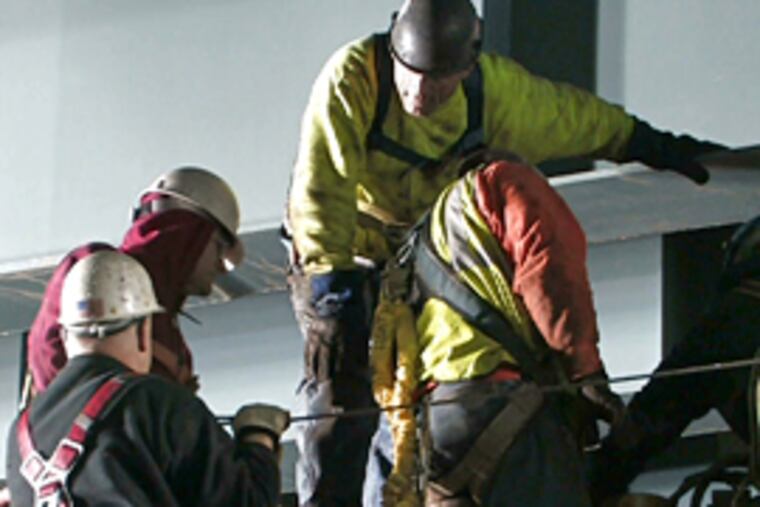
Contracting crews, working nonstop throughout the night, were making repairs to take the load off of the damaged column and shift it to the four towers that they have been building since early Wednesday morning to support the cracked column.
"The foundations that the tower is on are settling," said Harold Windsh, a PennDot senior construction engineer.
"The towers are going down more than the bridge is going up," said Chuck Davies, PennDot's assistant district executive for design.
Such settling was expected, until the base stabilized, PennDot officials said.
The base underneath the damaged pillar was made of crushed stone overlaid with timber mats and on top that steel plates.
Shortly after 6 a.m., the workers came down off the scaffolding and took off their harnesses.
"We're good, we're good," announced Greg Burkhardt, the vice-president for J.D. Eckman Co. of Atglen, Pa., the firm that constructed the four support pillars.
The salt trucks, located on the southside of the road, rumbled up northbound.
Surveyors then looked at how the road reacted to the weight before PennDot gave the OK for the reopening.
Work to repair or replace the tower is expected to take place over the next few weeks. The towers and beams will remain in place to support the highway during that work, so no additional shutdowns are expected.
Overnight, workers began installing four support towers brought in from Baltimore, Pittsburgh, Scranton and Coatesville, placing them around the compromised column.
Each of these open structures has four steel columns at their corners with connecting braces.
By 7 a.m., a huge metal "jacking beam" was put across two of the towers, on one side of the column.
After the second beam is in place, "there is a considerable bracing work that needs to be done and the jacking pads are to be installed this afternoon," Baum said.
But he expected the road to reopen tonight.
The chain of events leading to the latest shutdown was triggered Monday afternoon when Peter Kim, an engineering consultant for PennDOT, inspected a center support pillar near Cambria Street.
He found that a crack that had been about a half-inch wide and four feet long in 2005, and two inches wide in October, had become an 8-foot-long gash ranging in width to 2.5 inches to 5.5 inches and exposing rusted steel rebar, officials said.
Two hours after Kim's discovery, PennDot decided to close the highway, even though officials said there was no imminent danger of collapse.
The shutdown snarled Port Richmond streets with detoured traffic, and problems rippled to other highways