Philadelphia team repairs, restores murals
At Broad Street and the Vine Expressway, the evolution of public art is under way. Since 2002, a mural, a tribute to nursing, had graced the wall overlooking the busy highway. But it had chipped, cracked, and otherwise deteriorated, and something had to be done.
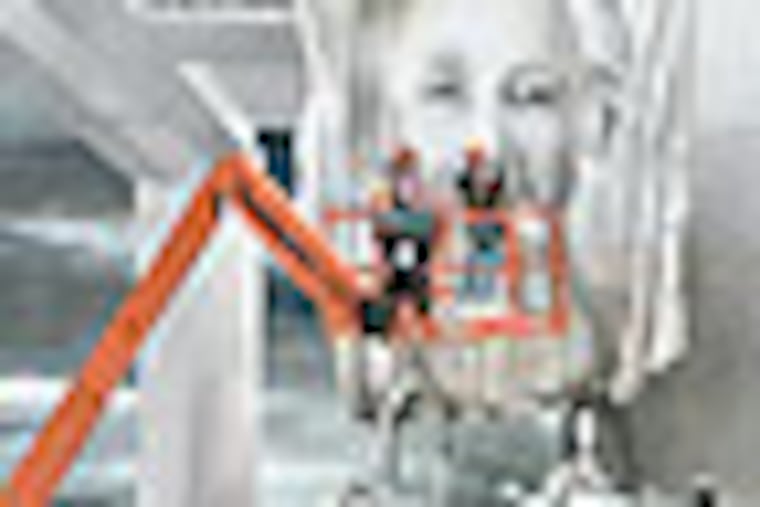
At Broad Street and the Vine Expressway, the evolution of public art is under way.
Since 2002, a mural, a tribute to nursing, had graced the wall overlooking the busy highway. But it had chipped, cracked, and otherwise deteriorated, and something had to be done.
"That mural had an important story to tell," said Amy Johnston of the city's Mural Arts Program (MAP). "So the question was: What do we do?"
Every year, about 100 of the city's more than 2,000 murals need to be restored, either with small patches and repainting or complete overhauls. Currently, three murals, including the nursing tribute, are being redesigned and repainted from scratch.
"There is a sadness when we have to replace murals. We don't do that lightly," said Jane Golden, director of MAP.
Until this year, the staff had identified murals for renovation in an "ad hoc" fashion, she said. All mural-arts employees consider it part of their job to keep an eye out as they travel through the city, checking for murals that have been defaced or battered by nature.
The original 6,500-square-foot nursing mural, created by Sam Donovan, was dedicated the year of the American Nurses Association biennial convention in Philadelphia. That project involved collaboration from numerous city agencies and 16 area nursing schools.
Both the artists and the communities become attached to their murals and often do not welcome change.
"We went back to Sam and asked if he would like to redo the mural or create a new one with a similar theme," said Johnston. "That's what he did with the Harriet Tubman mural."
The Tubman mural, which had been on the I. Goldberg flagship store on Chestnut Street, lasted only two years before the building was taken down for a parking garage. Donovan redesigned it for a location in North Philadelphia.
He was asked last fall if he wanted to repaint or re-create the mural, but was not available. So his friend Meg Saligman, a well-known mural artist who has done more than 50 works in Philadelphia, volunteered.
Major funding for the $250,000 mural was provided by the Independence Foundation, and again more than a dozen area nursing schools contributed money and creative advice.
"The older one was a tribute to nursing's heritage," said Saligman. "This time, the nursing community was more interested in looking to the future."
Given the technological advances in the field, Saligman said, she wanted to incorporate new mural technology in her work. LEDs will illuminate sections so that a painted image will be transformed into a different one at night. The project is scheduled to be completed in July.
"We paint two faces on top of each other," Saligman explained. "One is looking forward. One is in profile. At night, depending on the lights, it will look as if the face is turning. Words, quotes, and faces will appear and disappear. We also played with X-ray imagery."
Any mural artist who has been in the field for more than a few years has seen his or her work destroyed.
"Their lives are all different lengths. These murals have very high exposure and vibrant lives," she said. "Some may stand the test of time as far as imagery, location, and acceptance from the community."
One of the enduring murals is Saligman's 1997 Common Threads, on the west wall of the Stevens Administrative Center at Broad and Spring Garden Streets. "It has more of a landmark status," she said. "That is one I would like to see preserved as long as possible."
She has accepted the disappearance of other murals with fatalism, and some with relief. "Some of my earlier work had bad drawing," she said.
Every week, the MAP restoration team goes around the city repairing murals.
"We're always learning about how to do this better," said Seth Turner, the 33-year-old director of mural operations and mural restoration. "Materials change. The top coat, the adhesion, the pigments."
When a beloved mural is so far gone that it needs to be redone and reimagined, MAP has to work with the community to reach a new consensus. But most of Turner's work is conservation.
"The reaction is almost always positive," he said. "When I was working on the Dr. J mural a few years back, people would come by pumping their fists and yelling, 'Oh! You're fixing Doc!' "
James Shuster, codesigner of the new nursing mural, was up on a lift Friday repainting the contours of one of the main portraits. The 24-year-old artist, in paint-crusted jeans and an orange bandanna, said drily, "I'm putting in the top of this guy's head because he would be incomplete without it."
Occasionally, Shuster said, passersby ask what he's working on. "A lot of them remember there was a mural here, but don't remember exactly what it was of."
This year, MAP is developing a computerized system to collect data about every mural and its condition. The program has come a long way from the early days, said Golden.
"We used to use plain house paint and not seal the walls. The new materials will just last longer. We'll be doing fewer new projects and spending more time on preservation . . . really looking at the body of work we've created and make sure it's taken care of as if it were in a museum."