Democrats mobilize to thwart the GOP 'tsunami'
In South Dakota, Democratic Rep. Stephanie Herseth Sandlin's "Flyover Country" commercial shows the checkerboard plains from a jet window. "They look down from 30,000 feet and don't care about our agriculture, our Second Amendment, or our fiscally conservative values," she says.
In South Dakota, Democratic Rep. Stephanie Herseth Sandlin's "Flyover Country" commercial shows the checkerboard plains from a jet window. "They look down from 30,000 feet and don't care about our agriculture, our Second Amendment, or our fiscally conservative values," she says.
And in northern Indiana's Second District, Democratic Rep. Joe Donnelly shows unflattering photos of President Obama and House Speaker Nancy Pelosi in one ad as he rips the "Washington crowd."
It's the go-to slogan for endangered Democrats everywhere this midterm election: Don't blame me. I'm on your side.
And that may be the wisest approach. With the traditional Labor Day weekend start to the fall campaign under way, evidence is mounting that Democrats could lose control of the House and even see their hold on the Senate threatened.
"It's not just a wave election, it's a tsunami," said Mike Hudome, a Republican media consultant handling several House races across the country, including in Pennsylvania's Seventh District. "We're going to have seats in play that have no business being in play. All anybody cares about are jobs and the economy. People are scared to death."
Unemployment stands at 9.6 percent, Obama's approval rating is low, and vast majorities of voters in polls say the country is on the wrong track. The stimulus, health-care overhaul, and bailouts of banks and automakers are increasingly unpopular - and the recession has not lifted.
A president's party nearly always loses seats in Congress in the first midterm election of the administration, but analysts say public dissatisfaction is higher than normal this year. And Democrats, who control both houses, are likely to get the blame.
Larry Sabato, director of the University of Virginia's Center for Politics, predicts that Republicans will gain a net 47 House seats Nov. 2, more than enough to retake control. He projects the GOP will pick up eight or nine seats in the Senate, just short of the 10 needed to take it over.
The Cook Political Report, a respected handicapping service, lists 73 Democrat-held House districts as toss-ups or highly competitive races, up from 39 when the year began.
And last week, the Gallup Poll reported an "unprecedented" 10-point lead for Republicans on the generic ballot question it has been asking for 68 years. Fifty-one percent said they would vote for a Republican in their local House election, while 41 percent would support a Democrat. The generic-ballot test has often correlated with the results.
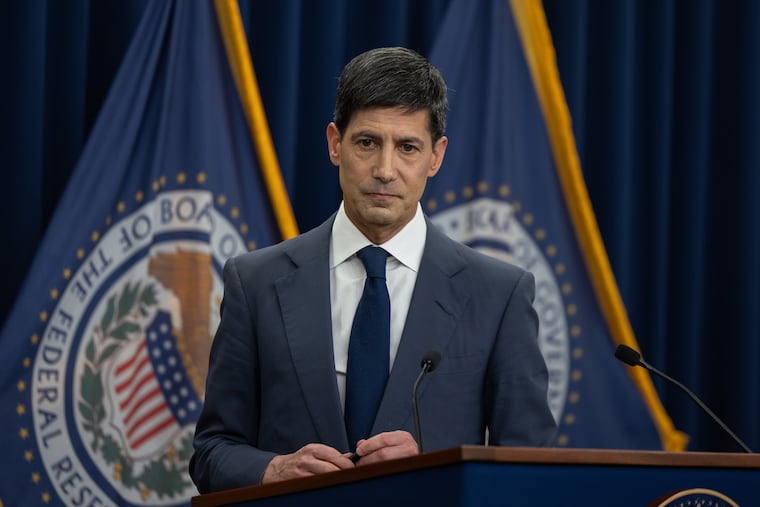
"Elections are comparisons," Democratic National Committee chairman Tim Kaine said in an interview. The former Virginia governor plans to visit Philadelphia on Wednesday for an event launching the party's fall campaign, in a state that features seven competitive House contests and wide-open races for senator and governor.
Kaine argued that tea party activists have pulled the GOP too far to the right in some cases, with some Republican-nominated candidates in favor of privatizing Social Security, ruling unemployment benefits unconstitutional, and seeking to eliminate corporate taxes.
"There are some extreme candidates on the Republican side," Kaine said. "That gives us great opportunities, race by race."
Eileen Donahue, a registered Democrat in Levittown who has voted for Republicans, is the kind of moderate the Democrats plan to target.
Rep. Patrick J. Murphy (D., Pa.), campaigning for reelection, knocked on her door one recent evening.
"I'm worried we're going to get slammed" by the tea party, Donahue told Murphy.
Later, she said she did not want to hear about the proposed mosque near ground zero and thought conservative talk of "restoring the nation's honor" was absurd.
"I see a facade of nothingness there," Donahue said, "just talking points that are pointless to our lives."
But the Democrats may be hard-pressed to find enough Eileen Donahues. Many of the party's political pros say they believe the House is already gone.
"It's going to be ugly - unless unemployment drops a full point and the market gets up to 12,000," said a Democratic strategist working on races around the country, who spoke on condition of anonymity in order to be candid about the party's prospects. He thinks the Democratic House caucus will shrink to as few as 210 members. (It now has 255, plus a vacancy in a formerly Democratic-held seat.)
"I don't think it will change in the next eight weeks unless there's a national emergency" and voters rally around the president, the consultant said.
While voter turnout surged in 2008 for the Democrats, they now face an "enthusiasm gap," with several polls indicating a fired-up GOP base. A Gallup survey Thursday found 54 percent of Republicans surveyed saying they had followed the elections closely, compared with 30 percent of Democrats.
In a Franklin and Marshall College poll of registered Pennsylvania voters last month, 45 percent of Republicans said they were likely to vote, compared with 37 percent of Democrats. In another measure, half of those who voted for Republican John McCain in 2008 said they were likely to go to the polls, compared with 35 percent of Obama voters.
"The Republican electorate finds a lot to excite them now, [things] they see as threats out there," said Christopher Borick, a pollster and professor of political science at Muhlenberg College. "The Democratic rank and file is in a malaise."
Independents are trending toward the GOP because it's not the team in charge, he said.
The Democratic Party has weapons with which to fight back, however: more cash than the GOP and a better-tested field operation. Organizing for America, the Obama campaign arm, has been running for more than three years, establishing personal connections that move turnout. Its volunteers have made multiple trips to the same houses in districts across the country, reminding Obama supporters of the importance of voting in 2010.
"We really believe in field politics," Kaine said.
On a recent Saturday, a group of Democratic canvassers, including Sixth District House candidate Manan Trivedi, knocked on Eric Gooden's door on Walnut Street in Ardmore.
Gooden, 24, voted for the first time in 2008, for Obama, and the campaigners told him his vote was needed now more than ever - for Trivedi and the party's candidates for senator and governor. Gooden took their offered literature and said he probably would go to the polls.
"I haven't really been paying attention," said Gooden, a restaurant worker. "I'm too busy to think about politics when I'm working every day."
If the Democrats' plan works as designed, a volunteer is sure to be back to remind him.
Coming Monday
Pennsylvania has an inordinate percentage of the congressional contests around the country that are considered true toss-ups.EndText