Yardley to get federal grant to help stem flood claims
The tiny Bucks County borough of Yardley has a handsome historic district, a picturesque canal path, and some of the most frequently flooded properties in the nation.
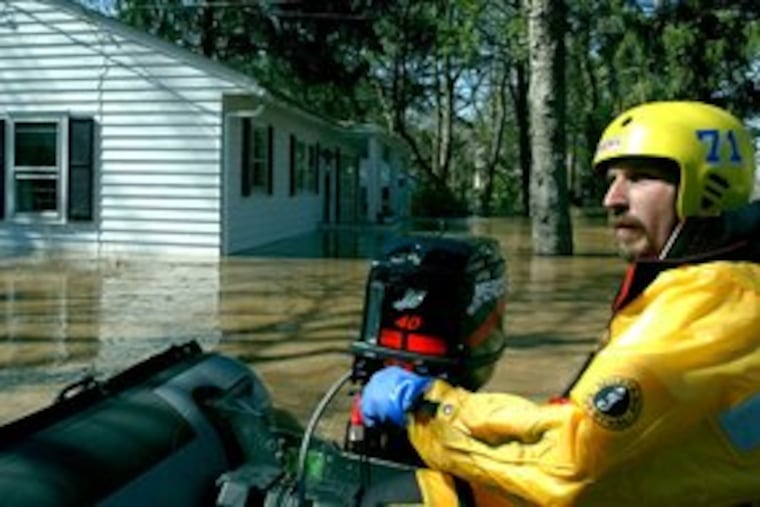
The tiny Bucks County borough of Yardley has a handsome historic district, a picturesque canal path, and some of the most frequently flooded properties in the nation.
Because of the Delaware River's chronic deluges, Yardley expects to receive $655,000 from a pilot grant program aimed at stemming federal flood claims in hard-hit towns.
With its National Flood Insurance Program (NFIP) swamped in $17.3 billion worth of red ink, the Federal Emergency Management Agency is making up to $160 million available to hundreds of communities across the country, including 172 in Pennsylvania and, so far, two in New Jersey.
The money - to be used for buyouts, elevations, and other flood-control projects - will be targeted at "severe repetitive loss" properties, or SRLs. Those are structures that have been flooded four or more times in the last 10 years, or that have sustained damage exceeding the value of the property. There are an estimated 7,000 nationwide.
In Yardley alone, more than $11 million in claims have been filed on such properties since 1978, according to the Delaware River Basin Commission. The borough plans to use its share of the grant money to elevate five structures, said Bill Winslade, Yardley's manager.
Yardley is the regional SRL capital, with at least 32 and as many as 46 of them, according to FEMA. That is more than 15 percent of the total in Pennsylvania. Yardley tops chronically flooded West Norriton Township, along the Schuylkill in Montgomery County, and even oft-flooded New Jersey barrier-island towns such as Atlantic City, Ocean City and Wildwood.
Most of Yardley's flood-prone structures along Delaware Avenue, next to the river, were built before the 1970s, when the creation of the National Flood Insurance Program required the mapping of flood hazards.
Citing privacy considerations, Winslade declined to identify the SRL properties. The Department of Homeland Security, FEMA's parent agency, has also rejected The Inquirer's petition to release addresses. The Inquirer holds that the information is in the public interest, given the amount of taxpayer investment in the program.
As of Jan. 3, the NFIP owed the treasury $17.3 billion - more than $150 for every U.S. household - largely resulting from the devastating 2005 hurricane season. That's roughly eight times what the program has typically collected in annual premiums.
Unlike conventional insurance programs, the NFIP operates without cash reserves to cover catastrophic losses. Claims from Hurricanes Katrina, Rita and Wilma overwhelmed the program in 2005, leading to a record $17.4 billion payout.
Structures that flood again and again have been a major drain on the NFIP. While the 7,000 SRLs amount to a mere 0.012 percent of all properties in the program, they have accounted for $1.1 billion of its losses, said FEMA spokesman Simon Chabel.
J. Robert Hunter, former NFIP administrator and now director of insurance for the Consumer Federation of America, said the effort to eradicate the SRL problem was long overdue.
"Obviously, they are not going to get all of it with this little amount" of grant money, he said. "But it's a start.
"It's been something that's been needed for a long time."
Under the new grant program, property owners in towns with "approved" mitigation plans can apply for the money through their state governments. Chabel said that 70 percent of Pennsylvania's SRLs will be eligible.
In New Jersey, two communities - Atlantic City and Wayne Township - currently qualify, said FEMA spokeswoman Barbara Lynch.
It is up to the states and FEMA to determine which projects are most cost-effective. FEMA then awards the grants to the states, which, in turn, pass them on to the municipalities. Property owners do not have to accept the government's offers, but if they refuse, they may be hit with steep premium increases.
FEMA said the eligible property owners in the participating towns already have been notified. Their deadline for applications is May 30.
The SRL problem is just one of the major challenges confronting the troubled flood insurance program. The SRLs are only the worst subset of the repeat-loss properties, which have constituted up to 30 percent of all losses.
The major problem, Hunter said, is unwise building in floodplains that has been encouraged by the government insurance program.
"All you have to do is look at the buildings on the barrier islands, and you have to say this program is not working," he said.
"It's pretty much impossible to build any structure, other than a fort, that's going to withstand a 20-foot storm surge," Hunter said. "We have to either stop the unwise construction, or stop the program."