Two Pa. school districts merging
They're the first in 20 years. It's an effort to save money, add offerings.
MONACA, Pa. - Pennsylvania will shed a school district by the end of this school year - a significant development after years of nationwide efforts to nudge and sometimes force school systems to share services or merge.
The merger between two western Pennsylvania school systems with sharply declining enrollments is the state's first consolidation in at least 20 years and, most notably, its first voluntary one.
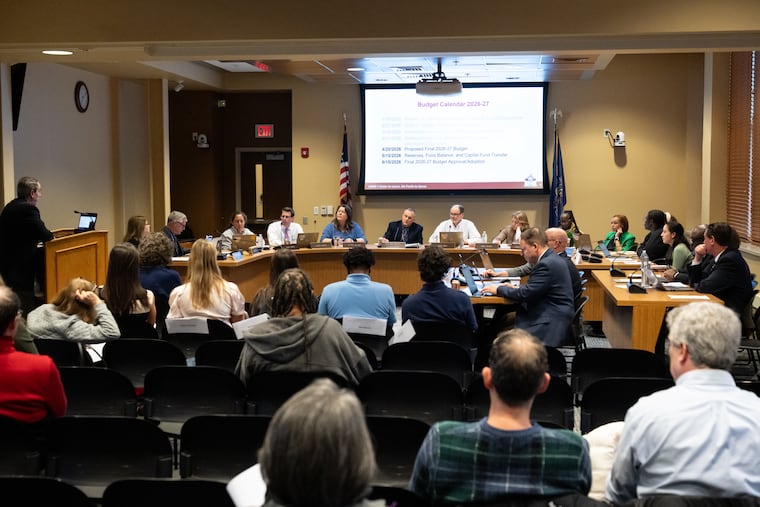
Officials say the move will save money and improve educational offerings, yet parents in both districts worry that some losses will accompany any gains. The consolidation is expected to be closely watched.
The willingness of two districts to dissolve boundary lines is rare in states where local control is sacrosanct and school traditions that define a community are deeply ingrained. In recent years, at least a few states have tried to force mergers, with mixed results.
Yet the marriage of the Center Area and Monaca School Districts northwest of Pittsburgh is part of a national progression toward fewer districts.
Over the last two decades, the number of school districts nationwide has declined 10 percent, from 15,714 in 1985-86 to 14,166 in 2005-06, according to the National Center for Education Statistics.
With school boards facing spiraling prices for fuel, employee health insurance and other operating costs - and opposition to increases in the property taxes that largely pay for them - the idea of consolidating to save money is becoming a common topic.
"These conversations are going to be inevitable," said Education Secretary Gerald Zahorchak, who has been gently encouraging Pennsylvania's smallest rural school districts to at least consider merging or sharing services. "School districts are realizing that the cost of doing business won't get any cheaper."
Proponents say small-district mergers can streamline administrative costs and achieve economies of scale. But even in the most difficult economic times, resistance can be strong.
The arguments against consolidation are not just rooted in nostalgia for the old alma mater or skepticism about promised savings. Critics also question whether educational quality will improve under the larger school enrollments that mergers produce.
"It's not that consolidation is bad, but big schools are bad, and the notion that you can make education better by making schools bigger is just plumb wrong," said Marty Strange, policy director of the Rural School and Community Trust in Arlington, Va.
Enrollments in Monaca, a borough of about 6,000 people along the Ohio River, and in Center Area, which consists of two neighboring townships, have dropped steadily along with the region's population following the steel industry's decline.
Monaca Superintendent Michael Thomas has seen his district's enrollment decrease from 900 to 672 students during his 11-year tenure, while Center Area has lost 175 students during the five years Daniel J. Matsook has been superintendent.
With fewer students, the menu of academic choices becomes limited. Monaca does not offer advanced placement classes, and it has no mathematics beyond calculus and no science beyond physics. For its part, Center Area cannot afford to continue offering courses that typically have 10 or fewer students. The merger is expected to produce about $1.5 million a year in combined savings for the districts.
"It is not financially responsible to offer courses that have three, four, five students in them," Matsook said.
The last major state-ordered consolidation of Pennsylvania school districts occurred in the 1960s, when the state had more than 2,000 districts. By the 1980s, the number was reduced to 501.
With the consolidation under way in Monaca, the number will edge down to 500.
Zahorchak says his philosophy emphasizes encouraging small districts to pool resources to spend their money efficiently but to keep their enrollments manageable.
"Let's buy big and deliver small," he said.Though the merger is voluntary, Thomas, the Monaca superintendent, concedes many challenges lie ahead on the way to creating a school district. Several committees have been formed to sort out issues such as picking a new mascot, school colors, and a new district name.
"There are a lot of traditions tied to schools and dealing with that is difficult," Thomas said. "There has never been a voluntary merger in Pennsylvania. There is no blueprint for us to follow."