Councilman Jones fined over campaign money
On at least six occasions in 2007, City Councilman Curtis Jones Jr.'s campaign failed to deposit or disclose thousands of dollars in contributions, according to a document released yesterday by the Philadelphia Board of Ethics.
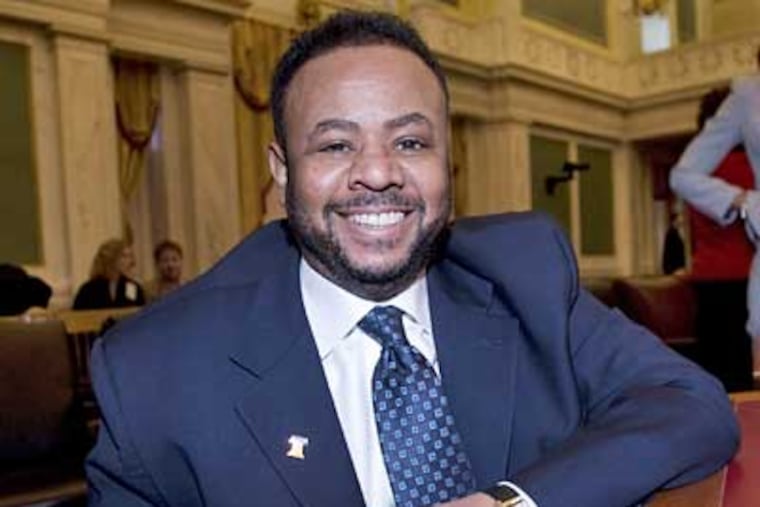
On at least six occasions in 2007, City Councilman Curtis Jones Jr.'s campaign failed to deposit or disclose thousands of dollars in contributions, according to a document released yesterday by the Philadelphia Board of Ethics.
In one instance - on primary day, as Jones made his first run for Council - Jones' campaign manager accepted two cash payments totalling $15,700 from the campaign committee of State Sen. Vincent Hughes, Jones' longtime ally. The money was used to pay election-day workers to distribute 27,300 sample ballots in a heated three-way Council race to succeed Michael Nutter in the Fourth District. Jones won by 470 votes out of 26,000 cast.
In interviews yesterday, Jones and Hughes said that although their campaigns made administrative mistakes, there was no intention by anyone to hide money.
Nonetheless, the ethics board announced yesterday that Jones had agreed to pay $22,500 in fines for 23 campaign-finance violations, and that Hughes had agreed to pay $7,500 in penalties for seven violations.
The penalty against Jones is the second-largest issued by the ethics board since it was established in 2006.
The largest, for $39,000, was issued more than a year ago to the Appreciation Fund, a political committee with ties to the late Councilwoman Carol Ann Campbell and U.S. Rep. Bob Brady. Though the committee has almost no money to pay its debt, the ethics board is pursuing litigation.
Board of Ethics Chairman Richard Glazer said the two settlement agreements reached with Jones and Hughes represented "a total capitulation" from them. He singled out the pact with the councilman as "admissions of fairly egregious conduct."
The bulk of nearly all the violations stem from $10,700 in cash given on May 15, 2007 - primary day - by Hughes' campaign to Al Spivey, Jones' former campaign manager and now chief of staff.
The money was part of a larger get-out-the-vote effort coordinated by Hughes' staff in support of Jones and nearly two dozen other Hughes-backed candidates running for office that day. It was funded with "street money," cash delivered by candidates to political operatives.
According to Hughes, Jones and Spivey, the $10,700 payment represented an expenditure by the Hughes campaign, and not a donation to Jones.
"Street money has always been viewed as an expense on election day, and that's the way it was viewed at the time the transaction was occurring - not as a contribution," said Ralph Teti, a lawyer for Hughes, who has been a state senator since 1994.
As such, the Jones campaign saw no reason to report the payment on its campaign-finance report or to deposit the money in its campaign committee bank account.
But the ethics board interpreted the payment as a donation. That view was buttressed by Hughes' May 15, 2007, campaign-finance report, which listed a $10,700 expense as a "contribution" to Friends of Curtis Jones Jr.
Teti yesterday called that disclosure a mistake. "It should have been reported as an expenditure, and it wasn't."
Viewed as a single donation, the payment meant that Hughes and Jones had already exceeded the city's $10,000 annual limit that year for how much a candidate's committee could legally accept from a political committee.
As a result, the ethics board said, further violations occurred as Hughes gave Jones $1,500 on June 29; $1,000 on Aug. 7; $1,200 on Sept. 4; and an in-kind contribution of $935 to produce the sample ballots. Two of those donations, for $1,000 and $1,200, also were not deposited in the campaign's bank account.
The board counted yet another violation of the contribution limit rule when Spivey, in return for cash, signed over to Hughes' campaign a $5,000 check that Jones had received from the political committee of Councilwoman Jannie L. Blackwell. That, too, was not reported in Jones' campaign-finance reports.
In all, the ethics board contends that Jones accepted $10,335 more than he was allowed from Hughes' campaign. Though Hughes is a state senator, anyone giving money to a city candidate is subject to the city law.
"This is a little bit painful," said Hughes, who still disagrees with the ethics board's characterization of the $10,700 payment, "but we'll work with it."
The ethics board also penalized Jones' campaign for failing to disclose a $10,000 donation he received on April 1, 2007, from the mayoral campaign of U.S. Rep. Chaka Fattah, another backer of Jones; and $2,200 worth of campaign T-shirts that Jones received from Local 98 of the International Brotherhood of Electrical Workers.
Asked about the failed disclosures and undeposited money, Jones said: "At the end of the campaign, we tried to sort things out, and we fully admit to not complying with the letter of the law. Administrative mistakes occurred, but clearly our intentions were not to defraud anyone."
Jones must also repay $5,335 worth of excessive contributions to Hughes' campaign.
The ethics board began investigating Jones' campaign finances after a related matter was referred to it by the city Inspector General's Office. That matter dissipated but it spurred the board's interest, ethics board executive director Shane Creamer said.
Jones' $22,500 fine is to be paid by his campaign in small increments between now and November 2010. His campaign has about $5,000 in the bank, he said. Hughes will pay his fine from his campaign account within the next 90 days.