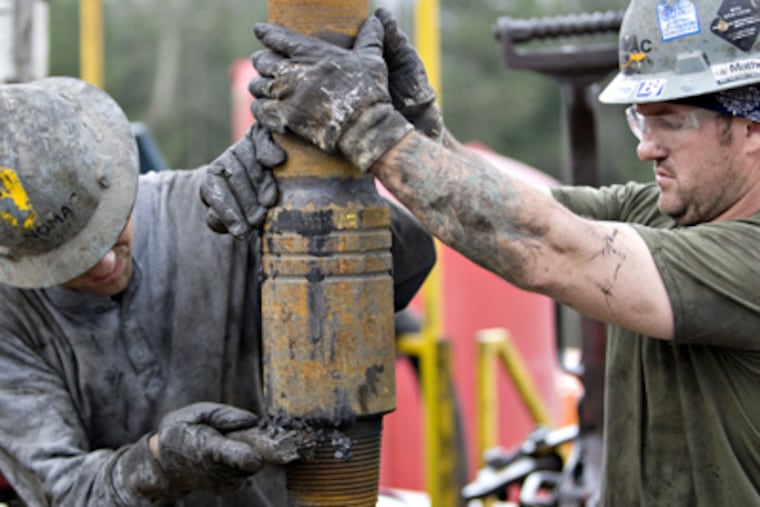
A new industry-funded study says Pennsylvania could produce a quarter of this country's natural gas within 20 years. Does that sound like an industry that's likely to turn tail and hike out of the state if it's asked to pay a tax for the right to drill?
Yet that's the oft-repeated mantra of the thou-shalt-not-tax crowd. They keep trying to scare Pennsylvanians into believing the shale-gas drillers will walk away from the bonanza they are enjoying if asked to share a bit more of their profits with Pennsylvanians in the form of a tax.
That's not going to happen, which is why the gas industry of late has turned down the volume in resisting some form of taxation or fee, so long as it's reasonable. Not that the industry needs to be loud when it's got so many others willing to scream on its behalf.
Gov. Corbett isn't a screamer. In fact, sometimes he isn't much of a whisperer. But when he does talk, it's clear that he gets the willies just thinking about taxes. He has taken the Grover Norquist pledge not to raise taxes, nor does the governor want to impose any new revenue measures.
But because even the gas industry has moderated its position on helping to pay for some of the more distressful impacts related to drilling, Corbett, to his credit, has tried to find a way to open that door. Thus was born his Marcellus Shale Advisory Commission, which reported a week ago.
The commission took four months to study the issue, but there is little in its report that wasn't known during the Rendell administration. In fact, some of its findings mirror what was in studies done by PennEnvironment in 2009 and earlier this year, which has led PennEnvironment to accuse Corbett of using the commission to stall a decision.
Before painting the governor any particular color, let's give him a chance to be decisive and go beyond studying the matter. His commission has recommended that the drillers pay an impact fee to the local counties and communities where they operate. But Corbett hasn't said if he will even do that.
He really should do much more. It borders on insanity for a state that is telling schoolchildren, old folks, and the sick that it doesn't have enough money to pay for all their needs to turn around and say it would be too great of an imposition to ask a booming industry to do more to help.
It's great that the shale-gas industry is creating jobs, nearly 48,000 in just the past year alone, it says. And it's true that those employees are paying taxes and buying goods and services, which has invigorated the economies of some communities that had been down and out for decades. But when the boom times are over and the jobs gone, will Pennsylvania find itself wondering if it was shortchanged?
Those pretending the Marcellus Shale industry will never go away so long as it's not taxed are ignoring that, for one thing, the natural resource is finite - the gas will be gone within a matter of two or three decades, if it lasts that long, and in some locations it won't. Furthermore, they are ignoring the nation's effort to wean itself from all polluting fossil fuels, including cleaner-burning gas.
Pennsylvania would do well to benefit as much as possible now from shale-gas production. Every other state where such drilling is occurring is taxing the industry in varying degrees, including poorer states like Alabama, Mississippi, and West Virginia, which should have greater fears about losing a major economic partner.
There's no argument that the communities enduring the drilling, water contamination, truck traffic, poor air-quality, and other problems associated with gas extraction should benefit from any gas revenue. Of course, they are benefiting the most now from the jobs and related commercial activity.
That's good. And the rest of the state has benefited from the industry, too. But it can and should do more for Pennsylvania. His study complete, it's time for Corbett to act.