How a logger from Maine toppled a giant of the Senate
A fortuitous mix of personal narrative, message, and timing powered him to a victory no one could have imagined just months ago.
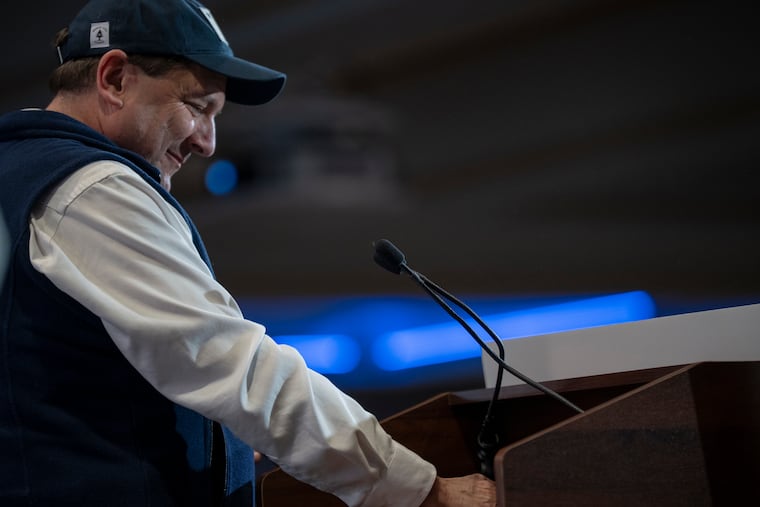
PORTLAND, Maine — Troy Jackson was nobody’s first choice to run for the U.S. Senate from Maine. Only weeks before stumbling into one of most consequential races in the country, he had come in third in the Democratic primary for governor. He looked like a political washout.
But today he is a giant slayer, having toppled a five-term Republican incumbent, Sen. Susan Collins, in Tuesday’s election.
How Jackson, a former logger and state lawmaker from a struggling northern outpost, got from there to here — in just 101 days, no less — is an extraordinary story of the man meeting the moment.
Less than five hours after the polls closed, as he scanned a raucous crowd of supporters chanting his name, he shook his head in apparent disbelief.
“I will be thinking about generations of Mainers who worked in our woods, built our ships, kept our mills running, the people who built this state and deserve a government that works for them,” Jackson, 58, told a packed hotel ballroom in Portland shortly after midnight. “That is what I am going to fight for every damn day.”
Even amid the blue wave that swept Democrats into power across the country, Jackson’s triumph over Collins was notable, considering her seniority in the Senate and five previous statewide wins, versus his abbreviated campaign and limitations as a candidate. A fortuitous mix of personal narrative, message, and timing powered him to a victory no one could have imagined just months ago.
Drawing on his working-class roots and populist record as a state senator, Jackson could empathize with voters’ frustrations and fears like few other congressional candidates. Perhaps even more important, Collins, despite her efforts to assert her independence, could not escape the shadow of an exceedingly unpopular president — especially in a state hit hard by his tariffs and war with Iran, inflating costs for Mainers dependent on heating oil and trade with their Canadian neighbors.
“It is stars aligning,” said Heather Quinn Cuzzi, a Democratic consultant who has worked in Maine politics for more than 20 years. “It’s the blue wave. It’s the right time. A lot of union folks and working-class people have not had a candidate they could be excited about, and Troy gave them a voice.”
Jackson was an accidental Senate candidate, with no burning desire to go to Washington. But he quickly recalibrated after the implosion of the Democratic Party’s chosen nominee. Graham Platner, an oyster farmer hastily anointed a rising star, was forced to quit the Senate race amid allegations of sexual misconduct. As the possibility of chaos loomed, Jackson, a card-carrying union member, called in a cavalry of shipbuilders, teachers, and mill workers who helped him easily sew up the nomination at a Democratic convention in late July.
Jackson had less than four months to wipe out Collins’ 30-year record of constituent services and federal patronage that had brought billions of federal dollars to the state.
“A lot of people were wondering if he was up to the challenge,” said Ethan Strimling, a former state senator and mayor of Portland. “This is the big time, up against one of the all-time pros of Maine history.”
Even before Jackson sealed the nomination, Maine was rocked by the fatal shooting of a Colombian immigrant by a federal agent in the coastal city of Biddeford. As Jackson condemned President Donald Trump’s deadly immigration crackdown, the incident helped set the tone for a campaign in which Collins was repeatedly pressed to defend the administration’s most unpopular policies.
Jackson lacked Platner’s rugged charisma and rhetorical skills, and he suffered by comparison — what his senior campaign adviser, David Farmer, called “the Platner hangover.” But at more than 100 public events, including 15 town halls, he endeared himself to voters by sharing stories of his hardscrabble youth in Aroostook County, along the Canadian border. At 19, he followed his father into Maine’s North Woods. At 30, he helped to lead a logging blockade at the border to protest powerful landowners hiring cheaper Canadian labor. Jackson greeted supporters as “brothers and sisters,” and the labor anthem “Solidarity Forever” became a campaign staple.
“He’s a once-in-a-career candidate for many of us,” said Will Bergeron, a representative of the painters union.
When he wasn’t leaning into his up-from-the-bootstraps biography, Jackson was pledging to hold the line against a Trump administration he argued was destroying the dreams of the working class. Jackson, a disciple of Sen. Bernie Sanders of Vermont, pushed a progressive agenda that included doing away with Trump’s tax cuts, abolishing the Immigration and Customs Enforcement agency, and establishing a universal healthcare program. His unflattering portrayal of Collins as a corrupt creature of Washington was reinforced by a widely circulated ProPublica report that said the FBI had examined her interactions with a donor seeking federal contracts. (Collins denied any wrongdoing.)
Jia Yang, a 36-year-old restaurant worker who lives in Lewiston, was among the voters who had backed Collins in the past but said her retirement was overdue.
“I think she’s lost touch with what it means to be an average citizen,” said Yang, a new father who can tell you the price of diapers and baby formula, even with coupons. “Things are getting worse, and I think we need change.”
Anger over the rising cost of living was a driving force in Senate races across the country. But in Maine, Jackson also seized on simmering resentment over Collins’ vote to elevate Brett Kavanaugh to the Supreme Court, which cemented the conservative majority that gutted the federal right to abortion.
This race was the first for Collins, one of the only Republican senators who favor abortion rights, since the demise of Roe v. Wade.
The campaign’s lineup of debates — four in 10 days — posed a major test for Jackson, a halting and sometimes awkward speaker. He pushed for a town-hall format over traditional debates, but Collins would not agree, according to Jackson’s campaign. The matchups ultimately offered few fireworks or gaffes by either candidate until the fourth and final one. “Oh shut up,” Jackson said to Collins, after she suggested a heckler “obviously” was his supporter.
Collins turned the moment into an attack ad that reminded voters about an episode five years earlier when Jackson was Senate president. During a heated argument with a female lawmaker, he had flung a water bottle, an incident that drew media scrutiny just as he was poised to clinch the nomination. Questions about his temperament surfaced again in campaign’s early days when the Bangor Daily News published a 1988 police report describing his arrest on a charge of misdemeanor assault.
Jackson apologized for the water bottle episode. He took responsibility for the fight, which had occurred when he was 19 years old. He did not express regret for his retort during the debate, however.
“What I’m not going to be is talked down to by Senator Collins,” he said in a televised interview. During the debates, she had repeatedly referred to Jackson, who served as a legislator for nearly 20 years, including six as president of the Maine Senate, as “Troy.”
Her apparent disrespect toward Jackson permeated the race — and may have backfired. A Republican super political action committee denigrated Jackson’s longtime partnership with Lana Pelletier, his second cousin, in an ad that included a crude jingle. Collins called for the spot to come down but weeks earlier, she had arguably laid the groundwork by taking a swipe at Jackson’s relationship. “I never imagined U.S. Sen. Susan Collins and her allies would stoop this low,” Pelletier, who has two sons with Jackson, wrote in a column responding to the attacks.
Collins also ran a widely criticized ad in the homestretch of the campaign featuring a supporter who scoffed, “We’re not talking about buying a cord of wood here. We’re sending someone to the U.S. Senate, and Troy doesn’t have the tools he needs to be effective.”
Collins and her allies outspent the Democrats by about $40 million, according to AdImpact, with a deluge of attack ads that decried Jackson as a “crook” and a “creep.” Voters at town hall meetings urged Jackson to fight back more aggressively.
“In general, he allowed those things to roll off his back,” said Charles Dingman, chair of the Maine Democratic Party. “Or he greeted them with humor.”
For Halloween, Jackson dressed up as a cord of wood. Three days before the election, he was already having the last laugh.