After America’s 250th, Trump will test how far he can push NATO allies
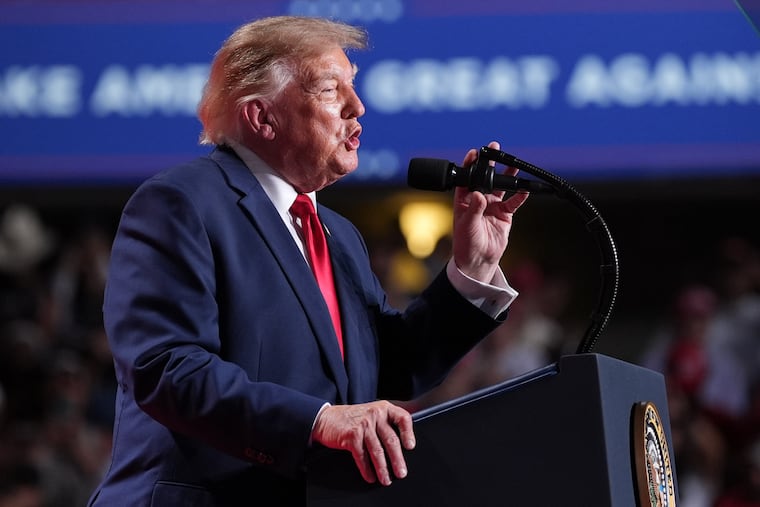
Fresh off a week of star-spangled celebrations of America’s 250th, President Donald Trump departs for Turkey on Monday to meet with fellow leaders of NATO.
Fresh off a week of star-spangled celebrations of America’s 250th, President Donald Trump departs for Turkey on Monday to meet with fellow leaders of NATO. They hope he wouldn’t declare independence from them.
Trump has long been skeptical about NATO and European allies, asserting that the alliance the United States forged after World War II to fend off the Soviet Union has been taking advantage of Washington’s largesse. Deep into his second term, the president by now is now well acquainted with the theatrics of NATO gatherings, reveling, according to his associates, in the drama of threatening fellow leaders and watching them scramble to keep him happy.
The strains increase every year, with Trump’s popularity sinking in Europe after he threatened to seize Greenland in January and sent energy prices spiking with his attack on Iran. The president has fumed that European allies didn’t do enough to help Washington in its war. And in recent days, he has renewed complaints about their defense spending, though he has successfully driven big increases.
Now, the alliance will again attempt to weather Trumpian pressure, by flattering him where possible and avoiding unnecessary confrontations.
Trump is scheduled to arrive in the Turkish capital of Ankara on Tuesday and will meet Turkish President Recep Tayyip Erdogan before having dinner with fellow NATO leaders that evening.
The substantive meeting will be Wednesday morning, which diplomats have kept short to minimize potential disruptions. Afterward, Trump plans to meet with Ukrainian President Volodymyr Zelensky and Syrian President Ahmed al-Sharaa before holding a news conference and returning to Washington, according to White House spokeswoman Anna Kelly.
The president’s grievances have already subsumed much of NATO’s business. NATO Secretary General Mark Rutte laid the foundation last month, praising the president’s stewardship and delivering a presentation in the Oval Office of what he called the “Trump trillion,” with poster boards in golden, “Art of the Deal”-style lettering boasting increases in Europe’s defense spending over the last decade.
Trump told Rutte that he would skip the gathering altogether were it not being hosted by Erdogan, who for 23 years has ruled his nation with an increasingly tight grip.
Asked what he wanted from allies, Trump said alongside Rutte that “I just want their loyalty.”
He has rewarded allied leaders in recent months whom he perceives as friends, including Polish President Karol Nawrocki, whose country has been promised 5,000 more U.S. troops. And he has moved to punish those he views as insufficiently deferential, including German Chancellor Friedrich Merz, who faced weeks of open criticism from Trump after questioning the president’s Iran strategy during a public conversation with schoolchildren.
Trump began and ended one day last week with angry posts about NATO on his social media account, declaring that “the United States spends more money on NATO than any other country, by far, to protect them, without getting any benefit from so doing.” But behind the public criticism, a senior White House official said, the president views the summits as an opportunity to impose pressure, leaning into his tough-guy role and seeing how leaders respond.
The last summit, held in June 2025 in the Netherlands, “was great fun,” the official said, referring to an event in which Rutte called Trump “daddy,” comparing him to a father who needs to use authority to stop kids from fighting on a schoolyard. The comment went viral online and was boosted by the White House’s edit of the video clip with the Usher song “Hey Daddy (Daddy’s Home).”
“The president always has fun at NATO, contrary to what people think,” the White House official said, speaking on condition of anonymity to speak candidly about the sensitive politics of these encounters.
NATO officials and diplomats from NATO countries don’t expect Trump to threaten to pull from the alliance this year, as he did in 2018. But they know the president likes to surprise, and they say much will depend on his mood when he lands in Turkey. It is expected to be the first international trip on the refurbished, luxury Boeing 747 that he pushed Qatar to give him for use as Air Force One.
One senior European diplomat fretted that Trump would arrive in Turkey exhausted and angry after a week of tiring travel, including a 3:30 a.m. Saturday return from an event at Mount Rushmore and a rally on the National Mall later that day in the sweltering Washington heat.
Europeans are “nervous that the way [Trump] feels about NATO is that this is not fundamentally in U.S. interests and so [they] are nervous that the summit could be more calamitous,” said Max Bergmann, an expert on U.S.-Europe relations at the Center for Strategic and International Studies, a think tank. “Especially now as there’s more domestic political pressure on European leaders to be seen as standing up to Trump.”
NATO officials are coming to the summit armed with big numbers that play to Trump’s wishes. They will trumpet an extra $139 billion spent on defense by European allies and Canada last year. They will make a show of signing billions of dollars of weapons deals and letters of intent, according to senior NATO diplomats speaking on condition of anonymity to discuss the sensitive planning around the meeting.
And they hope to promise as much as they can to help ensure security in the Strait of Hormuz, although many countries say they need Tehran’s assent if they are to deploy naval missions there to remove the Iranian mines that are hampering shipping traffic.
But many of NATO’s core security issues have been overshadowed by Trump’s dispute with the alliance. Ukraine and Russia have stepped up attacks on each other in recent weeks, but U.S. efforts to mediate a peace deal have all but halted. Trump’s peace envoys, Steve Witkoff and Jared Kushner, have been focused on Iran, and the White House hasn’t empowered other officials to engage, despite the deep ranks of policymakers who might do so.
NATO diplomats are negotiating a pledge for Ukraine of about $70 billion in military aid for this year and the next, to be announced at the summit. Washington would not take part, but it has not opposed language supportive of Ukraine, as it sometimes did last year, two diplomats said, speaking on the condition of anonymity to share internal deliberations.
The alliance has shelved work on a strategy for responding to threats from Russia, a consequence, European diplomats say, of White House caution about doing anything that would portray Moscow as an adversary.
Some U.S. officials have downplayed the tensions. The U.S. ambassador to NATO, Matthew G. Whitaker, said last week that the summit “really is going to be a measurement of the progress,” since allies pledged last year to each spend 5 percent of their annual economic output on defense by 2035.
Whitaker offered assurances that “the U.S. isn’t going away” but said the administration would try to reward the countries that are spending the most. He said the Pentagon and State Department have discussed possible benefits such as “more time with leaders” and “priority in acquisition and procurement.”
Asked if the U.S. was considering measures targeting nations that are lagging behind, he said yes, but did not elaborate.
The Trump administration has made disjointed troop announcements in recent months, with the Pentagon at times out of step with the White House. After the Pentagon surprised Poland by canceling a planned troop rotation, for instance, Trump scrapped it and promised an increase. In other cases, the president has suggested some cuts were punishment for European criticism of the war on Iran.
European leaders plan to declare their commitment to assume increased responsibility of the continent’s defenses — a message many of them have converged on with the Trump administration, which is intent on pulling U.S. resources.
European policymakers describe their vow to rearm as a response to an increasingly tense confrontation with Russia and shifting U.S. priorities, rather than just a bid to placate Trump. But policymakers including in France and Germany have pressed their U.S. counterparts to coordinate any military drawdown.
Some Europeans, especially those in Western Europe, have started to work with Pentagon planners on an orderly handover. French Deputy Defense Minister Alice Rufo said Paris has long led calls for greater European autonomy, and “today it is the Americans saying it” too.
“What we need to achieve at this summit is for this shift to happen in a coherent manner for collective defense, which also concerns the Americans,” Rufo said. “It’s in our best interest to ensure that this shift takes place in an orderly, efficient manner to deter our adversaries, and not to create frictions among us.”
But the effort is creating strains in the alliance. Rutte is still trying to preserve a robust U.S. presence in Europe. And many policymakers in countries that border Russia still trust Washington more than France and Germany to defend them in a war with Moscow. They believe that old American instincts to defend democracies would kick in, along with pressure from hawkish Republican lawmakers.
A senior NATO diplomat said there was a sense of optimism ahead of the summit but also a recognition that “things can derail.”
The diplomat mentioned Italian Prime Minister Giorgia Meloni, a far-right leader who shares much of Trump’s skepticism about migration and is sympathetic with many of his issues. But the two leaders traded barbs in recent weeks in a dispute that originated with Trump’s anger at Italy’s initial caution about allowing its bases to be used to attack Iran.
“Can I totally exclude that something like that will happen? No. I’m optimistic because I think the leaders know what is at stake,” he said. “And if something does occur, then we always have the ultimate marriage counselor, Mark Rutte, to smooth things over.”