Many of Trump’s predecessors also trafficked in rumor mongering and demonized their opponents
These tactics have proved effective throughout American history.
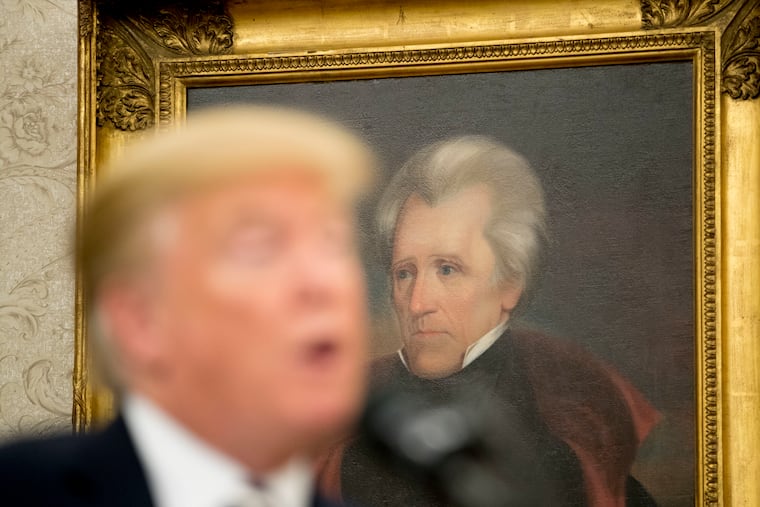
President Donald Trump recently accused Democrats of being “godless Communists,” building on his previous denunciation of his opponents as the “enemy from within.” These “Communists” were allegedly plotting to destroy Mount Rushmore once they seized control of the government. Such assertions reflect Trump’s willingness to peddle disinformation and rumors designed to paint the opposition as politically unacceptable.
But while Trump spreads disinformation to an unprecedented degree, he is far from the first president to do so. Ambitious politicians’ intent on proving their populist bona fides have circulated unfounded conspiracy theories since the birth of the American republic — including many of Trump’s presidential predecessors. Their experiences reveal that while Trump’s rumor mongering has unique elements, especially his focus on eroding practices essential to a functioning republic, similar tactics have long been highly effective.
Five of Trump’s predecessors stand out as serial conspiracy mongers: Thomas Jefferson, Andrew Jackson, Andrew Johnson, Woodrow Wilson and Franklin Roosevelt. These presidents represented many points on the ideological spectrum but shared one thing in common: their conspiracy mongering was rooted in their perception that the opposition was disloyal. All five men were also willing to peddle such claims because they believed they were saving America from a major threat.
Thanks to his prominent role in the founding, Jefferson felt a certain ownership of the American experiment. That shaped the ruthless way in which he dealt with those who stood in his way. He claimed, for example, that Federalist leader Alexander Hamilton, “bewitched and perverted by the British example,” had betrayed the “Spirit of 1776.” Hamilton, Jefferson held, was not only a “monarchist” but an advocate for a monarchy “bottomed on corruption.”
At the time, tradition prohibited public figures from directly attacking one another. Instead, Jefferson employed newspaper surrogates to circulate damaging and often unfounded information. These surrogates claimed that Hamilton’s goal was to destroy the republic and replace it with “an unlimited hereditary” government. Jefferson’s willingness to do anything to ruin his opponents became clear when one of his surrogates exposed Hamilton’s involvement in an extramarital affair.
Unlike Jefferson, Andrew “Old Hickory” Jackson’s dark view of his opponents and his willingness to engage in conspiratorial thinking stemmed from his defeat in the 1824 presidential election. Jackson charged that a “deep state” had stolen the presidency because he believed he received the most popular votes and, then, after no candidate received a majority in the Electoral College, the House of Representatives had handed the election to John Quincy Adams. Jackson claimed that the selection stemmed from a “corrupt bargain” between Adams and Speaker of the House Henry Clay, in which Adams promised Clay the position of Secretary of State.
Losing in this fashion to Adams, the Harvard educated son of a former president, convinced “Old Hickory” that the system was stacked against self-made frontiersman like himself who were looked down upon by East Coast elitists. Jackson’s contest with, as the Jacksonian press called him, “John the Second” was “a struggle between the honest yeomanry of the country, and an aristocracy” intent on “perpetuat[ing] in certain families” all government positions. One Jacksonian paper told its readers that Adams and his supporters were creating a system that was “fast tending to monarchy.”
Taking a page from Jefferson, Jackson’s surrogates claimed that Adams was somehow un-American. They based this charge on the amount of time the president had spent working as a young man at his father’s side in Europe and serving overseas as an American diplomat. Much was also made of Adams’ private purchase of a billiard table —— a purported sign of decadence and creeping European sensibilities. One Jacksonian editorial claimed that Adams admired “monarchy and aristocracy” and had learned his “contempt of republics and democracy” from his father and from his elitist education at home and abroad.
By 1828, having been falsely accused of election theft and doing the bidding of East Cost elites, Adams lost decisively to Jackson.
Forty years later, Jackson’s fellow Tennessean Andrew Johnson blamed “traitorous” Radical Republicans for undermining the Constitution and conspiring to oppress the white South by establishing “Negro supremacy.” In Johnson’s mind, they were traitors on par with, if not worse than, Confederate President Jefferson Davis.
In Cleveland, Ohio, on Sept. 4, 1866, Johnson asserted that Republican leaders Thaddeus Stevens and Wendell Phillips should be executed. Johnson’s overtly racist rhetoric emboldened various white supremacist organizations, including the Ku Klux Klan, leading to a reign of terror throughout the South.
As with Jackson and Johnson, racial considerations were central to President Woodrow Wilson’s conspiratorially inclined approach to interpreting the nation’s past and present. In that sense, the nation’s first and only PhD president shared some surprising similarities with earlier presidents who lacked his extensive formal education and could rightly be accused of being provincial nativists. The president who vowed to “make the world safe for democracy” presided over an administration that was openly contemptuous of the civil rights and civil liberties of his fellow citizens.
Wilson saw plots by “hyphenated” Americans designed to undermine the government and claimed that opponents of American entry into World War I — especially immigrants — were on the German kaiser’s payroll. In his 1915 State of the Union message, Wilson claimed that “there are citizens of the United States, I blush to admit, born under other flags but welcomed under our generous naturalization laws to the full freedom and opportunity of America, who have poured the poison of disloyalty into the very arteries of our national life.”
Echoing Wilson, two decades later, Franklin Roosevelt accused American isolationists of disloyalty and argued they were placing themselves at the disposal of the German government in the lead-up to the Second World War. Roosevelt’s public and private statements about American businessmen, journalists and the Supreme Court, often involved circulating rumors and innuendo. His critics were “selfish men, jealous men, fearful men,” “big chiselers,” who were also “rumor-mongers” and “poison peddlers.” These “privileged princes … thirsting for power” were in some cases potential” would be dictators,” intent on creating a “new despotism.”
Roosevelt believed that groups opposed to his initiatives lacked virtue and patriotism and were undermining self-government. This was particularly true of his Republican opponents, who by the time of his 3rd reelection campaign in 1944, the president saw as emulating Hitler and Mussolini.
Each of these presidents used the “bully pulpit” to persistently question the patriotism of their opponents or to ascribe criminal motives to them. These presidents aimed to persuade the public that their opponents were un-American, if not outright traitors. That was possible, in part, because the five presidents saw no distinction between themselves and the state. What was good for them was good for America.
These tactics proved to be highly successful for each of these presidents, except for Johnson: Jefferson, Jackson and Wilson all won reelection to a second term, while Roosevelt went on to be elected a record four times.
Trump has much in common tactically with this group of presidents, as he too indulges in fear mongering, trafficking in rumor and innuendo and smearing the opposition. However, he lacks the accomplishments of many of them: Jefferson, for example, was the poet laureate of the American founding, while Roosevelt arguably saved American capitalism during the Great Depression and deftly guided the U.S. crusade against fascism during World War II. Some also have doubts about Trump’s commitment to the public good as he seems to profit from his office, adds his name to public places and focuses on things like a new White House ballroom.
Yet, it would be a mistake to latch onto these differences and to miss the lesson from these conspiracy mongering presidents from the past. Their success in using many of the same tactics Trump is deploying in 2026 serves as a stark warning for his opponents. History shows that rumor mongering works and one should never underestimate the threat presented by a president whose unbridled rhetoric is used to destroy those who dare to dissent.
Stephen F. Knott is author of Conspirator in Chief: The Long Tradition of Conspiracy Theories in the American Presidency (2026)
Made by History takes readers beyond the headlines with articles written and edited by professional historians. Opinions expressed do not necessarily reflect the views of The Inquirer.