Rowdy residents at Plymouth Township zoning meeting draw rebukes as they push back on big data center plan
Hoots and hollers, which included some expletives, provoked repeated pleas for order from the board’s solicitor.
The crowd at a raucous Plymouth Zoning Hearing Board meeting on Thursday repeatedly shouted down an attorney and expert witness representing developer Brian O’Neill’s plans for a hyperscale data center on the site of a closed steel mill.
The hoots and hollers, which included some expletives, provoked repeated pleas for order from the board’s solicitor David Sander, who said the outbursts interfered with the court reporter’s ability to make accurate transcripts of the meeting.
Although the two-and-a-half hour meeting was largely procedural, it was emblematic of flaring tempers throughout the region when it comes to data centers.
The hearing, the first of at least several quasi-judicial proceedings, was held at Colonial Middle School to accommodate the number of residents expected to attend. Many have expressed fears about potential power and water usage, and pollution by a data center.
The hearing also came on the heels of a recent social media post by Pennsylvania Gov. Josh Shapiro calling O’Neill’s plans “the exact wrong way to do development,” and public opposition by township council and Montgomery County commissioners.
O’Neill, stung by the attacks, went on the offensive in the days before the meeting, releasing a study showing the economic might he says the data center will flex. In an interview with The Inquirer, he called his proposal the “opportunity of a lifetime” for the township, and said officials have bowed to political pressure by residents misinformed by social media.
But residents at Thursday night’s meeting weren’t interested in the economic argument, which was set to establish who could testify and which experts could be admitted as the township considers zoning for the site.
Frances Wood, who lives on West Elm Street, about 400 feet from the steel mill, was allowed to testify after outlining her personal health concerns regarding the data center’s potential air emissions.
“I walk my dog every day by that building,” she said. “I also have respiratory distress and asthma related to my health as well. I will be breathing the air immediately because it is right there.”
Residents interjected so frequently during Thursday’s meeting that Sander admonished them, especially after someone shouted an epithet.
“We can’t get a record, and the zoning board can’t decide this case if we can’t hear the questions and answers because someone’s screaming and yelling at everything that the witness says or the counsel says,” Sander said.
O’Neill’s lawyer, Edmund J. Campbell Jr., suggested there should have been security at the meeting.
“I would ask that those who repeatedly disrupt the proceedings be removed,” Campbell said, to more jeers.
What is O’Neill’s data center proposal?
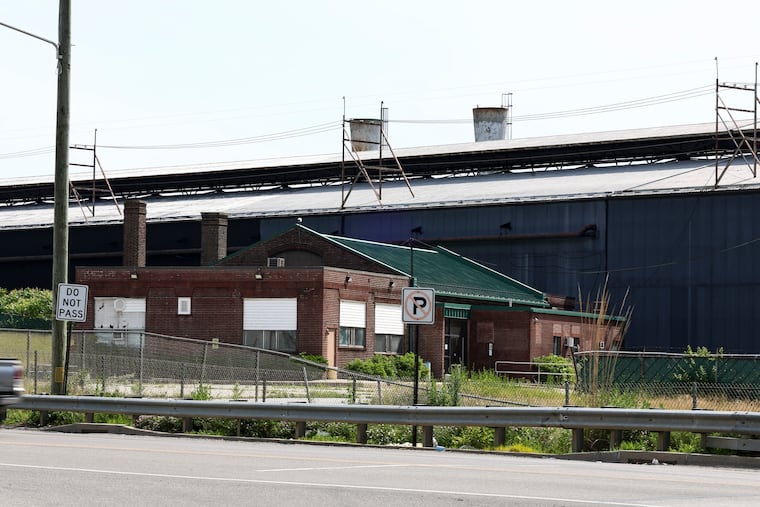
O’Neill wants to build a 2 million-square-foot data center at the shuttered Cleveland-Cliffs steel mill at 900 Conshohocken Rd., a 66-acre site along the Schuylkill. It would sprawl over 10 existing buildings as part of a reuse of a current industrial-zoned site.
O’Neill, who did not testify at Thursday night’s meeting, cited Alan Wood, who founded what became the now-closed Cleveland-Cliffs steel mill, as an example of a job creator. That’s the same site where O’Neill wants to build a data center.
And he noted John Ellwood Lee, who founded the nearby Lee Tire and Rubber Company, the site of which O’Neill has since developed into an office park. Both the steel mill and tire company once employed thousands.
O’Neill said he hoped to kick-start thousands of construction jobs.
“We’re bringing new technology to town, and we’re bringing it in a way that is sensitive to our neighbors and sensitive to the town,” he said.
The hyperscale AI data center just outside Conshohocken would generate $21.11 million a year in taxes, according to a report O’Neill commissioned by 4Ward Planning. And it would create 5,000 construction jobs a year over a three-year period, the report said. It would result in 371 “direct data center jobs” and 468 “indirect and induced jobs,” according to the report.
But opponents of the plan are concerned about light, noise, and air pollution. They worry about emissions from on-site power generation that’s been proposed, water use, and the impact on electricity costs, as well as the proximity to existing homes.
O’Neill has said the facility would provide its own on-site electricity generation via natural gas-fired turbines. The operation, he has said, would be cooled by a closed-loop system that does not require outside water.
O’Neill said the facility would utilize “dark sky standards” to ensure there is not light pollution, with outdoor lighting “less than a single soccer field.”
He asserts that the proposed data center would not violate local noise ordinances and that his team has hired sound consultants.
O’Neill has not named an operator or tenant, but said he is “negotiating with multiple large tenants.” He has indicated those tenants would be related to life sciences.
Who decides whether to allow a data center?
O’Neill has applied for a special zoning exception so the data center can be built in the township’s heavy industrial zoning district. He argues that zoning should include data centers.
The township zoning code allows a warehouse or laboratory, but does not specifically cite data centers.
The township council has taken the position that a data center is not the same use as a warehouse. They said O’Neill’s application for a special exception must be decided by the zoning hearing board.
If that exception is granted, the project would move onto the township’s land development process, which includes additional reviews, public meetings, and approvals.
Richard Roseberry, an engineer at Colliers Engineering & Design who O’Neill hired, testified during Thursday’s zoning meeting that data centers fit in with other heavy industrial uses.
But Charles Campbell, an attorney representing nearby property owners, said O’Neill’s team has not supplied enough information to make informed decisions, including a drawing of what’s being proposed.
“It’s clear as day that this application is insufficient,” Campbell said. “It does not include what the applicant intends to put on the property. It talks generally about a data center … but does not provide a scale plan as required.”
What does O’Neill say?
Under Pennsylvania law, O’Neill argues, municipalities must have zoning for all legitimate land uses, and data centers have been recognized by the courts as a legitimate commercial or industrial use. Developers have, as a result, targeted industrial or commercial zones for data center proposals.
A municipality cannot ban data centers under Pennsylvania law. As a result, many municipalities have raced to craft ordinances to limit their impacts.
But municipalities are allowed to treat a land use not specifically mentioned in a zoning ordinance as a special exception or conditional use. That requires a developer to go through a zoning hearing board.
If a municipality refuses to classify data centers as a legitimate use, a developer can file what’s known as a “substantive validity challenge,” which O’Neill says he has done because some township officials are on record as saying they don’t support his application.
» READ MORE: In Montco data center fight, local officials say a developer has ‘bullied’ them. He says that’s a ‘bold-faced lie.’
“If they don’t work with us in good faith, we’re going to get it by right,” O’Neill said.
Sander, the zoning hearing board solicitor, ended Thursday’s hearing without setting a date for the next, saying it would likely continue in September.
This story has been updated to say that developer Brian O’Neill did not testify at the meeting, and clarified the estimated number of jobs that would be associated with the data center.