PennDot to repair deteriorating steel beams on University Avenue Bridge
Vehicular access will be reduced to one lane in each direction between Aug. 17 and Dec. 15.
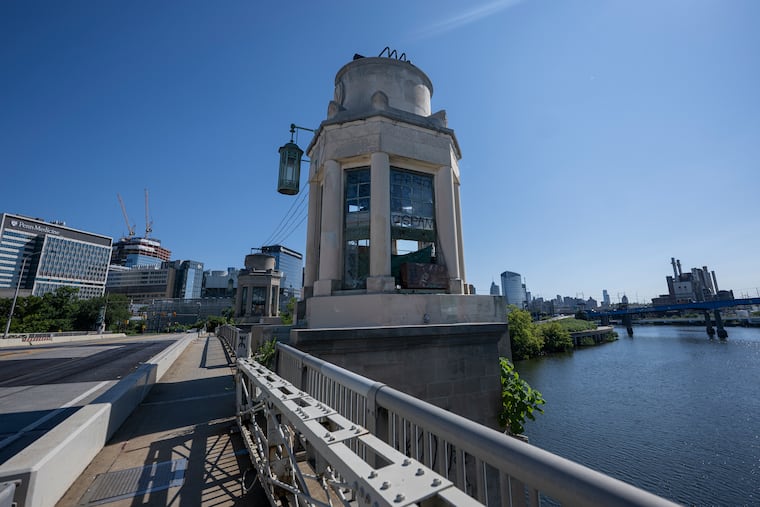
The University Avenue Bridge will soon receive structural repairs, and some of its architectural details will be secured from further vandalism, but a full-scale restoration of the historic span isn’t happening anytime soon.
PennDot is slated to begin work on the drawbridge Aug. 17, the agency announced Monday. Pedestrian and vehicular traffic will be partially impeded for the duration of the job.
A routine inspection in March of the Paul Philippe Cret-designed structure turned up deterioration in some of the steel members, said PennDot assistant district executive for assets Kerri Cutright, “and we were a little concerned, and so that’s why we’ve initiated these repairs.”
The goal is to move the drawbridge from “poor” to “fair” condition, said Cutright.
In addition, plans call for the installation of 8-foot-tall chain-link fencing in front of the two operator’s houses on the east side of the bridge to deter vandals.
Work is expected to continue through Dec. 15.
The project, estimated to cost about $2 million, leaves unaddressed the needs of some major features of the bridge, which was built around 1930. It will not bring back the bridge’s ability to raise its leaves, though the work won’t prevent restoration of that function in the future. The 10 elaborately detailed lighting fixtures will not be returned to working order as part of the job.
» READ MORE: The University Avenue Bridge is a Philly gem. It’s embarrassing how it remains neglected.
Graffiti has marred the bridge in several places, most noticeably on the Center City-facing sides of the operator’s houses, but there is no immediate plan to clean up the scrawls.
“At this time, graffiti removal is not in the scope, but it is being explored in the near future,” said PennDot spokesperson Brad Rudolph.
Vandalism and deterioration on the bridge linking West Philadelphia and Grays Ferry have attracted sporadic public attention for decades. The Inquirer highlighted the conditions last September, with another article in June, and other news outlets have called for the bridge’s stabilization and restoration. A recent change.org petition advocating that it be protected from further damage collected hundreds of signatures.
“Without intervention, these unique design elements risk permanent loss,” the Preservation Alliance for Greater Philadelphia wrote in its magazine, which lists the bridge as one of the city’s places to save.
“We welcome PennDot’s attention to the University Avenue Bridge and the planned work to address some of its most urgent deficiencies. This is a positive first step, especially after years of visible deterioration, but it should not be the end of the effort,” said Paul Steinke, executive director of the Preservation Alliance for Greater Philadelphia. “The bridge is one of Philadelphia’s most distinctive historic spans, and it deserves a broader rehabilitation plan that addresses its historic features, long-term condition and role as a public gateway between neighborhoods.”
The repairs at hand will address the structural elements beneath the bridge’s deck. The bridge uses a girder floor beam stringer system to carry the load, said Cutright, and the deterioration will be addressed with plating, cleaning, and repainting, and some steel members may be replaced.
Vandalism and the elements have damaged the two operator’s houses on the Center City-facing side of the bridge. They will be cleaned out and sealed, and a chain-link fence will be installed in front of the two structures to deter trespassers.
Lane closures will reduce vehicular access to one lane in each direction during construction. Two of the bridge’s four lanes will be closed all day every day, with two lanes left open (one in each direction) through mid-December. The work will begin with closing the two lanes closest to the operator’s houses, and moving all traffic to the other side. Then, in a couple of months, the closure pattern will flip.
The bridge carries more than 36,000 vehicles per day, according to PennDot, and the agency expects significant backups during construction. Pedestrian access will be permitted on the side of the bridge opposite from where work is being conducted.
Cutright said that while PennDot would like to restore the bridge, the cost is estimated around $50 million, and no funding is currently lined up for an effort on that scale.
Even if funding were in place now, a major rehabilitation would be a long way off. Planning and construction would take five years or more, she said.
“It’s a beautiful bridge, and I would imagine that if we were to do a major project that we would want to restore it to its former glory.”