Three numbers that matter for the Eagles, from the schedule to Jalen Hurts’ running
The Eagles have one of the softest schedules in terms of pass defenses they will face this season and their running game could largely depend on how effective multi-tight end sets.
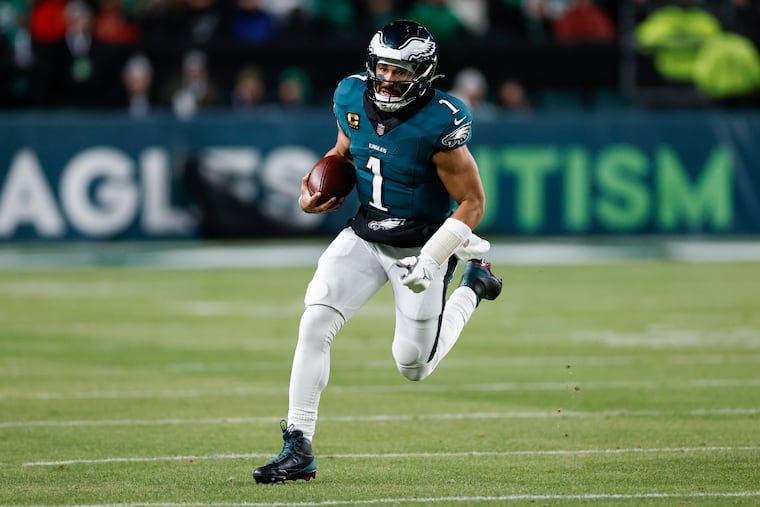
Diving deep into the data to look at three trends that will help determine the Eagles’ fate in 2026 (with an assist from pro-football-reference.com and nflfastR).
23rd
That’s the average ranking from last season of the 14 pass defenses the Eagles will face in 2026. It is the softest schedule in the league by a wide, wide margin. The Eagles couldn’t have handpicked a better setup for Jalen Hurts and first-year offensive coordinator Sean Mannion. Right out of the gate, they’ll face a Commanders defense that finished tied for 30th in yards per pass attempt allowed, then a Titans defense that finished dead last. In fact, nine of their 14 opponents finished lower than 20th in yards per attempt.
A big factor in the Eagles’ good fortune is a division that includes two of the three worst pass defenses from a year ago in Dallas and Washington, plus a Giants team that finished in the bottom half of the league. The Cowboys also finished in the bottom 10 in sack rate while ranking 27th in their rate of passing plays of 20 or more yards, two categories in which the Eagles schedule also ranks among the most favorable.
» READ MORE: This defense won’t be the best in Eagles history. But it will be plenty good enough. Even great.
The nondivision slate will likely play a little tougher than it looks on paper. The Rams (tied for 11th in YPA) rebuilt their secondary while adding Myles Garrett and Aaron Donald to the pass rush. The Colts could be better in their first full season of cornerbacks Charvarius Ward and midseason trade acquisition Sauce Gardner. That said, no team in the NFL has a more favorable schedule top to bottom. The Eagles’ opponents had an average rank of 22.9 in passing yards per game and 20.2 in yards per attempt allowed last season. Both are the highest in the NFL.
The sequencing is as beneficial as the actual opponents. The two toughest defenses on their schedule don’t come until Weeks 15 and 16, with just five days separating the Seahawks on Dec. 19 and the Texans on Christmas Eve. Both games are at home.

David Murphy alerts
The early-season schedule is soft enough to counteract whatever learning curve that will exist for Hurts and the rest of the offense in Mannion’s scheme. The expectations should be high.
3.98
That was the average yards per carry of Eagles running backs when they had multiple tight ends on the field last season in neutral game script situations. That ranked in the bottom half of the league and well behind the teams that made it to their conference championships.
A sampling …
Running-back yards per carry in multi-tight-end sets (first and second down outside the 10-yard line)
Bills: 5.25 (4th in NFL)
Rams: 5.23 (5th)
Seahawks: 4.56 (9th)
Bears: 4.52 (10th)
Broncos: 4.44 (11th)
Patriots: 4.30 (17th)
Eagles: 3.98 (20th)
Johnny Mundt didn’t get a ton of coverage in training camp. Blocking tight ends rarely do. But the Eagles signed the 31-year-old veteran for a reason. With Cameron Latu lost to waivers and Grant Calcaterra on injured reserve, the Eagles will enter the season without two of their top three tight ends from last year. Add to that the steep learning curve awaiting rookie second-round draft pick Eli Stowers and tight end is one of the bigger question marks on this 2026 roster.
The question is especially relevant given the leaguewide paradigm shift. Teams like the Rams and Seahawks have spent considerable resources accumulating talent at the tight end position in recent seasons. Seattle drafted AJ Barner and Elijah Arroyo in the fourth and second rounds in back-to-back seasons, while the Rams just added second-round pick Max Klare to a stable of tight ends that already included 2025 second-rounder Terrance Ferguson, high-priced free agent Colby Parkinson, 2023 fifth-rounder Davis Allen and veteran Tyler Higbee.
It remains to be seen how central a role multi-tight-end sets will have in Mannion’s offense. Last year, his Packers team finished in the top half of the league in both RB yards per carry and pass yards per attempt.
Zero
That’s how many quarterbacks rushed for 600-plus yards last season. The last time the NFL had a regular season where no quarterbacks reached 600 yards was 2017. At least two had done it in each of the previous five seasons.
Hurts’ rushing production has garnered plenty of attention, and deservedly so. The Eagles were a dramatically different offense in 2022 when he averaged 50.7 rushing yards per game compared to the one they’ve been over the last three seasons, when Hurts has averaged just 34.5 yards. It’s certainly reasonable to think that he can and should be well north of the 26.5 yards he averaged last season. But it isn’t all on him.
The natural trajectory of a dual-threat quarterback is to see a year-to-year decline in rushing production. It has happened to virtually every quarterback who has done the things Hurts did early in his career. The league adjusts quickly. It’s no coincidence that virtually every scrambling quarterback saw a significant decline in his rushing production last season.
Jayden Daniels missed 10 games, but in the seven games he played, he averaged just 39.7 yards, down from 52.4 the year before. Lamar Jackson’s 26.8 yards per game was barely half of the 52.6 he averaged over the two years prior. Bo Nix’s per-game rushing yardage fell by more than 20% (25.3 yards to 20.9). Drake Maye’s was down 18.5%. Josh Allen has averaged 32 yards per game over the last three seasons after averaging 46.2 yards per game in 2021 and 2022.
“I think [Hurts has] really operated through all facets of the offense comfortably,” Mannion said earlier this summer. “But the piece of him as an athlete in the running game is something unique. Those are elements we can lean into a little bit as well.”
Mannion should be thinking that way. But quarterbacks who have running ability will almost always see that running ability limited by defensive coordinators’ awareness of said running ability. The league has seen enough of it in recent years that it is getting better at stopping it.

The Eagles seem reluctant to address the handling of the Jalen Hurts blood clots saga, but the key questions involved in the story aren’t going anywhere. Throughout the week, in the absence of remarks from general manager Howie Roseman or team medical personnel, head coach Nick Sirianni was peppered by reporters. He’s offered few details in return. After speaking with high-ranking medical officials currently or previously employed by NFL teams, The Inquirer’s Jeff McLane frames four central issues that remain unanswered, while also looking at what this situation means for Hurts’ future in Philadelphia. Listen here.
Listen to all episodes here or wherever you get your podcasts.