The Philadelphia Museum of Art owns work by an enslaved potter. His family wants it back.
The inclusion of Dave the Potter's "Storage Jar" in a Semiquincentennial exhibition is a nod toward equity. Is that enough?
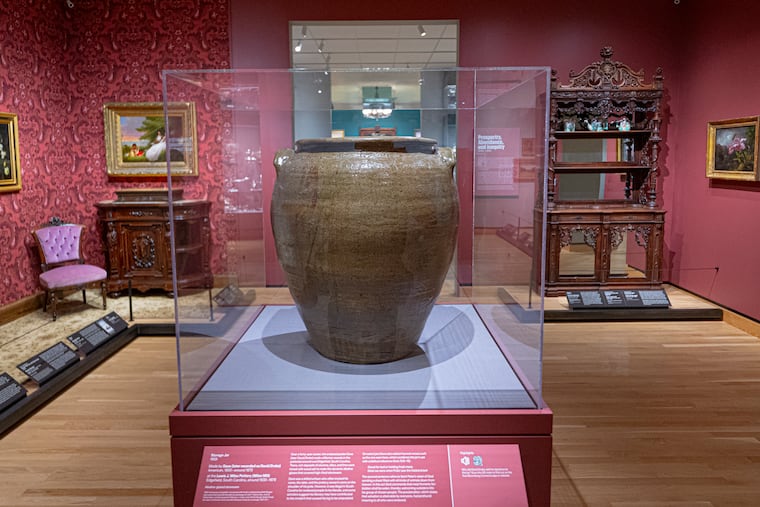
A sandy-hued 83-pound pot with a wide lip, fired by enslaved potter David Drake in the mid-19th century, anchors a gallery in the Philadelphia Museum of Art’s “A Nation of Artists,” its Semiquincentennial salute to illustrious American makers.
The stoneware stands proudly among chestnut étagères, plush upholstery, and vibrant oil paintings in a section called “Prosper, Abundance, and Inequity” staged by Art Museum curators to look like an ornate antebellum living room.
An inscription in the craftsman’s jagged script reads: Good for lard or holding fresh meat,/blest we were when peter saw the folded sheet, suggesting the potter was literate at a time when it was illegal for Black people to learn to read and write, making the earthenware even more valuable.
The Art Museum’s inclusion of the bounded ceramicist’s work is an equitable nod to the artists — potters, basket weavers, tailors, and dressmakers — who made enslavers so rich that their progeny continues to benefit from that wealth today.
That is noteworthy, say Drake’s descendants, who prefer to call their ancestor “Dave the Potter” rather than use his enslaver’s surname.
They say they are grateful institutions like the Art Museum are acknowledging Dave’s work within the canon of great American artists.
But a nod, they say, is not sufficient.
Dave’s descendants want museums to give the pottery back, including the giant, alkaline-glazed jar on display at the Art Museum.
“We want to own the pieces free and clear,” Yaba Baker, Dave’s fourth great-grandson and executive director of the Dave the Potter Legacy Trust, told The Inquirer. “Our goal is to then loan them back into public spaces so they can be viewed and Dave’s story can be told to the next generation.”
Restitution and repurchase
The seven lines of Dave’s descendants who are alive and living in and around Washington, D.C., and South Carolina have never benefited from their forefather’s labor.
Meanwhile, Dave’s pottery fetches tens of thousands of dollars per piece — and sometimes much more — at estate sales, at auctions, and on eBay.
With the help of Los Angeles-based real estate attorney and social justice advocate George Fatheree III — who helped transfer Bruce’s Beach, a beachfront property in Manhattan Beach, Calif., back to its original Black owners in 2022 — Baker has spent the last two years fighting to have Drake’s work returned to his family.
So far, five museums and three private collectors, including Chicago-based installation artist Theaster Gates, have returned 10 pieces.
On Wednesday, several of Dave’s descendants attended a ceremony at Richmond’s Virginia Museum of Fine Arts for the return of a double-handled jug, inscribed with one of Dave’s poems, to the family. VMFA will repurchase the jug for an undisclosed price for its permanent collection.
The Milwaukee Art Museum announced last month it planned to return two of Dave’s jars to his descendants and purchase one of the restituted jars for an undisclosed price.
Both agreements are inspired by a similar deal struck last October between Dave’s descendants and the Museum of Fine Arts, Boston, the first institution to return one of Dave’s jars.
Of the more than two dozen museums Fatheree is talking to, about half a dozen are “engaged in conversation and moving toward a return.”
The Art Museum, Fatheree, said, is not.
Fatheree reached out to Art Museum director and CEO Daniel H. Weiss in February and was directed to museum attorney Rebecca Wui.
“Since the initial contact, we’ve had a few conversations that I would characterize as cordial in tone, but noncommittal,” Fatheree said, “… and to date, the museum has not indicated whether or not they intend to return the work to the family, and they have not provided any concrete sense of a timeline on the decision.”
The Art Museum acknowledged through a spokesperson the importance of Dave’s legacy and said it is engaged with various stakeholders to determine next steps, adding that at “this time, we are not able to discuss any further details.”
That, Fatheree said, is “disappointing.”
“What they need to understand is the act of delay and failure of urgency is a further act of injury to the family,” Fatheree said.
Art Museum’s history of restitution
During the last several decades, prominent museums across the world have been examining how they have acquired significant pieces of art and scientific specimens.
In 2022, the Smithsonian Institution and the Metropolitan Museum of Art were among dozens of museums that returned bronzes stolen from Benin, the capital of Nigeria, during the 1897 British raid on the city.
Many institutions, including the Penn Museum, have returned tribal artifacts to Native Americans under the 2024 expansion of the Native American Graves Protection and Repatriation Act, or NAGPRA.
Fatheree is applying the principles of ethical restitution to Dave’s case. It’s a concept, he says, to which the Art Museum is not a stranger.
In 2021, the Art Museum returned to Czechia an elaborately decorated 16th-century ceremonial shield that was once owned by Archduke Franz Ferdinand and was stolen from what was then Czechoslovakia by Nazi looters.
As an enslaved man, Fatheree argues, Dave made his pottery under duress. He did not have agency over his body, nor did he have the opportunity to profit from his labors. His work was stolen from him.
The chain of provenance, used to establish that art has moved fairly and ethically from artists to buyers to new owners throughout a piece’s history, was not just broken. It never started.
“No museum would acquire a piece today where there has been a real break in provenance from an act of violence,” Fatheree said. “That’s what every museum that acquired Dave the Potter’s work did. … That’s a very uncomfortable conversation to have.”
‘An amazing individual’
Dave the Potter was born around 1800 on a plantation in Edgefield, S.C., where he was enslaved by a man named Harvey Drake. Drake and his uncle Abner Landrum owned Pottersville, 12 sprawling pottery factories that enslaved more than 75 Black people.
Landrum was also the publisher of the local newspaper, the Edgefield Hive. Scholars suggest he taught Dave to read. One of Dave’s many jobs was to assemble the newspaper type.
“Dave was such an amazing individual,” Baker said. “His skill set included writing and poetry at a time when our people couldn’t even read. His skills and craftsmanship were just so remarkable.”
Harvey Drake died in 1832, and Dave began making pottery for Harvey’s brother, Reuben. Dave’s oldest known piece with writing on it is a jug with earlike handles that dates to 1834, currently housed at the South Carolina State Museum. The piece features a rhyming couplet: Put every bit all between. Surely this jar will hold 14.
In 1740, South Carolina passed a law that made illegal teaching enslaved people how to read. In 1834, the law was updated so that any Black person, free or enslaved, caught reading would be punished by 50 lashes.
That did not stop Dave from signing his work, marking others, or adding signed couplets just under the lip and along the body of his massive storage jars, jugs, pots, and syrup and whiskey jugs.
When they were made, the pieces — which stored fruit, vegetables, and meats to feed the family of enslavers — sold for pennies on the gallon. In the meantime, Dave — who had two wives, both of whom were sold away from him — had no idea where his family was.
Today, Dave’s pieces are generally estimated to be worth between $45,000 and $50,000. In 2021, a 25-gallon jar by Dave sold for $1.56 million at Maryland’s Crocker Farm.
Historians believe Dave made from 40,000 to 60,000 pieces. It is unclear how many remain. Dave’s descendants are trying to get about 60 of them returned through their appeals to museums, Fatheree said.
“This man worked every single day doing the same thing, sometimes in 110-degree heat,” said Baker, who pointed out that Dave had just one leg. Although it is contested by historians, Dave’s descendants believe his leg was cut off as punishment, perhaps for knowing how to read.
“He was a valuable potter, and his enslavers wanted him to stay put,” Baker said. “His family was sold from underneath him. He didn’t have any agency over his body. Every day of my life, I’m inspired by him.”
Rightful owners
In 1849, Lewis Miles purchased Dave and brought him to his South Carolina pottery farm, Stony Bluff. Here is where it appears Dave made the bulk of his inscribed pieces. He marked many with LM, after Miles. Dave was signed on some.
Miles’ pottery plantation is where most of Dave’s poem pieces were seemingly made: three in 1857, eight in 1858, and seven in 1859.
The Art Museum’s piece is dated May 3, 1859.
Throughout the late 19th and most of the 20th century, Dave the Potter’s work was not considered high art, but it was recognizable in South Carolina, where it was commonly seen at yard sales and antique shows. And as historians discovered the pots, especially the ones with Dave’s etchings, the glazed ceramics increased in value.
The Art Museum has a history of collecting stoneware crafted by enslaved potters starting in 1904, when it acquired three alkaline-glazed stoneware face vessels made in the Edgefield district of South Carolina. That, the Art Museum said in a recent statement, set “the precedent for art museums to collect the art of this potting tradition.”
The face vessels are also on view in “A Nation of Artists.”
In 1997, the Art Museum purchased Dave’s pot for an undisclosed price when it was offered for sale by collectors.
A year later, the late historian Jill Beute Koverman curated the exhibition “I Made This Jar … The Life and Works of the Enslaved African American Potter, Dave” at the McKissick Museum at the University of South Carolina, the first solo exhibition of Dave’s work.
That show traveled to the Winterthur Museum in 2000 and featured 30 of Dave’s pots.
“These pieces weren’t made to be placed in the parlor of a home,” Koverman told The Inquirer in 2000. “According to the standards of the day, they wouldn’t be considered art at all.”
In 2016, the late historian April Hynes contacted Daisy Whitner, Baker’s aunt, informing her that she and her siblings — John Williams, Pauline Baker (Yaba’s mother), and the late Priscilla Williams Carolina — were descendants of Dave.
“We didn’t have any idea we were connected,” Baker said. “Before then, slavery felt distant to us. Now we have a personal connection.”
But it was not until Baker and his family were invited as guests to the Metropolitan Museum of Art’s 2022 exhibit “Hear Me Now: The Black Potters of Old Edgefield, South Carolina” did he consider himself and his family to be the rightful owners of Dave’s pottery.
“Someone asked me, ‘Do you own any pots?,’ and then I had to say, ‘No.’ I only had a replica,” Baker said.
“In any other situation, the descendants would at least have some of the artwork. And then I realized how my family was really missing out. People start businesses with this equity. They take loans out on these pieces.”
Baker thought of his daughter and his cousins who have children in college with tuition that costs upward of $75,000 a year.
He formed a trust and hired Fatheree in 2024.
‘Left out of the process’
The 2025 settlements between Drake’s descendants and the Museum of Fine Arts, Boston and, last month, with the Milwaukee Art Museum represented the first times a museum applied the principles of ethical restitution to artwork created by enslaved African Americans, Fatheree said.
The arrangements in Boston, Milwaukee, and now Virginia are accompanied with a certificate of ethical ownership that states the museum has “established good faith, lawful, legitimate, and ethical possession of the artwork and has all right, title, and interest to and in the artwork.”
Establishing provenance for artwork made by enslaved people when it was legal to enslave them is important, explained Vedet Coleman-Robinson, president and CEO of the Association of African American Museums. It establishes a precedent of what to do when valuable work made by enslaved African American artists ends up in art spaces today.
“African Americans have systemically been left out of the process,” said Coleman-Robinson, emphasizing that African Americans had no say in their work because they, too, were property.
“What we created during enslavement wasn’t owned by us, and it didn’t have a chance to become a part of our collective generational wealth. That’s why I think what the Drake descendants are doing is phenomenal. They aren’t just asking for money, they are asking for acknowledgment, and that acknowledgment piece is pivotal in telling a complete story.”
Baker said his family is only asking the Art Museum for a conversation about what is owed them. That is not reparations, Baker said. It’s justice.
“Don’t treat our family differently,” he said. “If you are giving pieces back that have been taken under duress and stolen, then we deserve our work back. You said those were your ethics. Now we are just holding you to your word.”