‘Sad girls crying’ in Washington Square Park brought cupcakes, vapes, and tissues to find community
About 20 women answered the call of a TikTok created by 26-year-old Megan Kwiecien, who posted about crying in Old City.
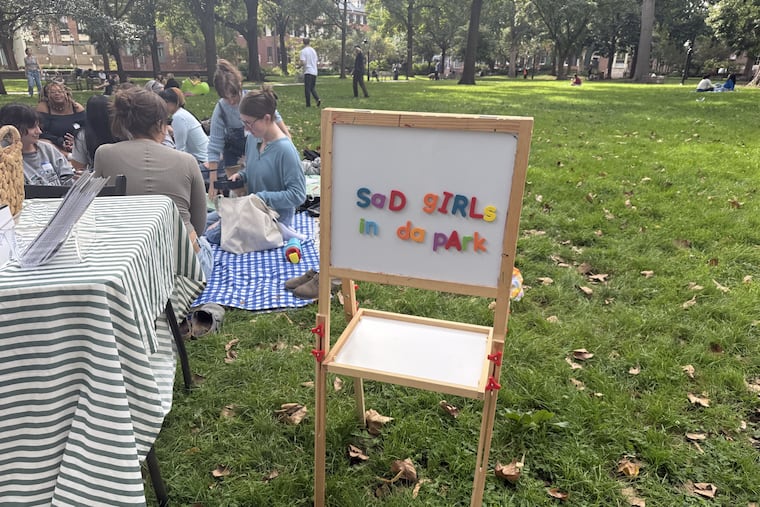
Every moisture-repelling compound in 18-year-old Angel Smith’s waterproof mascara kicked into gear as she sat on a picnic blanket in Washington Square Park and told two strangers about recently losing her uncle.
“He was the person I looked up to the absolute most,” Smith said with glossy eyes. “Life is … it’s not life-ing right now.”
A fresh high school graduate, Smith, who works as a caretaker for her great-grandmother, said she felt lost. Her uncle, like her, wasn’t particularly gifted academically, she said, but he leveraged his artistic skills to build a career for himself as a painter, tattoo artist, and musician.
He would have offered her guidance right now, but his heart stopped a few days after Christmas. He was 34.
Smith hadn’t opened up about the grief to anyone, she said. But when she saw an event advertised as “Sad Girls Crying in the Park” on TikTok, she felt drawn to go as did about 20 other women ranging from teens to women in their 50s. On a crisp October afternoon, they set up a patchwork of picnic blankets, passed around pink tissues, red velvet cupcakes, and vapes, and shared stories of loss, loneliness, money troubles, and heartbreak.
The group catharsis was envisioned by 26-year-old Megan Kwiecien. The idea hit her after she lost her cafe manager job and found herself crying alone on Third Street.
“And, like, what else do you do when you’re crying on the street other than record it and post it online?” she said.
@megans_room it’s also my duty to let every tourist pet the cute dogs i walk #oldcity #philly #prima #adela #la ♬ Ain't In LA - ADÉLA
So she did just that on Sept. 10. Soon, the comments rolled.
“U dont wanna know how many times i cried on septa,” one read.
“I’ve cried on chestnut st,” read another.
“sobbed next to elfreth’s alley three times this summer😜” someone wrote.
“been there done that,” Historic St. George’s Museum in Old City added.
As a joke, Kwiecien posted about a crying picnic. Commenters insisted she make it real.
“You asked, unfortunately I listened,” Kwiecien wrote in the invitation textbox. “Overshare to a stranger, enable someone’s bad decision, stare into the middle distance, or say ‘no literally I’m fine’ while clearly NOT being fine. Basically: sad girls, outside. See you there.”
Most of the women came to the event alone, courageous and open-hearted — trusting another woman, a stranger, would catch her if she came undone. And many did. For as many women who came to get support, more came to offer it.
Many participants found commonalities among themselves. Some helped each other nurse fresh heartbreaks of relationships spanning from five years to one week. Others shared frustrations over struggling to make friends in a new city.
Sitting around a black-and white-checked blanket on the leaf-dotted grass, Smith and 23-year-old Maya Mason quickly started tracing similarities between their lives. Mason, who lives in the Gayborhood, lost her mom to breast cancer a year and a half ago and the pain was as raw now as ever. Like Smith, she felt like she’d lost her guiding light.
“The rest of my life without my mom … I’m scared,” Mason said. “If I fall apart, I won’t have my mom to put me back together.”
Her friends offer wonderful support, but many are in relationships.
“They all have a person,” Mason said. “And my mom was my person.”
When she’s around her friends, she worries that talking about her grief will dampen the mood, but, surrounded by strangers who she knew were grappling with their own problems seemed safer somehow, she said.
Smith felt similarly.
It’s “sonder,” Smith explained. “The realization that everybody’s life is as complex as yours.”
Smith told Mason she copes with her grief by continuing to seek advice from her uncle, even knowing he’s not around anymore.
“I still text his old number,” she said.
Every update, every challenge, every accomplishment — she shares. Maybe it’s into the void, maybe someone whom his number has been reassigned to. Either way, it helps. She thinks about how he’d respond.
She advised Mason to try something similar. The idea perked Mason up.
“I made her smile,” Smith said. “It made me feel good.”
Eric Spiegel, a psychologist who runs a group practice in Philly and co-authored the book Attachment in Group Psychotherapy, explained that group therapy and similar experiences like “Girls Crying in the Park” hold their power in simply making people feel less alone.
Someone expresses something they’ve been struggling with to strangers, expects to be alienated, looks around, and “they see empathy, they see compassion, and they see curiosity,” he said. “Then they start to feel more confident like, ‘Hey, you know, I could be this way with my friends.’”
Kwiecien’s vulnerability in posting the video of herself crying and hosting this event likely emboldened others to show up and be vulnerable, too, he said. Gatherings like this offer the participants perspective, a sense of normalcy and a sense of community, Spiegel said.
By the end of the afternoon, the women had made a group chat to keep in touch. Kwiecien smiled with satisfaction, surveying what she’d created, already contemplating a Halloween version for spooky season.
“I was hoping it would turn out like this — making friends, community,” Kwiecien said. “Trauma dumping a little bit.”
She waved brightly to the several remaining women as she left.
“Bye, sad girls!”