Keith Haring’s famed Point Breeze mural moves one step closer to historic designation
The nomination for the 1987 mural, 'We the Youth' to become a part of the city's Register of Historic Places was approved in a Philadelphia Historical Commission meeting.
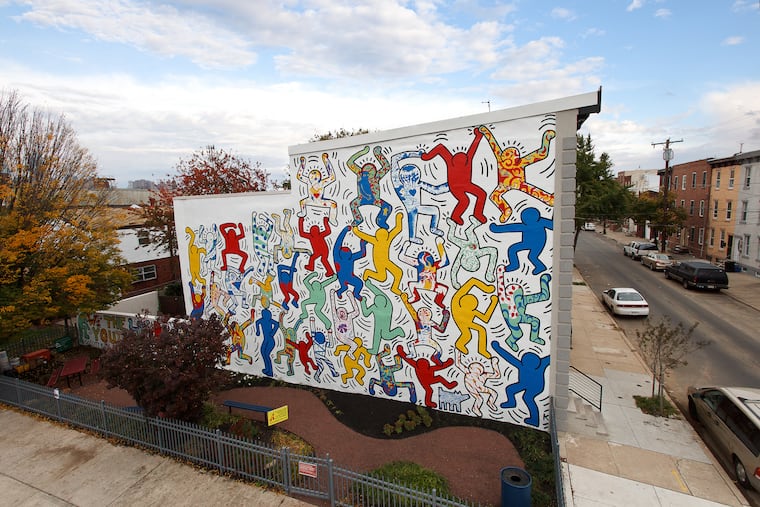
For nearly 40 years, Keith Haring’s We the Youth has been a neighborhood highlight in Philadelphia’s Point Breeze neighborhood.
The vibrant figures dancing across the facade of a three-bedroom rowhouse at 22nd and Ellsworth Streets is the only Haring mural that still sits in its original location.
Now it’s one step closer to being added to the city’s Register of Historic Places. On Wednesday, an advisory group of the Philadelphia Historical Commission unanimously approved its nomination to be included.
If approved at next month’s Philadelphia Historical Commission meeting, the outdoor mural will be added to the Philadelphia Register of Historic Places. That would make it the first outdoor mural to be an officially designated and protected landmark in the city’s history. It’ll be only the fourth mural to be designated as such, after The Dream Garden inside the Curtis Center, the New Deal-era murals inside the Family Court building, Angelic Exaltation of St. Joseph into Heaven inside Old City’s Old St. Joseph’s Church, and Iron Plantation Near Southwark inside the Southwark Station Post Office in South Philly.
Haring, the Reading, Pa. native, whose bold drawings and vivacious paintings meld the worlds of graffiti and contemporary art, became one of the defining artists of his generation. He died in 1990, at age 31, due to AIDS-related complications.
In 1987, Haring and a group of 14 Philly and New York-based students collaborated on We the Youth to commemorate the bicentennial of the U.S. Constitution.
In 2013, Mural Arts Philadelphia undertook a massive restoration of the Haring mural, located on a shared party wall at 2147 and 2149 Ellsworth St. But in recent months, organizations have advocated for the designation of the pop artist’s mural.
During Wednesday’s meeting, the nomination was presented by Alex Tiff, a historic preservation planner for the City of Philadelphia, who referenced designation criteria A and E because of the mural’s artistic and cultural significance.
According to the City of Philadelphia website, criteria A is considered for “significant character, interest, or value as part of the development, heritage, or cultural characteristics of the City, Commonwealth, or Nation or be associated with the life of a person significant in the past.” Criteria E is for the work of a “designer, architect, landscape architect or designer, or engineer whose work has significantly influenced the historical, architectural, economic, social, or cultural development of the City, Commonwealth, or Nation,” according to the government site.
Tiff was joined by Mural Arts Philadelphia founder and former leader Jane Golden; Jenny Greenberg, executive director of the Neighborhood Gardens Trust; and Simon Castets, executive director of the Keith Haring Foundation.
Golden said the mural is a part of the “unique fabric of Philadelphia.” And its designation will protect an integral piece of the city’s history in its most fragile state.
“There are few opportunities to preserve history while it is still physically present and still connected to our city and our community. This is the moment,” Golden said.
Greenberg said amid the ongoing threat of development and gentrification in this city, it is almost rare to find a mural that has been at the same site for 40 years. And this is why historical designation is a necessary step.
“The mural’s location reflects Haring’s commitment to making art accessible to the public, regardless of socioeconomic status, and to engaging young people as creative partners,” she said.
The advisory group, comprising architects, historians, and preservation experts, agreed that the mural meets the criteria. After nearly an hour of deliberation, including comments from Philadelphia residents who tuned into the Zoom meeting, the group approved the nomination and recommended it to the commission for next month’s meeting.
The commission will vote on Oct. 9. If approved, We the Youth would be the first designated mural in over four years.
A potential historic designation will not affect the larger property and will be restricted to the mural and the wall it is painted on. The building’s owner will be required to maintain the structural integrity of the wall and commit to set obligations, with Mural Arts making any necessary restorations to the mural itself.
If the mural is designated, the building’s owner, listed as “2147 Ellsworth LLC” in city records, will not be allowed to remove or alter the appearance of the mural without the Historic Commission’s review.
While speakers were impassioned by the possibility of historical designation, 2147 Ellsworth LLC manager Ori Feibush, serving as a representative at Wednesday’s committee meeting, opposed the nomination.
Feibush warned that the designation would impede the building’s renovation efforts, which may require the demolition of the rowhouse’s interior, based on analysis from engineers. Since purchasing the property eight years ago, Feibush said his company has worked diligently to reduce water infiltration and minimize movement to “preserve the mural.”
In spite years of efforts, he said, the mural has delaminated from the underlying salmon brick and is in a fragile condition.
“The removal and, ultimately, reinstallation of the mural here is the only path to create something that can be here long term,” Feibush said.
By gaining historical designation, he said, there will be temporary plans made to preserve the site, rather than long-term fixes that will ensure the mural lasts “another 100 years,” rather than the five to seven he projects.
“This mural we hope will forever be at this location, but the only way this location could have a mural is without a designation,” he said.
Committee member Jeff Cohen was one of several who questioned whether historical designation and preservation could happen simultaneously. He and his fellow member Elizabeth Milroy agreed that both methods should be carefully studied and explored before next month’s commission meeting, ensuring that all scenarios are properly vetted and that all attendees’ views are considered.
The committee then opened the meeting to the public. Several Point Breeze residents, many who live within walking distance of the mural, supported the historical designation.