19th century Philadelphia was a finance and science hub. The Pennsylvania Academy of the Fine Arts made it a cultural touchstone.
Founded in 1805, PAFA hasn't had a perfect history, but has always been a progressive institution. It has helped define what it means to be an American artist.
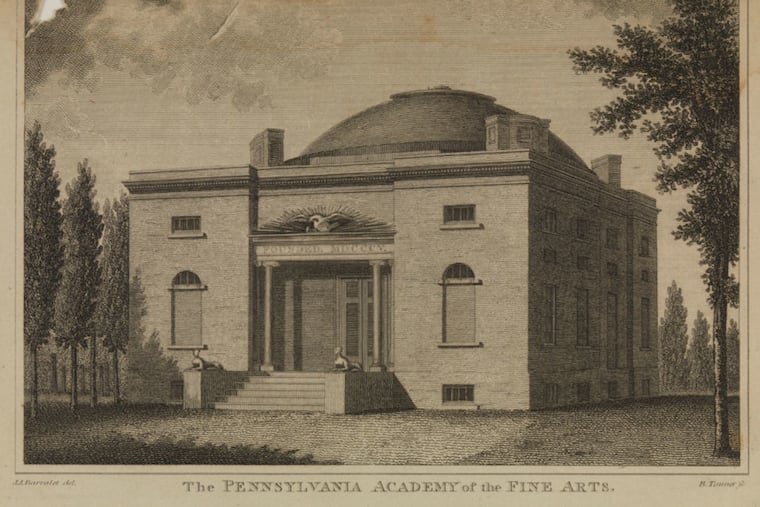
At the dawn of the 19th century, Philadelphia, having served as the nation’s capital, was well established as America’s founding city.
The city stood strong as the center of American commerce thanks to Alexander Hamilton’s insistence that the first federal bank open its headquarters here. It was a global hub of science and innovation too, thanks to the country’s earliest universities, medical schools, and hospitals laying down their foundations here.
Then in 1805, 71 of the fledgling country’s leaders started a movement to turn Philadelphia into a leading arts city, adding culture to our list of wonders.
That group included Founding Father and signer of the Declaration of Independence George Clymer; businessmen Henry C. Pratt and Simon Gratz; and artists William Rush and Charles Willson Peale. On Dec. 26, the men signed a charter authorizing the creation of the Pennsylvania Academy of the Fine Arts, the nation’s first fine arts museum and art school.
Clymer was named its first president and Philadelphia’s arts and culture scene was born.
PAFA will fete their historic first status on Saturday, July 25 as part of the Philadelphia Historic District’s yearlong celebration of America’s 250th birthday. The birthday party, or firstival, will be from 11 a.m. to 1 p.m. at PAFA.
“As the young United States was finding its footing, a group of visionaries set out to give the new nation a cultural heart,” said Hoang Tran, PAFA’s director of archives, library, and collections.
PAFA opened to the public in the spring of 1806 on Chestnut Street between 11th and 12th. In 1845, that building was nearly destroyed by a fire. The museum and art school reopened in 1847.
By 1870, it had outgrown its space and leaders purchased land at Broad and Cherry Streets.
That building, designed by Frank Furness, opened in April of 1876, a month before America kicked off its centennial celebration. At the time, PAFA’s building was one of the city’s most ornate spaces and was touted as a centerpiece of the Center City landscape. (City Hall wouldn’t be finished until 1901.)
Newspapers reported that PAFA cost $400,000 to complete, $12.5 million in today’s money. Today, the Furness Building is also known as the Historic Landmark Building.
The Broad Street building increased PAFA’s shine. Early Americans often turned to Europe as their cultural North Star, but in the late 19th century, PAFA’s leaders began centering American artists like Thomas Eakins, Rembrandt Peale, and James McNeill Whistler in its galleries, forging and defining fine American art.
PAFA was groundbreaking in its inclusivity, allowing women students into its classes as early as 1844. In 1879, PAFA established the Mary Smith Prize, the first major American art prize established exclusively for women.
» READ MORE: We can thank Philadelphia for ice cream sodas and root beer floats
In 1855, eight years before President Abraham Lincoln signed the Emancipation Proclamation, PAFA welcomed Black visitors. And in 1880, African American painter Henry Ossawa Tanner exhibited paintings in PAFA’s annual show. Tanner soon became an international arts sensation.
“We certainly weren’t perfect but we were definitely progressive,” Tran said. “Today that is a point of pride for us.”
Nearly every notable American artist has attended, taught, or had their work exhibited at PAFA. That long list includes Mary Cassatt, Cecilia Beaux, Robert Henri, Louis B. Sloan, Barkley Hendricks. Jacob Lawrence, Andy Warhol, and Kehinde Wiley.
In 2025, PAFA stopped offering its degree program and celebrated its 220th anniversary.
Currently, in honor of America’s 250th, PAFA and the Philadelphia Museum of Art are hosting a joint exhibit, “A Nation of Artists” through September.
This week’s Firstival is Saturday, July 25, 11 a.m.-1 p.m. at the Pennsylvania Academy of the Fine Arts 118-128 N. Broad Street, Philadelphia, PA
The Inquirer is highlighting a “first” from the Philadelphia Historic District’s 52 Weeks of Firsts program every week. A “52 Weeks of Firsts” podcast, produced by All That’s Good Productions, drops every Tuesday.