Interviews, archives, and zines: How a Penn historian is trying to preserve six decades of Philly’s trans history
Nat DiFrank runs the Philadelphia Trans Oral History Project. This year, he developed a zine highlighting six decades of Philly's trans history.
One of the nation’s earliest protests for LGBTQ+ rights was years before Stonewall — and miles away from New York. It was in Rittenhouse Square in 1965.
Organizers staged a series of sit-ins at Dewey’s restaurant after dozens of genderqueer, trans, gay, and lesbian people were refused service.
Today, a historical marker commemorates these groundbreaking demonstrations, but its description only mentions discrimination against “homosexuals” and overlooks the trans and gender-nonconforming people on the front lines.
For trans historian Nat DiFrank, that is just one example of the erasure of trans people from mainstream narratives about LGBTQ+ movements.
“We’re actually working with the Pennsylvania Historical Society to get [the marker] edited because it does not accurately depict what was actually happening,” DiFrank said. “We hear so often that trans people are ‘new’ or [we see some] forgetting trans people completely when it comes to organizing or supporting them, [but] trans people were part of a major sit-in and a major movement that became the gay rights movement.”
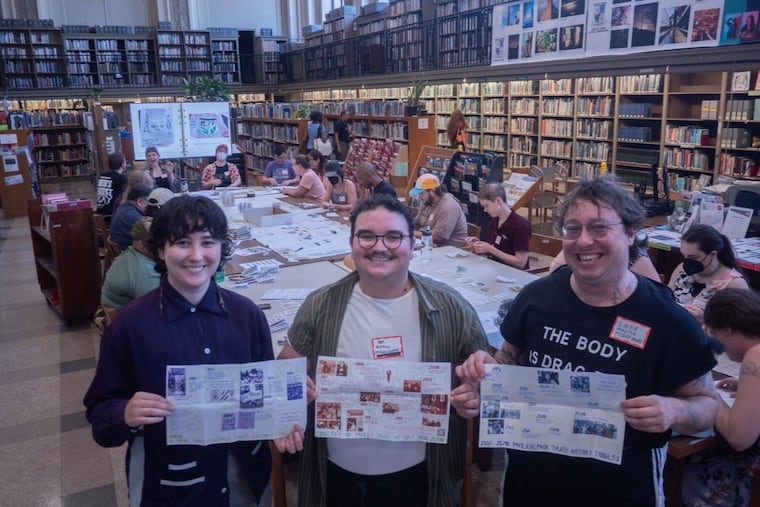
DiFrank runs the Philadelphia Trans Oral History Project, a collaborative effort out of Penn that includes the Center for Research in Feminist, Queer, and Transgender Studies, the William Way LGBT Center, and the Annenberg School for Communication. This year, he developed the project’s first zine, resulting in a three-page illustrated timeline that covers 60 years of trans history in Philadelphia. Drawing from 13 interviews with trans people and archival research, the pocket-sized zines highlight significant moments from 1965 to 2026 with colorful designs by West Philly-based artist Alex Hanesworth.
Fittingly, the timeline starts at Dewey’s.
The zines spotlight important figures in LGBTQ+ history, like Cei Bell, a Black trans and intersex writer who served as a marshal in the city’s first Gay Pride March in 1972, as well as grassroots publications that helped people connect and build community, like The Radical Queen: Magazine of the Non-Man and Colours Magazine.
A recent entry focuses on Penn swimmer Lia Thomas, who broke barriers becoming the first openly trans athlete to win an NCAA Division I national championship in 2022. In 2025, Penn caved to significant pressure from President Donald Trump — whose administration temporarily withheld $175 million in federal funding for the university — and stripped Thomas of her titles, amid other concessions.
“Lia Thomas is in our zine because that’s important to me. They’ve erased her title, but that doesn’t mean that that history actually needs to be erased,” said DiFrank.
The Trump administration’s efforts to dismantle diversity, equity, and inclusion programs on college campuses nationwide have been acutely felt at Penn. The Ivy League has become embroiled in controversies as its leaders scrambled to comply with the expansive executive order targeting diversity initiatives.
These changes, DiFrank said, have had a huge impact on the gender studies program and the Center for Research in Feminist, Queer, and Transgender Studies.
“Internal grants that used to be focused on social justice and anything related to DEI [diversity, equity, and inclusion] have largely been cut…[and] we haven’t been able to find sustainable funding,” he said.
Navigating financial struggles for a project centered on trans people, who have been prominent targets for the Trump administration, has been stressful, DiFrank added. He has received hateful and threatening emails about his work and worries that he and other participants in the project could be doxxed.
“On an individual level, working as a trans historian at an institution that’s actively participating in erasing trans history while I’m there is a really big, to be unfiltered, mind f—,” said DiFrank.
Despite the difficulties, DiFrank said he has been heartened to see Philadelphians turn out to support the Trans Oral History Project at zine-folding events. For him, it’s especially meaningful to see trans people making intergenerational connections. DiFrank said, he too, has built close relationships with some of the interview participants, like Dionne Stallworth, cofounder of the Transgender Health Action Coalition, who connected the historian to other elders.
So far, organizers have printed hundreds of zines to distribute at branches of the Free Library of Philadelphia and the Gender and Sexuality Development Program at the Children’s Hospital of Philadelphia. But their funding has since run out, leading DiFrank to lose his role. He’s now working on a separate but related oral history project at Penn, focusing on its LGBT Center.
DiFrank still has big goals for the Trans Oral History Project’s zines and hopes to secure funding to print more copies and conduct more interviews, particularly with trans elders in Philadelphia. There is a waiting list of people who want to participate and DiFrank said the need is urgent. The interviews will be archived at the William Way LGBT Community Center.
DiFrank is looking for volunteers who can help with printing and distribution and creating PDFs of the zines that can be widely shared. Interested folks can continue following their journey on Instagram.
“There are so many stories we haven’t been able to cover or preserve, and there’s so much more that we can do with what we have,” said DiFrank. “I hope this will be a seed of something more for people to work on, add to, critique, and be in conversation with all of it.”