As tailors disappear, this Upper Bucks shop looks to a fifth generation
With tailors disappearing, an Upper Bucks shop is set to pass to a fifth generation. That's "extraordinarily uncommon," the head of a trade association said.
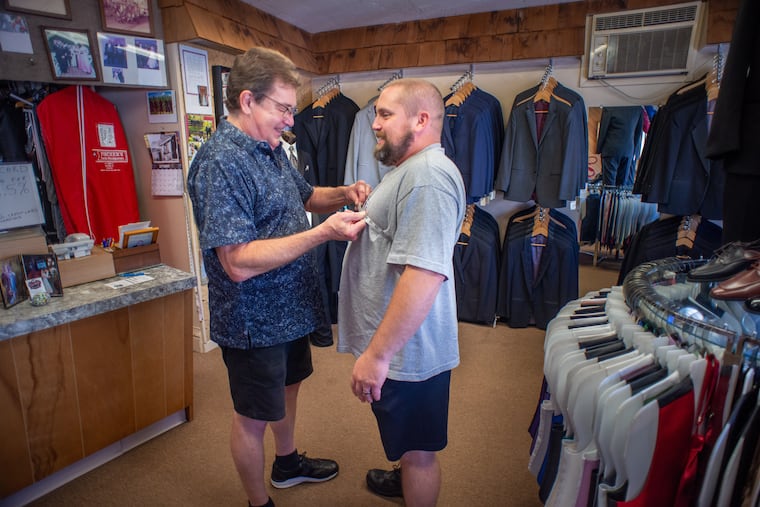
Brett Fischer of Fischer’s Tuxedo in Quakertown learned tailoring as a kid, when his dad owned the store. Now, Brett runs the tailor and dry cleaning business with his son Dustin, who learned from Brett.
Dustin started out “shining shoes in the back, and then you know, little by little ... sew a button on, shorten sleeves, just easy things,” Brett said.
Dustin is the fifth generation to run Fischer’s, started over a century ago by his German-Romanian great-great-grandfather in the same Broad Street location the family operates today.
That’s “extraordinarily uncommon,” said Cindi Husbands, CEO of the American Tailors and Sewing Association.
Across the country, tailors are disappearing as business owners reach retirement without anyone to replace them.
Fischer’s offerings have changed over time. Services once included seasonal clothing storage because many home closets were too small to hold them, Brett said. His grandfather used to send clothes on the train to Philadelphia for dry cleaning, before he brought that service in house.
The store grew with it.
Originally built as a twin home, the front porch is now an indoor reception area. The upstairs apartments became storage. On the wall by the entrance hang painted portraits of Brett’s father, grandfather, and great-grandfather.
Today, weddings and other formal events are the heart of the business. There are 10,000 suits stored in the 5,900-square-foot shop, Dustin said. But, weddings are smaller than they used to be, he said, and people buy less formal clothing in general.
“It’s a very dressed-down society. ... They just wear what we’re wearing,” Dustin added, pointing to his blue polo shirt. “You can wash it in your laundry machine.”
In towns without tailors, other businesses like bridal shops have absorbed some of the demand, Husbands from the trade association said, but it’s difficult to replace the skills and experience of a professional, full-service tailor.
Her organization, along with major retailers like Nordstorm, are investing in tailor training programs to rebuild the workforce.
With fewer tailors, Dustin expects to see higher costs and lengthier pants.
“They’re going to charge you an arm and a leg for a simple job,” he said. “Or you just won’t get it done. You’re going to wear your pants, and they’re going to be nice and long.”
Brett attributes his family’s long success to word of mouth, good customer service, and providing “a great product at an extremely fair price.”
Father and son both worked other jobs before joining the family business full time. Brett, made office furniture, and Dustin worked in restaurants, a car wash, and a chocolate factory.
After 34 years at the helm, Brett’s not sure when he’ll retire: “I’m probably gonna wake up one day and say ‘I’m just done’.”
And Dustin doesn’t know yet whether he’ll keep the store running himself, though he expects someone in the family will.
“But you never know,” he added. “Life’s weird.”
This suburban content is produced with support from the Leslie Miller and Richard Worley Foundation and The Lenfest Institute for Journalism. Editorial content is created independently of the project donors. Gifts to support The Inquirer’s high-impact journalism can be made at inquirer.com/donate. A list of Lenfest Institute donors can be found at lenfestinstitute.org/supporters.