Krasner says ‘criminal’ police conduct tanked past murder case against man accused of killing Philly cop
Larry Krasner blamed two officers for the 2023 acquittal of Eric Lewis, now charged with killing Officer Shane Seiber.
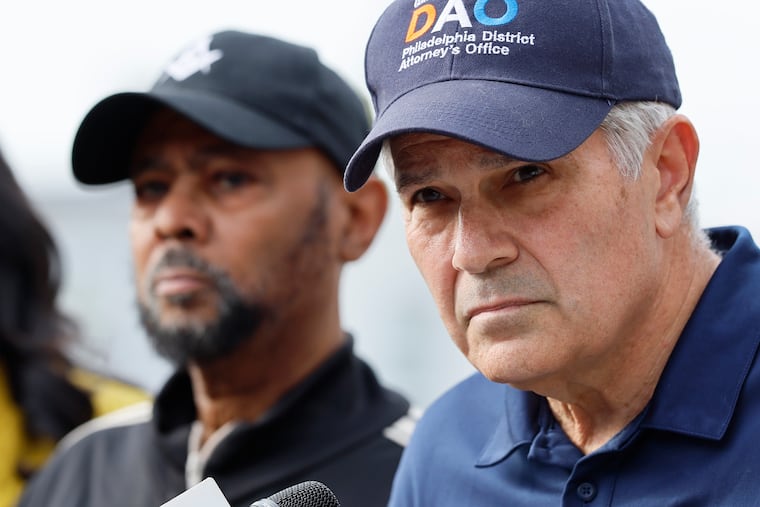
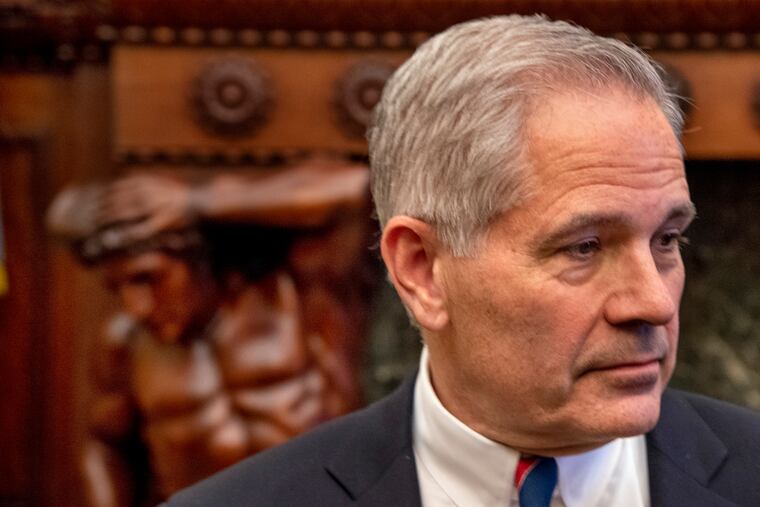
District Attorney Larry Krasner said Tuesday that Eric Lewis, the man charged with killing a Philadelphia police officer and shooting at 10 others this weekend, was free to commit that crime because two other officers had botched an earlier murder case against him in a way that was “arguably criminal.”
The startling allegation from the city’s top prosecutor, delivered in a YouTube video Tuesday morning, not only blamed a police officer and a homicide detective with sinking the case against Lewis at a 2023 trial — it also insinuated that their actions had allowed Lewis to remain free to kill Police Officer Shane Seiber three years later.
Krasner did not make himself available to answer questions about the case, and his office did not respond to a list of detailed questions about it this week.
» READ MORE: Man accused of killing Police Officer Shane Seiber was acquitted of murder three years ago. ‘They had him in 2023.’
His video statement did not indicate whether his office planned to investigate the officers — one of whom he said dated Lewis’ sister and gave false information to police — for actions he said could amount to obstruction of justice.
Krasner’s explosive remarks, alongside documents in the case and its fallout obtained by The Inquirer, offered insight into an extraordinary set of circumstances: a police officer who the district attorney said sought to “torpedo” his testimony; a homicide detective who appeared to fail to investigate key aspects of the case; and a judge who was left so disturbed that he reported the conduct to the Philadelphia Police Department’s Internal Affairs Bureau.
And it has left the mother of Christopher Williams, the man Lewis was accused of killing in August 2019, confused and seeking answers from Krasner’s office.
“It’s overwhelming,” Darlene Brown said. “It’s information that we never knew.”
The developments come just days after Seiber was killed in a shooting that has rocked the local law enforcement community. And the comments threatened to deepen tensions between the reform-oriented Krasner and many within the Philadelphia Police Department who for years have said his office has failed to hold defendants accountable.
Krasner, in the video, insisted his staff was not to blame for the acquittal, saying they had done “everything humanly possible” to salvage a weak case and convict Lewis.
Sgt. Eric Gripp, a spokesperson for the police department, said that the department was reviewing the records in the case, but that its focus remained on supporting the family of Seiber, the wounded officer, and the grieving police force.
“There will be a time to address the full record, but it is not now. Assigning blame while families are grieving does nothing to advance accountability or support those affected. True leadership does not seek to assign fault in a moment like this. It stands with the families. And when the time comes, it holds itself to the same scrutiny it asks of others.
“We will have more to say. Right now, these families deserve our attention, our support, and our respect,” he said.
Lewis, 35, remained in custody Tuesday, charged with murder and related crimes in the fatal shooting of Seiber and the wounding of another officer on his porch early Saturday. Lewis went on to fire at nine other responding officers in a nearly hour-long standoff, police said, and was later arrested with three guns — one of which police said he had stolen from an officer he shot.
Seiber, 40, a 10-year police veteran and married father of two, died hours after being struck. His 33-year-old partner, a nine-year veteran, was shot 12 times and remains hospitalized.
The case has led to an outpouring of emotion from across the city, including from police officers who questioned why Lewis — who had been charged by Krasner’s office at least twice for violent crimes — was free to commit the shooting in the first place.
Krasner’s comments served as something of a response to that, and stemmed from a case in which Lewis was charged with killing Williams, 32, in a road-rage shooting in West Philadelphia in 2019.
Prosecutors tried Lewis on charges of murder and related crimes during a two-day bench trial before Common Pleas Court Judge J. Scott O’Keefe in April 2023.
O’Keefe, troubled by weaknesses in the police investigation and inconsistencies in testimony between a witness and homicide detectives, acquitted Lewis.
The judge was so disturbed by the investigation that he contacted the police department’s internal affairs bureau, sending a letter to then-Deputy Commissioner Robin Wimberly.
Krasner said he believed it was the only instance in O’Keefe’s career in which he had taken such action.
O’Keefe declined to comment Tuesday.
A ‘troubled’ investigation
In the letter, a copy of which was obtained by The Inquirer, the judge said he found several aspects of the investigation problematic. One was that two different sets of evidence were recorded under the same property receipt number — a clerical error that O’Keefe said “clearly created a great deal of suspicion” about the investigation.
Other issues revolved around the examination of evidence by then-Homicide Detective Laura Harris.
O’Keefe said it did not appear that Harris, the lead detective, had done any investigation of an eyewitness’ version of events — a key issue since, according to the judge, the witness’ account was “impossible with the physical evidence and the medical examiner’s findings.”
Another was that Harris said she had subpoenaed Lewis’ Facebook and Instagram records and turned them over to the district attorney’s office — but prosecutors insisted they never received those records, and Harris said she did not keep any copies.
In addition, O’Keefe said in his letter, Harris filled out a search warrant to obtain Lewis’ cell phone records, which could have been a key piece of evidence to determine if he had been near the crime scene. But in court, Harris admitted she never actually got a judge to sign the warrant — and therefore never obtained the records.
When she was confronted with that issue on the witness stand by Lewis’ defense attorney, Michael Diamondstein, Harris gave a one-word answer to explain why she had not followed through.
“Oversight,” she said, according to a transcript of the trial.
The transcript showed that Diamondstein, who declined to speak about the case this week, also pointed to inconsistencies in the statements made by the sole eyewitness in the case — a woman who was in the car with Williams during the shooting, and who later identified Lewis as the gunman to police and in court.
The woman told investigators that she and Williams, driving a Jeep, had pulled onto Fallon Street around 1:15 a.m. on Aug. 31, 2019, but were blocked by a double-parked Nissan.
Williams honked his horn, and an argument broke out with the people in the Nissan, she said, before a bald man walked up and shot Williams.
During the shooting, she said, Williams reached around her hip to grab her black 9mm handgun to fire back. But the woman did not turn that gun over to police until hours later — and a forensic analysis later showed no gunpowder residue inside or on the weapon, suggesting it had been cleaned before it was handed over to police, Diamondstein said.
Diamondstein also said the physical evidence in the case — including the location of Williams’ blood and the shell casings fired by her gun — did not line up with her story.
Assistant District Attorney Erica Rebstock said the witness was traumatized by having just seen her friend get killed, and having been grazed by a bullet.
Still, the prosecutor said, the witness “unequivocally identified” Lewis as the shooter. And the shooting took place directly in front of Lewis’ mother’s house.
But the discrepancies, Diamondstein said, were severe. He again pointed to the testimony of Harris, the detective, and said she willfully ignored discrepancies in how the witness identified the shooters’ car as a Nissan Pathfinder — but Lewis owned a Nissan Xterra. Harris, he said, never tried to sort out those facts.
“That was lies,” he said of Harris’ testimony. “That was intentional falsehood.”
O’Keefe found Lewis not guilty.
Harris declined to comment Tuesday. She was later disciplined for how she handled the case, Krasner said.
Rebstock, the lead prosecutor who is now head of training at the district attorney’s office, did not respond to a request for comment.
A cop dating Lewis’ sister
Krasner said the investigation was “deeply flawed.”
But the “worst example,” he said in his video, was the conduct of a police officer who was a potential witness against Lewis.
That officer, Naeem Amir Crawley, had brought information to homicide detectives identifying Lewis as the gunman, according to a source familiar with the case who was not permitted to speak publicly about it.
But Crawley, who records show joined the police department in 2018, was dating Lewis’ sister, Krasner said. Marriage records show the couple were married in February 2024.
Because of that relationship, Krasner said, the officer tried “to torpedo his own testimony” by “making up a complete lie” about an alternate suspect who did not exist, and by giving “false information to law enforcement.”
“It’s obstruction of the administration of justice. And it is frankly, well, outrageous, despicable, and tragic all at the same time,” Krasner said.
Crawley did not testify at the trial or preliminary hearing. It was not immediately clear whether he had been subpoenaed to testify and failed to appear or whether prosecutors did not summon him to court.
The officer was later fired, Krasner said.
Crawley could not be reached Tuesday. Calls and texts to a number listed for him in public records were not returned, and he did not respond to a letter left for him at his home seeking comment on the case.
His wife, Keilah Lewis, also did not return a call or text seeking comment.
A mother seeking answers
The questions surrounding Lewis’ earlier case reopened wounds for the family of the man he was previously accused of killing.
Darlene Brown said she has no doubt that Lewis killed her son. And she resents, she said, how the case fell apart.
“These kids didn’t have to be fatherless had they done their job back in 2023,” Brown said.
“They had him in 2023,” she said. “They freed that murderer, and it took him three years to come back and do it again.”
Brown, in an interview Tuesday, said Krasner’s video statement was the first she had heard anything about police misconduct potentially affecting her son’s case.
Brown said her interaction with law enforcement was challenging from the start. The first detective assigned to the case was rude and did not return her calls, she said. She complained to police leadership and was assigned a new investigator and ended up having a good relationship with Harris, she said.
But she was frustrated, she said, with how the case was handled by the district attorney’s office. The case was transferred between at least two prosecutors, she said, before another took it over before trial.
She felt that the prosecutors were passive, she said, and after the acquittal, Rebstock apologized but did not offer an explanation for what went wrong.
Brown said she called the district attorney’s office Tuesday but had not heard back.
The entire ordeal, she said, has made her feel as if she is reliving the trauma of her son’s death all over again.
“I need answers,” she said.
Staff writers Jesse Bunch and Ryan W. Briggs contributed to this article.