Teaching in Philly can be tough. At some schools, so is finding a place to park.
Neighborhood residents have threatened to slash teachers' tires if they park in public spaces, and one staffer amassed more than $5,000 in parking tickets during her tenure.
The math is simple: There are 11 parking spots reserved for Academy at Palumbo teachers and 107 teachers and staff at the South Philadelphia school.
There’s no parking lot and people who work at the acclaimed magnet school tend to drive, teachers say.
Though public transportation is an option for some school staff, many teachers live outside the city, with fewer transit options nearby. And while some schools in the Philadelphia School District are close to bus, train, or trolley stops, others are farther afield, making them tougher to access via public transit.
“Before I even walk in the doors of the school, I am already overwhelmed with stress every single day,” Palumbo teacher Sheila Fisher said. She and other Palumbo staff might circle for 30 minutes or more hunting for a space and often have to park in two-hour spots, they said — meaning they have to dash out during the school day to move their cars.
It’s a common problem at many Philadelphia School District schools that lack dedicated parking lots, or those that have lots too small to fit all employees’ cars. Amid a continuing teacher shortage, in an underfunded school system that offers lower pay and tougher working conditions than many neighboring districts, it’s a quality-of-life problem with a real effect.
Bridget Mason, a Palumbo teacher, said neighbors have threatened to slash her tires if she parks in front of the public spaces in front of their houses.
Fisher estimates she’s gotten 150 or more tickets in the three years she’s worked at Palumbo and said she has paid close to $5,000 in tickets and lot fees on the days she just can’t find any spot.
Fisher loves teaching at Palumbo and hopes it will be her last job before retirement, years from now. But that’s not a given, she said.
“The stress has come to the point where my husband has mentioned the option of me leaving Palumbo to work elsewhere, because parking has become such a challenge,” Fisher said.
‘It’s a nightmare’
To park at Penn Treaty High School in Fishtown, you can’t arrive too early, because neighbors won’t have moved their cars yet. But you can’t arrive too late, or you’ll miss your window, get locked out of a spot, and be late to work because you have to “circle and circle” for a space, said Kerri Todd, a longtime Penn Treaty teacher.
“It’s a nightmare — parking is so scarce,” Todd said. Some cars park on the sidewalk around the perimeter of the building.
Todd knows exactly when she has to arrive for the best chance at a parking spot. And if she ends up having to settle for a two-hour space, it’s not as tough as it would be for other teachers, because Todd’s free periods make convenient times for car moving.
But it’s still difficult, Todd said. (Penn Treaty teachers have the extra headache of knowing their school is closing for good in 2030 — the fifth- through 12th-grade school is one of 17 the district plans to close permanently.)
Even Todd’s principal gets into the act. If she’s working in her office, Wajibah Thompson might hang her head out the window and help.
“She’s like, ‘Yo, Kerri, move over, I think another car can squeeze in there.’ She’ll ask neighbors, ‘Can you move your car up a little more? We can get another car in,’” Todd said.
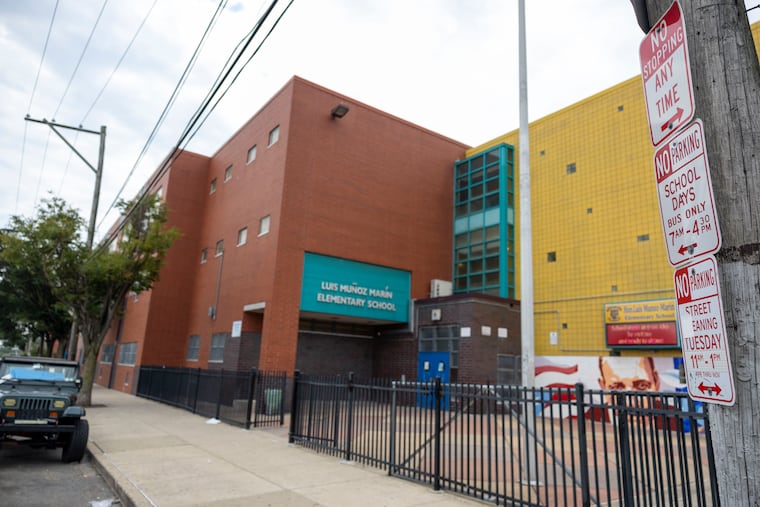
Parking is also a perpetual worry at Muñoz-Marín Elementary at Third and Ontario Streets in North Philadelphia, said Jennifer Goldman, a veteran teacher there. Muñoz-Marín has a lot, but it’s not nearly large enough for all staff at the 500-student school.
Compounding the problem, Goldman said, is a vacant parcel adjacent to Muñoz-Marín’s parking lot — people dump trash there, and it’s smelly and not usable.
“It’s awful parking around here,” Goldman said. “We just have to circle — it’s a race to find a spot, and sometimes people are late. Residents have started [putting cones in] their spots.”
Educators working in neighborhoods around the city struggle with parking, with teachers at schools including Bache-Martin in Fairmount, Fanny Jackson Coppin and Southwark in South Philadelphia, and Robert Morris in North Philadelphia raising the issues to an Inquirer reporter.
‘It should not be this difficult’
There’s some precedent for school parking help.
Councilmember Jamie Gauthier paved a way for special parking permits for teachers at Powel Elementary in West Philadelphia. (The same permits are not available to Science Leadership Academy Middle School staffers, who work in the same building.)
The permits are not free: The cost is roughly similar to the price of a monthly transit pass.
Palumbo’s parent group wants a similar option for their teachers and staff, but three years of efforts have yielded only frustration, its leaders said. They’ve been shuffled from bureaucrat to bureaucrat, and ultimately have been told the person who can make it happen is City Council President Kenyatta Johnson, whose district includes Palumbo.
Vincent Thompson, Johnson’s spokesperson, said Johnson understands parent and staff concerns but “at the same time, any discussion of changes to parking policy must consider the impact on the broader community” — the Philadelphia Parking Authority, neighbors, and residents who would be affected by turning some spaces into school staff permit parking during school hours.
“Council President Johnson and his district office are willing to work with the Philadelphia Federation of Teachers to find thoughtful, practical solutions to parking challenges around our schools in the Second Councilmanic District,” Thompson said in a statement.
The Philadelphia School District did not respond to a request for comment.
Martin O’Rourke, a spokesperson for the PPA, said it “does its best to assist whenever possible, recognizing the delicate balance that exists among residents, businesses, visitors and teachers necessary to manage and share the limited curb space available for parking in many neighborhoods near local schools.”
It’s frustrating to Julie Kaeli, the former Palumbo HSA president, that three years of “begging and nagging” Johnson’s office and others on behalf of students and teachers has led nowhere, she said.
“They’re giving us lip service,” Kaeli said. “It’s so clear to us that they are no interested in addressing this issue. Our school is highly ranked, our teachers are amazing and so dedicated. We know what little resources and support they have. This is such an easy fix; it should not be this difficult.”
‘Parking was a must have’
The lack of adequate parking for staff has consequences, according to educators and those who support them.
“For me, parking was a must have when deciding on a school,” said Cathy Provenzano, who recently retired from teaching at Hill-Freedman World Academy in East Mount Airy. Hill-Freedman has a large lot.
Parking problems have scared off teachers who were otherwise interested in coming to Palumbo, too.
“Each year when interviewing potential new staff, the school may be interested in offering a position to a candidate, but candidates turn down offers because of the lack of parking,” the school HSA said in a statement. “With the teacher shortages the district has had, this is not ideal.”
A teacher at a Kensington school has dealt with a lack of parking lot for years. But it’s gotten tougher to park in the neighborhood, and she’s at her wit’s end, she said. The teacher requested her name be withheld because she feared reprisal.
“I’ve been at my school for over 10 years and have never considered leaving until the first day of school this year,” the teacher said. “I drove around for about 35 minutes, trying to find parking.”
She ended up clocking in late.
“Our students deserve high-quality educators, but us not having a parking lot is a huge deterrent for many people,” she said. “While we are lucky to have several staff members at our school that have been there for five or more years, we also have had a higher turnover in the years since street cleaning became a thing. Teachers don’t want to spend extra time driving around to find parking. That time is meant to be preparing for our student, to make sure that they’re getting the education they deserve.”