A stray bullet paralyzed a Philly woman from the waist down. Now she surfs, teaches, and advocates for accessibility.
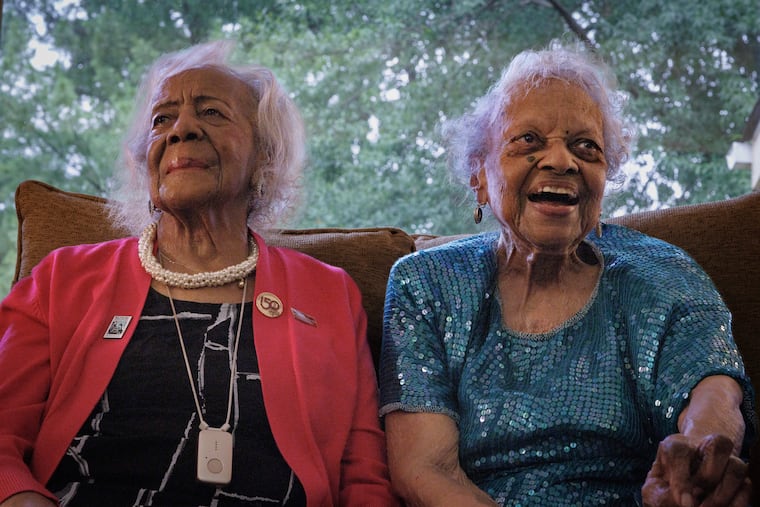
Amanda Parezo has represented Pa. in Ms. Wheelchair USA, serves on the Pennsylvania Governor’s Advisory Commission for Women, and teaches occupational therapy at Jefferson.
Amanda Parezo, a self-professed “beach bum,” can no longer get onto the sand or lay out a beach blanket on her own.
The loose grains are “just impossible to navigate through” in a wheelchair, she said.
Still, she seizes every opportunity to return to the Shore — an activity that has brought her healing since her childhood in New Jersey.
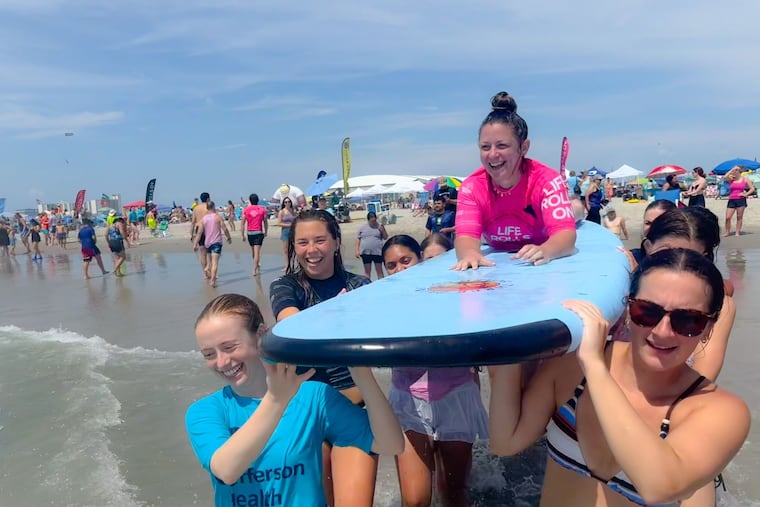
Five years after a random shooting in Olde Kensington left her paralyzed from the waist down, she participated in “They Will Surf Again,” an adaptive surfing event in August in Wildwood, N.J. Designed for people with physical disabilities, the event was hosted by California-based nonprofit Life Rolls On and sponsored by Jefferson Health.
Volunteers and friends helped her onto an adaptive surfboard that was wider and thicker for greater stability.
The first time she participated in 2022, she was afraid of how her legs might shift while riding. But whenever she fell off the board, volunteers scooped her back up immediately.
Parezo loved the feeling and energy of going fast in the wave. That sensory experience brought her relief as someone living with constant nerve pain.
“You can’t even describe it. It just felt so good,” she said of the summer surf event.
In the years since her life-altering injury, Parezo has had to take similar leaps of faith as she’s worked to rebuild her life.
She now had to worry about how she would shower, use the bathroom, drive, and simply enter public spaces while in a wheelchair. An assistant professor of occupational therapy at Jefferson, Parezo was used to helping patients, not being one herself.
“It was a lot of just mourning who I was before,” she said.
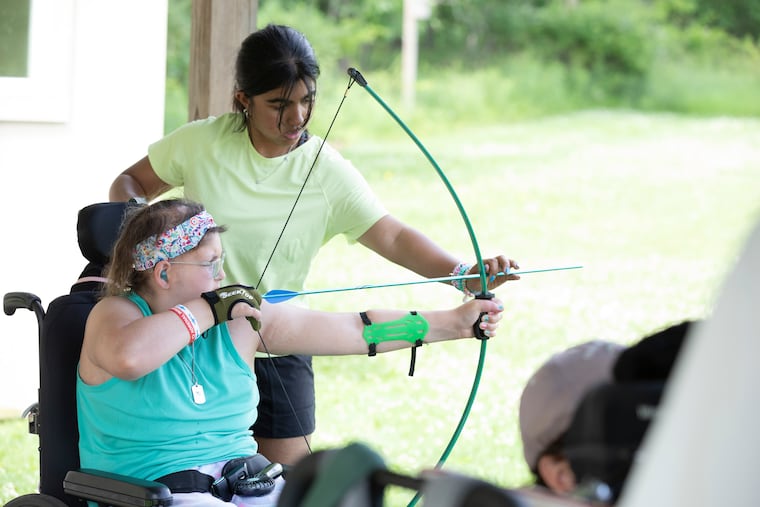
In the process, she has become an accessibility advocate, competed in a pageant for women who use wheelchairs, and taken on adaptive sports from surfing to chair yoga.
She says her former patients are her biggest motivators.
“I think about them every day,” said Parezo, now 40. “I haven’t forgotten a single one of them that I’ve treated in outpatient.”
The injury
On the evening of the shooting in 2021, Parezo, then 36, had just finished playing a game of kickball at Hancock Playground in Olde Kensington with her friends. They were sitting near the benches, chatting and packing up, when gunshots from a nearby shooting suddenly rang out.
As her teammates ducked for cover, she felt a stinging sensation enter the right side of her body, just below her ribs. Parezo immediately fell backward as a wave of numbness swept from her hips down into her toes.
In that split second, a series of images flashed through her mind.
She saw patients she had treated as an occupational therapist. She saw herself sitting in a classroom, studying a PowerPoint slide about spinal cord injuries. And she imagined herself in a wheelchair.
“There was no doubt in my mind that I had a spinal cord injury, and I knew it was bad,” she said.
She screamed in pain as everything the stray bullet touched started to dysfunction. Authorities have not identified the shooter.
At Temple University Hospital, she would be diagnosed with a complete spinal cord injury, leaving her paralyzed from the waist down.
“You don’t think you’re going to have to spend the rest of your life in a wheelchair the next day,” Parezo said.
Although she knew a yoga studio near her Old City home offered chair yoga, she was intimidated by the idea of going. She worried she would feel upset seeing women whose bodies looked like hers before her injury, wearing the outfits she once wore and attending 6 a.m. yoga classes, as she once had.
Then she attended an open house for the studio.
“They were just phenomenal women,” she said.
Now, she goes every Monday and is good friends with the instructor.
Parezo said she is grateful for the people in her life who encouraged her to get out of bed and do things.
She thought about a patient who had been shot in the head but continued coming to her clinic every other day for occupational therapy. If the patient could remain motivated after such a traumatic experience, Parezo thought, she needed to be motivated, too.
“I am just so grateful for my background, and just the irony of being on the other side of things,” Parezo said.
Advocating for accessibility
Parezo frequently encounters accessibility challenges in her daily life.
But she has turned those stressful moments into opportunities for advocacy, through posting to social media and reporting issues around the city to 311, the non-emergency contact center.
When Parezo arrived at a SEPTA subway station in 2024, she discovered the elevator down to the street level was broken.
The station had three flights of stairs, but no signage indicating that the elevator was out of service. SEPTA’s app also hadn’t marked the elevator as inoperable.
She posted a video to Instagram of her stuck in the station, in tears, frustrated by the lack of accessibility. That post went semi-viral on Instagram and caught the attention of SEPTA, who reached out for a conversation about her concerns.
“As we continue work to improve accessibility across the system, SEPTA is committed to working closely with riders to help them navigate outages and other challenges,” a spokesperson said in a Friday statement.
SEPTA recently began its latest accessibility improvement project at 11th Street Station on the L, and will invest more than $700 million to make Metro and Regional Rail stations accessible.
Her friend Katie Adams recalls seeing Parezo bump off curbs and nearly fall into traffic because of obstacles on the sidewalk.
“Never in my wildest dreams [did I think] anyone in this situation would turn this around and make this not a life-defining moment, but a lifelong work and advocacy,” Adams said about Parezo.
In July, Parezo represented the state of Pennsylvania in the Ms. Wheelchair USA pageant.
She was named first runner-up and received awards for education and inspiration. She also serves on the Pennsylvania Governor’s Advisory Commission for Women and draws on her experience as a wheelchair user to teach her occupational therapy students at Jefferson.
“Having to live the life of a patient that they might treat [gives] me a perspective I can share with my students that a lot of people probably couldn’t,” Parezo said.
Finding relief in surfing
Life Rolls On founder Jesse Billauer started the “They Will Surf Again” event 25 years ago after a surfing injury left him quadriplegic.
The first time his friends took him surfing after the accident, he experienced “that freedom, that independence, and just joy being on the water.”
The event became his way of sharing that sense of freedom with other people with spinal cord injuries and physical disabilities.
“It just gets people out of their wheelchair, doing things that they never thought was possible,” he said.
A little boy born with a spinal cord injury was among the 150 participants at this year’s event in Wildwood.
Parezo, who knows the boy’s mother, hopes seeing older participants with disabilities surfing will inspire him as he grows up.
“There are no limits to what we’re able to do,” she said.