A new streaming documentary tells the story of America’s founding through the eyes of Black Philadelphians
'Becoming American: Philadelphia’s Story' tells a story that would not have been possible to tell 50 years ago.
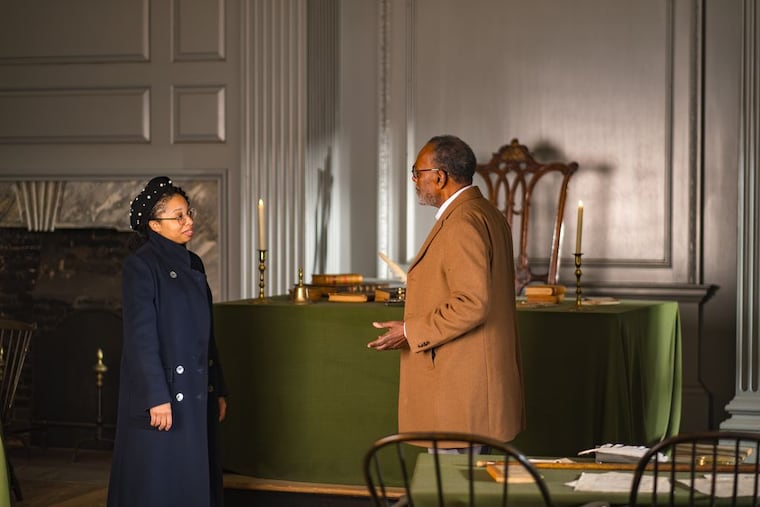
It’s a story about America’s founding that doesn’t begin in a Philadelphia state house — but on a rancid English slave ship sailing for Pennsylvania shores. It’s a story about the bustling slave auctions that once occupied the cobblestones outside the Old London Coffee House, while patriots plotted insurrection inside the Old City shop. A story about countless Black Philadelphians who sacrificed their own lives to a Yellow Fever epidemic — nursing dying victims and hauling the dead — to prove their worth to white Philadelphia residents.
Becoming American: Philadelphia’s Story, a new documentary now streaming on PBS.org, tells the story of Philadelphia and the creation of America through the lens and experiences of Black Philadelphians.
“At its core, this film is about people,” said executive producer Oliver St. Clair Franklin. “Those whose stories have too often gone untold — and the city that brought them together.”
While telling the sweeping story of America’s founding in its 250th year, the film stays firmly rooted in colonial Philadelphia neighborhoods, and the lives of lesser known activists and artisans who shaped the republic — and the age.
People like Anthony Benezet, a French born abolitionist who formed the African Free School out of his Chestnut Street home in 1770. Cyrus Bustill, a revolutionary-era Philly brewer and baker, who helped found the Philadelphia Free African Society. And the soaring lives of Richard Allen and Absalom Jones, pioneering Philadelphia abolitionists and rights leaders, both born into slavery.
“I wanted to tell the story that would connect African Americans to the founding era,” said Franklin, 80, scholar and former chief arts and cultural official for the city of Philadelphia. “In the process of doing this film, I realized that it will connect a lot of people to the founding because its a story of resistance and resilience.”
Franklin, who grew up in Baltimore, attended Lincoln University before earning a bachelor’s of philosophy in economics from Balliol College at University of Oxford in 1970. For years, he served as Philly’s chief British delegate.
Produced jointly with Bear House Media, a UK-based television production company, the film explores the nation’s origins through the racially diverse melting pot of colonial Philadelphia — its first makeshift capital and meeting points of cultures, ideas, and identities. And home to a vibrant free Black community fighting on the front lines for America’s freedom — and their own.
“I couldn’t have done this film 50 years ago,” said Franklin, crediting recent decades of research into the experiences of revolutionary-era Black Americans. “It makes it possible to tell a really coherent story — a human story — that touches everybody.”
In his film, bursting with Philly voices like historians Kelli Racine Barnes, a Mellon Humanities Postdoctoral Fellow, and Emma Lapsansky-Werner, a visiting professor of history at Haverford College, those human stories are often about ordinary Philadelphians. Free, enslaved, Native, and immigrant people all doing extraordinary things for freedom.
“We focus on the lesser known stories of individuals, whose dreams and challenges we explore at the ground level,” he said.
