Auto industry faring better than steel did under Bush
The steel industry and the auto industry have few rivals in their ability to stir political passions in the United States.
The steel industry and the auto industry have few rivals in their ability to stir political passions in the United States.
The auto industry has the spotlight now, and President Obama has responded forcefully, orchestrating the bankruptcy of Chrysler L.L.C. in a deal widely viewed as favorable to the United Auto Workers.
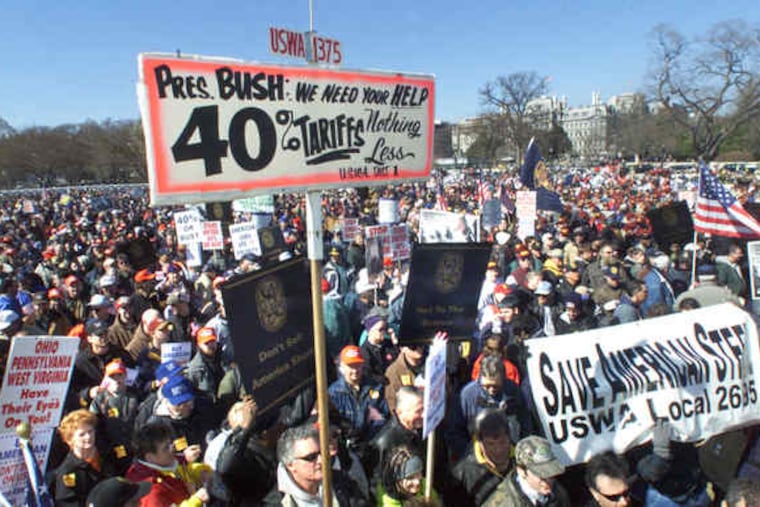
Early in George W. Bush's first term as president, it was the steel industry that was in crisis, and Bush outraged many supporters and economists when, under political pressure, he agreed to put tariffs on steel imports.
But that move came in March 2002, after Bethlehem Steel Corp. and dozens of other steelmakers had gone into bankruptcy, where they dumped pensions and health coverage for as many as 350,000 retirees. Many of the firms were bought cheaply out of bankruptcy and consolidated into leaner operations.
By contrast, Obama's Chrysler bankruptcy deal included a $4.6 billion note and 55 percent of the stock in a reorganized Chrysler to cover retirees' health care. Pensions were left untouched. (A General Motors Corp. deal is in the works.)
Bush's and Obama's approaches are like "night and day," said Lester B. Lave, an economics professor at Carnegie Mellon University in Pittsburgh. He and other experts said autoworkers were having an easier time of it now than steelworkers did earlier this decade.
"In the reorganization, the unions are getting the best deal," Lave said.
Asked about that view, United Steelworkers of America president Leo Gerard said in an interview Friday: "We never had the opportunity of having a president on our side."
Some economists worry that the Obama administration's approach will not succeed because it does not do enough to reduce legacy costs.
Chrysler is "not going to be competitive with the deal Obama cooked up," said Peter Morici, an economist at the University of Maryland. "In the steel bankruptcy, they got rid of all that stuff. In this bankruptcy, they are not."
Nariman Behravesh, chief economist at IHS Global Insight Inc., of Lexington, Mass., said that "we can debate whether the unions and management should be saved from themselves," but the fact is that the economic context for the automotive crisis is very different from that of the early 2000s' steel crisis.
"The worst recession since World War II is not the time to exercise tough love," Behravesh said.
Striking similarities beyond their psychological value to the American people and the weight of their legacy costs exist between the problems of the steel and auto industries, analysts said.
Both have been hammered by what unions and others would call unfair competition from Asia. Both have also suffered from domestic, nonunion competition.
In steel, it was new mini-mills whose costs were lower because they made their product from scrap rather than ore, as the traditional integrated steelmakers did.
For the Big Three automakers, now more commonly called the Detroit Three, it was so-called transplants such as Honda and Toyota, which spent billions on factories to build cars in the United States that would supplement their imports.
In the early 2000s, the biggest integrated steel companies - except U.S. Steel - and many smaller competitors went bankrupt.
That was a traumatic period, said Carnegie Mellon's Lave, but the companies that emerged are "now functioning and relatively healthy. It couldn't have happened without bankruptcy."
The former Bethlehem Steel plants in Coatesville and Conshohocken, for example, are now part of Luxembourg-based ArcelorMittal, the largest steel company in the world.
The current economic downturn has slowed work at the two plants, but workers there enjoyed six strong years, union officials said.
The Coatesville plant, where iron and steel have been made since 1810, employs 715 steelworkers, with 80 laid off right now, said Bill Sharp, president of United Steelworkers Amalgamated Local 1165.
At ArcelorMittal's rolling mill in Conshohocken, 95 of 321 members of United Steelworkers Local 9462 are laid off because of weak demand, said Ron Davis, the union grievance chairman. Since the Bethlehem Steel bankruptcy, wages and benefits either went up or stayed the same. In September, steelworkers got what Davis called the best contract ever.
None of that would have happened if Bethlehem Steel had not shed billions in legacy costs for pensions and retirees' health insurance, analysts said.
Bethlehem Steel's pensions were underfunded by $4.3 billion when taken over by the federal Pension Benefit Guaranty Corp. The fund to pay health-care benefits for 95,000 retirees and their dependents was $3 billion short.
Eliminating the benefits plunged retirees and widows of retirees into a world of worry over how they would afford insurance. Sharp, the union president, estimated that many workers who had a pension coming faced cuts in their monthly checks of $500 to $1,000, depending on years of service.
The Obama administration and the UAW have tried to avoid such a drastic purging of legacy costs. Under the Chrysler reorganization plan, which needs Bankruptcy Court approval, retirees are losing dental and vision insurance and will have to pay higher co-pays for drugs.
Pensions are unchanged, for now.
"Right now, the solution avoids what the steel industry went through," said Behravesh, the Global Insight economist. "But that might happen down the road."