Editorial: Open the debate
One of the most momentous House-Senate negotiations in history shouldn't take place behind closed doors. Yet that's what could happen when lawmakers meet with the Obama administration to reconcile different versions of the landmark $871 billion health-care reform bill, approved by the Senate on Christmas Eve.
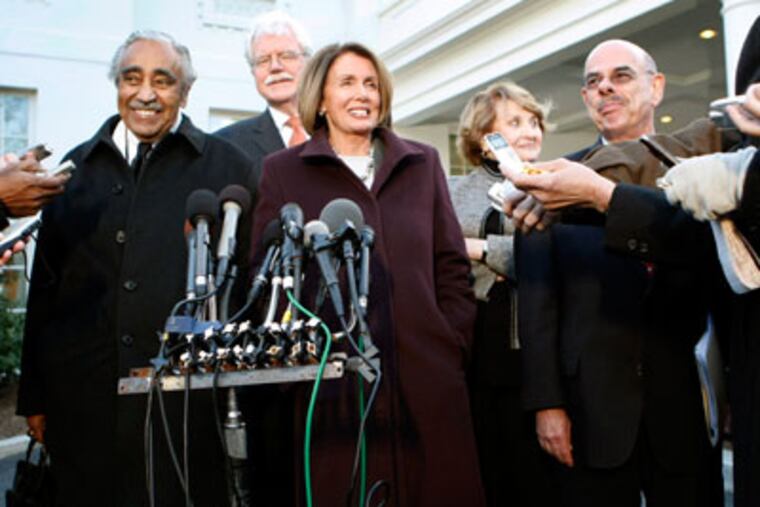
One of the most momentous House-Senate negotiations in history shouldn't take place behind closed doors.
Yet that's what could happen when lawmakers meet with the Obama administration to reconcile different versions of the landmark $871 billion health-care reform bill, approved by the Senate on Christmas Eve.
Speaker Nancy Pelosi (D., Calif.), Senate Majority Leader Harry Reid (D., Nev.), and President Obama should keep talks open. After all, during his campaign, Obama did pledge that the health-care negotiations would be televised on C-SPAN.
Ordinarily, when the House and Senate approve different versions of legislation, leaders of both parties in each chamber appoint negotiators to work on a conference committee. That panel then hashes out the final details of the bill, usually in secret.
On the health-care bill, Republican lawmakers are vowing to block a conference committee with procedural moves. No Senate Republicans voted for the legislation; only one House Republican did.
Democrats, in turn, are looking for ways to bypass the traditional conference committee process. That would probably include three-way negotiations among the president, House Democrats, and Senate Democrats. Top congressional Democrats held an initial meeting with the president on Tuesday.
Obama earlier said these talks could take place among "a whole bunch of folks over here in the West Wing" at the White House. And his spokesman has strongly suggested such negotiations would occur behind closed doors. Then they would present the bill to the House and Senate for final passage.
That would be the wrong way to conclude such an important piece of legislation. C-SPAN CEO Brian Lamb has asked congressional leaders to open the talks to his network's cameras. He's right. These negotiations should be open to the public, as Obama promised before he was elected.
Simply because congressional leaders traditionally run conference committees in secrecy doesn't make it right. This legislation would affect a huge segment of the public. There is already more than enough behind-the-scenes bargaining taking place daily in Washington among lobbyists and policymakers.
Important differences remain to be worked out in the House and Senate bills. The House version contains a government-run "public option," while the Senate bill calls for insurance exchanges. The House would add an income surtax on the wealthy; the Senate would tax high-cost insurance plans. The House version contains tighter restrictions on abortion coverage.
C-SPAN and other media were able to cover the debate on these issues as the House and Senate worked on their bills over the last several months. That access shouldn't be shut down, now that the final product is nearly at hand.