Abington is voting on a surveillance system to replace Flock this week
Abington is set to vote Thursday on a new surveillance camera system to replace Flock. But one of the township's Flock contracts will remain until 2028, an officer said: "We can’t get out of it."
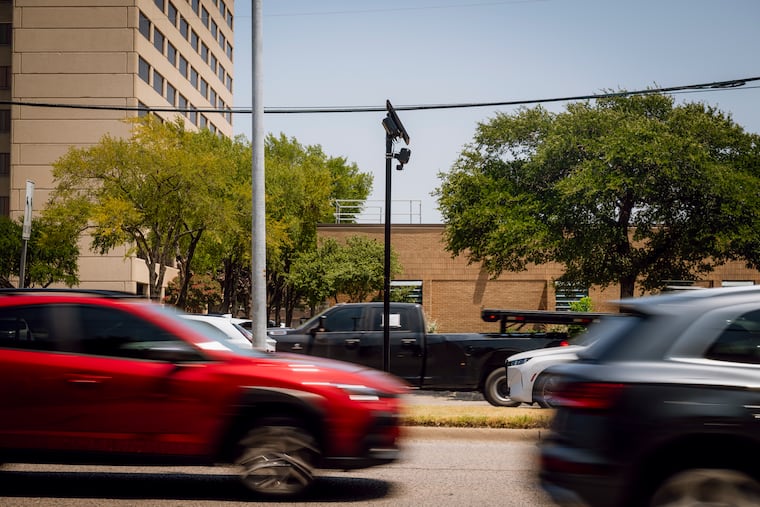
Abington Township commissioners are set to vote Thursday on a contract to replace the police department’s controversial Flock Safety surveillance system.
The new, five-year contract with Axon Enterprise would cost $6,576.50 per year and includes two cameras with accessories, installation fees, two licenses for Axon’s automated license plate recognition tool, and warranties for accidental damage or vandalism.
Both Flock and Axon systems aim to store photos of every vehicle that passes their cameras, along with the plate number and other details, for a set period of time. The systems also allow police to search camera data from other jurisdictions, which Abington police say helps solve crimes.
But Flock’s network design and vulnerabilities are leading Abington police to let their Flock contracts expire over data security concerns after the department’s searches on the company’s nationwide network leaked, along with searches by other police departments across the country.
“Flock had told us before that we own the data. Somehow, that turned out not to be the case,” Lt. Joe Blei said Monday.
Abington police will still have access to Flock’s network until the township’s second Flock contract expires in 2028, Blei said, and Abington cannot terminate it early. Its other contract expired this month.
“It’s the terms and conditions,” Blei said. “We can’t get out of it.”
Blei said the department fulfilled The Inquirer’s request for Abington’s Flock contracts last week, but the newspaper still had not received those records from the township by Monday. The township’s Right-to-Know officer did not return calls and emails.
The Axon cameras are set to arrive in mid-September, if approved, and access to Axon’s ALPR tool would begin on Oct. 15, according to the pending contract.
How Abington plans to use new ALPR cameras
The new Axon camera system, known as Axon Outpost, would not connect to Flock’s network. That is part of the appeal, Blei said: “Axon has a much clearer structure for how that data continues to belong to us.”
Axon puts more limits on data sharing so that Abington’s data are not duplicated in the systems of law enforcement agencies that Abington shares information with, Blei said. One of the ways that Abington’s Flock data had leaked was through records requests to police in other states.
The new cameras would also integrate well with the department’s existing Axon technology, officers wrote in an agenda memo for Thursday’s commissioners’ meeting.
Although the Outpost system has a livestream feature, Abington police will not be monitoring feeds in real time, Blei said. Instead, police will search data associated with a specific criminal investigation, as the department has done with Flock.
The department would check officers’ Axon searches randomly, Blei said, and Abington is considering instituting scheduled audits in addition to the random checks.
Oversight is critical, Abington officer says
Police departments in New York, Arizona, and Colorado in recent months have begun swapping Flock for Axon, a company that already supplies body cameras and Tasers for many departments.
But civil liberties groups have continued to raise concerns that without adequate regulation, other systems like Axon still present privacy risks.
Abington will prevent overreach by continuing to log, audit, and limit the department’s searches, Blei said.
“We are not doing generalized surveillance,” he said. “We are only accessing information for very specific reasons.”
The American Civil Liberties Union has criticized the data retention settings on some ALPR systems because of how much information long-term storage could reveal about private citizens, and recommends a 48-hour cap for mass data retention.
Abington police are about to implement a data retention limit of 30 days, Blei said, for data that are not being used in a criminal investigation.
While storing large quantities of accurate information has raised concerns, collecting erroneous data has also caused problems: An analysis by a California police department found that alerts Flock sent their officers in 2023 and 2024 about vehicles that were stolen or used in a crime were wrong more than 70% of the time.
Faulty ALPR readings can lead to unrelated cars getting flagged repeatedly, as happened in the California department. In Florida, a woman spent almost two weeks in jail this year after a Flock camera wrongly tied her car to a fatal hit-and-run.
Abington does not yet have accuracy data from Axon, Blei said, but township police would not act on a camera notification without manually checking the photo of the plate themselves.
“These cameras are not probable cause for us,” Blei said.

Inquirer Greater Abington
This suburban content is produced with support from the Leslie Miller and Richard Worley Foundation and The Lenfest Institute for Journalism. Editorial content is created independently of the project donors. Gifts to support The Inquirer’s high-impact journalism can be made at inquirer.com/donate. A list of Lenfest Institute donors can be found at lenfestinstitute.org/supporters.