‘I knew she was gone’: Police say at least two missing women likely killed inside Olney home linked to violent pornography
Maribel Fresses and Gabrielle Amarando had struggled with drugs, their families said. Their bodies have not been found.
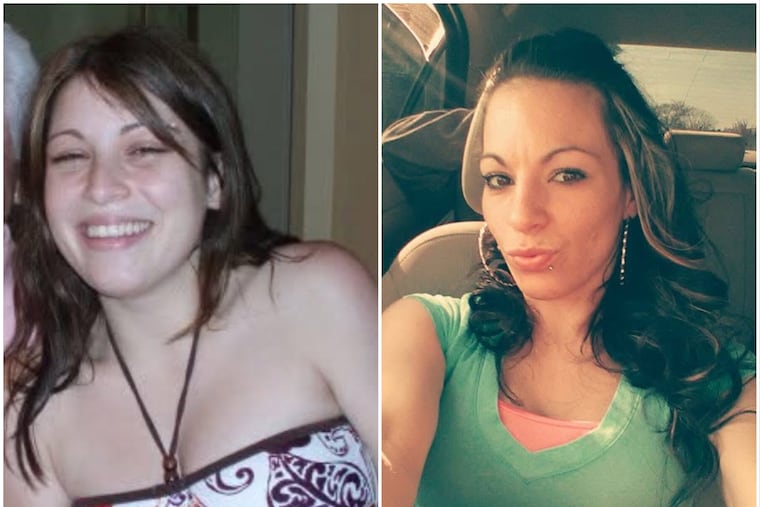
Philadelphia police now believe at least two women were killed inside the decrepit Olney home at the center of a sprawling missing persons investigation, officials said Wednesday — a stunning breakthrough in a probe that began nearly two months ago after a chance encounter near Independence Mall.
Inspector Raymond Evers said homicide detectives had recovered photos and videos on hard drives inside the home that appeared to show the deaths of two women who had been reported missing — neither of whom had been previously linked to the case.
Evers identified the women as Maribel Fresses, who was 27 when she was reported missing in February 2018, and Gabrielle Amarando, who went missing in September 2012 at the age of 22.
The announcement at a Wednesday news conference was the latest and most striking development in a case that has drawn national attention since police launched an investigation in June into the disappearances of two other women last seen at the home of Eugene Albert Horsch, 44, and his late father, Raymond “R.C.” Horsch.
Evers said the two-month search of the home, on the 400 block of West Chew Avenue, involved over 95 search warrants and surfaced an “astonishing” array of evidence: five urns of cremated remains, more than 20 containers full of unknown chemicals and oily substances, and 50 hard drives and other electronic devices holding more than 600,000 images, 70,000 videos, and 10,000 pages of writings and drawings.
» READ MORE: DARK ARTS A pornographer’s obsession and criminal past blur fact and fiction in Philly’s missing women mystery
Inside one of those hard drives, Evers said, detectives found images and videos that appeared to show Fresses and Amarando alive inside the house — followed by “graphic and dark” depictions of what appeared to be their dead bodies.
But the investigation is complicated, he said, because police have not recovered any human remains inside the home. And forensic tests of the substances in the basement, and of what initially appeared to be blood inside the house, did not test positive for human blood or DNA, law enforcement sources have said.
Without the bodies, he said, the Philadelphia Office of the Medical Examiner cannot officially declare the women dead. He said the case would likely have to go through Orphans’ Court.
Still, he said, the medical examiner’s office said that “if the images and the video are real and not altered in any way,” the women are dead.
Police are still working to determine when the women died.
Eugene Horsch has not been charged with any crimes connected to the women’s deaths or disappearances. Evers declined to say whether investigators believed he — or his father, a creator of erotic and pornographic art — may have been involved.
“Eugene lived there. He lived there for a long time. His dad lived there for a long time,” Evers said when asked about their possible connection to the deaths.
He said investigators had reviewed only about 5% of the digital materials so far and had hundreds of thousands more to go through.
A lawyer for Eugene Horsch did not immediately respond to a request for comment Wednesday.
The missing women
Police said they notified the families of Fresses and Amarando on Wednesday morning.
Ricardo Fresses, 61, said that, in his gut, he had known his daughter, Maribel, or “Bella,” was dead.
“She called me every day. Absolutely every day she called me, and one day she stopped calling me,” he said. “And as the years went by I knew she was gone.“
His daughter grew up in Holland, Bucks County, he said, and started using drugs in high school.
“She was a beautiful girl, a loving girl, always daddy’s girl,” he said, even as she slipped into opioid addiction.
He last saw her on June 19, 2018. They met for a slice of pizza in Kensington, and he gave her $50. He never heard from her again. He reported her missing shortly after.
“It’s a horrible situation that my family has to go through,” he said about what police found inside the hard drive.
Amarando’s family said the news followed 14 years of hope that she might finally turn up.
”I’m just so devastated. This brings some closure, but it still hurts," said Lora Timmons, Amarando’s stepmother. “She was a sweet little girl. She was always just such fun to be with. She and her father were best friends.”
Timmons said Amarando, who grew up in Doylestown, had been interested in modeling from a young age but “always found the wrong crowd.” She had struggled with addiction since she was a teen, her stepmother said.
Amarando would often come to visit Timmons, who lives in North Carolina, and her sisters, but they lost contact in September 2012.
”She just went away,“ she said. “We searched here and there but we never found her. … We always thought she was just off doing her drug thing, living her life.”
Timmons had not heard of the Horsches until Wednesday.
”I always hoped I’d see her again," she said. “I didn’t want to think the worst.”
Police declined to say how the women might have known Raymond or Eugene Horsch.
For decades before his death, Raymond Horsch offered drugs, cash, and shelter to women struggling with addiction, in exchange for nude photo and video shoots. Horsch’s visual works featured graphic violence — and sometimes death scenes. He also penned semi-autobiographical novels featuring serial killers who preyed on women in addiction.
How the case began
Wednesday’s developments came nearly two months after police began combing through the Horsch home in connection with at least two other missing women, following a chance encounter near Independence Mall.
On June 19, a U.S. park ranger saw Eugene Horsch and a woman acting suspiciously inside his parked BMW. After searching the car, the officer found drugs, guns, and various other weapons, along with a counterfeit U.S. Drug Enforcement Administration badge.
The woman with Horsch was also found with a fake ID in the name of Blair Tonzelli, a woman who was reported missing in 2023 and last seen at Horsch’s Olney home.
» READ MORE: She disappeared from Kensington three years ago. A fake ID in her name led police to a disturbing Olney house.
That also renewed suspicions about Horsch’s father, who died in May 2025. Raymond Horsch’s ex-wife, Amy McHale, was reported missing in 2016 and last heard from at the Chew Avenue house.
A witness later told police that Tonzelli was a home healthcare aide who had worked for Horsch’s father, and that she believed Tonzelli and Eugene Horsch had a disagreement over money, according to law enforcement sources.
Investigators interviewed people who knew Horsch and were told that, in the past, he had bragged about killing people and melting their bodies with chemicals in his basement, said the sources, who spoke on the condition of anonymity to discuss an ongoing investigation. Horsch, they said, said he could make a body so small it “could be flushed down a toilet.”
Since the June arrest, Horsch has remained in federal custody on charges related to illegal gun possession. Police continued to search the Olney home in hopes of learning the whereabouts of Tonzelli and McHale.
They went so far as to excavate the home’s yard and remove a pipe to test for DNA.
FBI agents, meanwhile, continued examining hundreds of pages of text messages, handwritten and typed documents, CDs, and videos — including many of Raymond Horsch’s artistic works.
It was in there, police said, that there was evidence of Fresses’ and Amarando’s deaths.
Fresses’ father said the discovery confirmed his worst fears. For months, years even, he said, he would wake up in the middle of the night and drive through Kensington. He would look into the faces of the women on the streets, hoping he would see his Bella.
“But I was just hurting myself because I knew she was gone,” he said. “I knew in my heart that my daughter was not around anymore.“

The Inquirer’s journalism is supported, in part, by the Lenfest Institute for Journalism and readers like you. News and editorial content are created independently of The Inquirer’s donors. Gifts to support The Inquirer’s high-impact journalism can be made at inquirer.com/donate. A list of Lenfest Institute donors can be found at lenfestinstitute.org/supporters.