Oil flows are up, but Iran is still menacing the Strait of Hormuz
Iran has been launching dozens of drones and missiles at commercial ships in the strait each week, largely out of the public eye, though it has often failed to strike its targets.
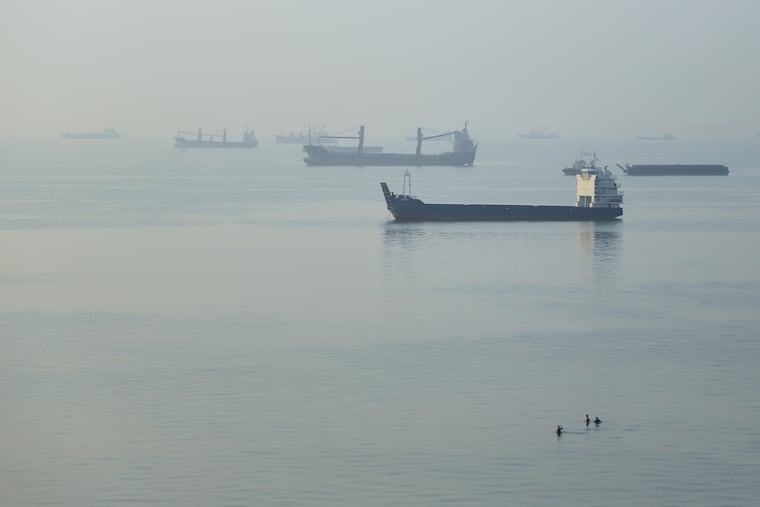
Almost every day in September, Iranian media outlets have published reports of explosions “heard from the sea,” an ominous sign that military activity is taking place in the Strait of Hormuz.
But the reports left mysterious just who was carrying out the attacks.
It turns out it was Iran itself.
Confidential data shared with The New York Times by a Western security official who spoke on condition of anonymity to discuss operational matters shows that Iran has been launching dozens of drones and missiles at commercial ships in the strait each week, largely out of the public eye, though it has often failed to strike its targets.
And on Wednesday, Iran’s Revolutionary Guard for the first time appeared to confirm it was behind the near-daily sounds of explosions heard from Iran’s southern coast, saying it was striking targets in the Strait of Hormuz every 24 hours.
“We prevent them from passing, but for some time now, America has not responded,” a spokesperson for the Revolutionary Guard said in a state news interview.
The aggression shows that even as oil exports from the Middle East have rebounded in recent weeks, shipping through the waterway remains risky, as Iran jostles to keep control of one of its biggest sources of leverage.
“Negotiations aren’t going anywhere. Neither side is really budging. So it’s a standoff,” said Gregory Brew, an Iran analyst at the Eurasia Group. He said that the violence in the strait “speaks to the position that both sides are in: Neither is looking to aggressively escalate the conflict.” But both, he said, want to control the waterway.
Since the beginning of August, Iran has launched about 30 drone attacks and 10 anti-ship missile attacks per week against commercial ships transiting the Strait of Hormuz, according to the data shared with the Times by the Western security official. At least four commercial ships have been hit by Iran in the past 10 days, the official said.
A tally of reports by a monitoring group run by the British navy show that since Sept. 10, at least 13 ships, most of them oil tankers, had been struck by projectiles or debris from projectiles. (Those reports may be incomplete because they are based on voluntary reports by ship crews.) While the reports do not specify who was responsible for the attacks, maritime experts say the details suggest many were Iranian.
The attacks in the strait have kept up even as crude oil exports from the Middle East have gotten closer to prewar levels. Part of that turnaround, analysts say, is because of a U.S. military operation aimed at protecting the vessels from the attacks, an effort that appears to have encouraged more shipments from big exporting countries, such as Saudi Arabia and the United Arab Emirates.
Those ships pass through Oman’s territorial waters in a U.S. Navy-guided route, with the support of U.S. fighter jets and attack helicopters to help ward off strikes. Some ships also turn their transponders off to help pass through the strait undetected.
But analysts say U.S. military protection requires significant resources and will be hard to maintain indefinitely. And a big part of the regional increase in exports, according to Kpler, a cargo tracking group, is from export routes that circumvent the Strait of Hormuz altogether.
Just because more ships and oil are moving than seen earlier in the war “doesn’t mean we’re seeing a normalization of flows,” said Ana Subasic, a trade risk analyst at Kpler.
U.S. Central Command, which oversees military operations in the Middle East, declined to comment on Iranian attacks on shipping in the Strait of Hormuz in September. The Pentagon has not announced any strikes on Iran or Iranian vessels since early that month.
Ian Ralby, president of the maritime governance nonprofit group Auxilium Worldwide, said the fact that Washington has appeared not to respond militarily against Iran for its shipping attacks may be a function of the Trump administration’s seeking an off-ramp to the conflict now in its seventh month.
Brew, the Iran analyst, said that with the rise in oil exports, the administration may think it has less to gain from retaliatory strikes.
Ever since the United States and Israel attacked in February and started the war, Iran has used its ability to throttle shipping through Hormuz, a key route for oil and gas exports, disrupting the global economy.
The United States has imposed a naval blockade and tougher sanctions on Iran in retaliation, putting the country under further pressure, as President Donald Trump has sought to pivot the war from a military campaign to one focused on strangling its economy.
This article originally appeared in The New York Times.