Kennedy drew $4 Million in book advances from publisher who also monetized MAHA
Ethics experts said the financial relationships may violate federal rules barring officials from profiting from their government position.
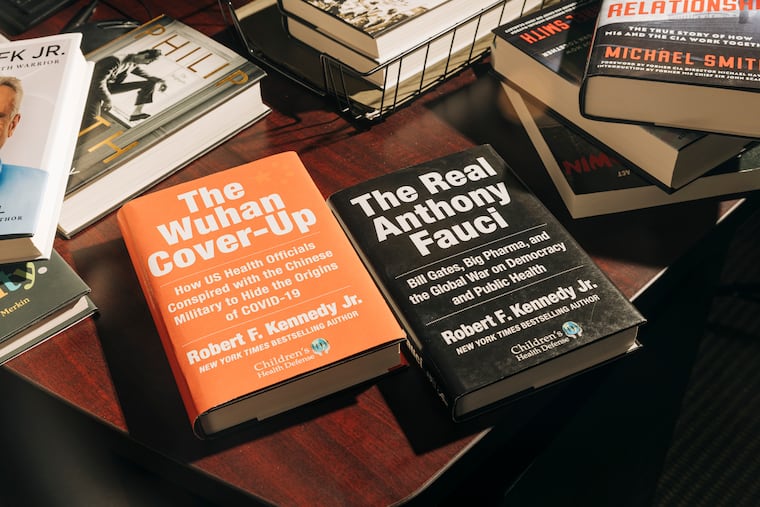
Health Secretary Robert F. Kennedy Jr. accepted $4 million in book advances and more than $270,000 in gifts over the past year from close allies who are working to advance his Make America Healthy Again agenda, according to his latest financial disclosure form.
Ethics experts said the financial relationships may violate federal rules barring officials from profiting from their government position, and call into question the secretary’s ability to remain independent and impartial.
The advances were for two books that will be published by a company owned by Tony Lyons, a longtime friend and business associate of Kennedy who also sits atop a constellation of MAHA-related entities, including some that accept political contributions and corporate sponsorships from health-related companies.
Cheryl Hines, Kennedy’s wife, accepted $210,000 in consulting fees from MAHA Action, a nonprofit advocacy group also led by Lyons. It rallies supporters of Kennedy’s priorities on weekly broadcasts and backs health-related legislation, including a federal bill to end liability protection for vaccine makers.
In an ethics filing before taking office, Kennedy pledged not to “engage in any writing, editing, or promotional activities” associated with the books, but did not promise to forgo advances.
Ethics experts said the payments related to one book called Unsettled Science raised questions since federal rules say that an official may not “receive compensation from any source other than the government” for writing a book related to his official duties while in office. (The other book is called A Defense of Israel.)
Additionally, the consulting fees to Hines from a group aligned with Kennedy’s priorities “reeks of conflict of interest,” and could appear to be a bribe, said Richard Painter, a White House ethics counsel under President George W. Bush.
“You have a situation like this,” he said, “it just looks horrible.”
Emily Hilliard, a spokesperson for the Department of Health and Human Services, said that Kennedy “complies with all applicable federal ethics laws, regulations, and financial disclosure requirements.”
She added: “The secretary works with HHS career ethics officials to ensure that his financial interests, gifts, outside activities, and other reportable matters are appropriately disclosed and handled consistent with those requirements.”
Lyons, who is also a lawyer and one of Kennedy’s staunchest defenders, did not respond to an email and text message seeking comment. Hines could not be reached for comment.
The annual financial disclosure finalized last week also showed that Kennedy accepted $126,000 worth of lodging in a Washington, D.C., home owned by Gavin de Becker, a longtime friend and who runs a security firm that specializes in protecting high-profile people.
Previously, de Becker contributed to Kennedy’s presidential campaign and earned money from it to provide a security detail for Kennedy.
De Becker said that he has no business with the federal government, including the Department of Health and Human Services, and that the arrangement reflected their friendship.
“Bobby is among my closest friends in the world for many years, and I’m grateful to be able to host him anytime,” de Becker said. “He has hosted my family at his homes, he’s stayed at my homes, we take family vacations together every year, and did so for years before he was in his current job.”
This past year, the records show that de Becker also paid for nearly $150,000 in airfares for Kennedy: $45,000 for a trip to Greece in July 2025 and nearly $97,000 for a trip to Fiji in November. The flights and book advances were reported earlier by The Wall Street Journal.
Kedric Payne, a vice president and senior ethics counsel at the Campaign Legal Center, said there were exceptions to federal rules for gifts from friends. But de Becker’s patronage appears to far exceed them, he said.
“Lavish gifts to an official from major political donors don’t get the same benefit of the doubt as dinner from a former classmate,” Payne said. “The public deserves full transparency about the nature of these gifts and any interests the donor has before the government.”
Like Lyons, who has a child with autism, de Becker shares Kennedy’s skepticism about the safety of vaccines and has a longstanding publishing relationship with Lyons.
De Becker has written several books on security but recently began writing about vaccines. His 2025 book, Forbidden Facts: Government Deceit & Suppression About Brain Damage From Childhood Vaccines, was published by Skyhorse, which is owned by Lyons. He has also written the foreword to two books about ketamine, a psychedelic drug that Kennedy has promoted as a therapy for depression.
Kathleen Clark, an expert in government ethics and a law professor at Washington University in St. Louis, said the gifts created a clear conflict for Kennedy, who oversees an agency reviewing at least one ketamine therapy for approval.
“By accepting such extravagant gifts from someone with a clearly articulated desire for a particular outcome from H.H.S. as a regulatory agency on these issues,” she wrote in an email, “R.F.K. Jr. has completely destroyed any possibility that the public could be confident that any action H.H.S. takes on these issues — childhood vaccines and ketamine — will be based on the public interest, rather than R.F.K. Jr.’s gratitude to and association with this gift giver.”
According to the latest financial filing, Lyons and Kennedy reached an agreement over the book advances in August 2024, the same month that Kennedy dropped his presidential bid and backed President Donald Trump.
Kennedy has written numerous books for Skyhorse Publishing, and worked as a consultant to the company before he became health secretary. In financial disclosures required for his Senate confirmation, Kennedy said he had earned $451,000 as a consultant. Hines also received a $600,000 advance from Skyhorse for her memoir, according to the disclosure.
The disclosure records said that Kennedy would also be paid $10,000 for a third book called America’s Path Back to Moral Leadership and that two of the three books were already written.
As Kennedy prepared to join the Trump administration, Lyons began to build an array of MAHA-allied entities, including the MAHA Center, which recently raised funds by selling corporate sponsorships for the MAHA Summit in Washington next week.
One top sponsor at the event, where senior federal health officials are expected to speak, is the company Grail, which is seeking Food and Drug Administration approval for its multi-cancer blood test. The test performed poorly in detecting cancers in two large studies. Kennedy spoke at last year’s summit.
Lyons also leads the MAHA Institute, which hosted monthly gatherings through much of last year where prospective donors mingled with Kennedy and other top health officials. Many had official business in front of Kennedy’s department.
MAHA Action supports legislation, including a bill introduced this year to end vaccine makers’ protection from traditional liability cases, which are handled in a specialized federal tribunal. Kennedy, who has worked as a plaintiff’s lawyer suing over alleged vaccine injuries, has long denounced the protection granted in a 1986 federal law.
Lyons wears yet another hat as the treasurer of the MAHA political action committee, also allied with Kennedy’s mission, which has raised more than $3 million since January 2025. About one-third of it came from Botanic Tonics, a company founded by Jerry W. Ross, a onetime energy executive who changed his name after pleading guilty to a financial crime.
The New York Times wrote about Ross’ attempts to influence Kennedy and the Trump administration as he successfully sought a prohibition against 7-OH, a gas station drug that competed with his company’s kratom-based drink called Feel Free. Both kratom and 7-OH have drawn widespread complaints over their potential for addiction and severe withdrawal symptoms.
At a Senate hearing last year, Kennedy brushed off criticism from Sen. Christopher S. Murphy (D, Conn.) who accused the secretary of being unduly influenced by MAHA PAC donors.
“Do you have a single instance where the MAHA PAC has taken a position that is not consistent with my values?” Kennedy said. “I don’t run the MAHA PAC. I have no idea who’s contributing to them.”