A summit gives Putin the win he craves: Equal stature with superpowers
Russian President Vladimir Putin emerged as the big winner after a meeting Thursday with President Donald Trump and Chinese leader Xi Jinping during a summit in Shenzhen, China.
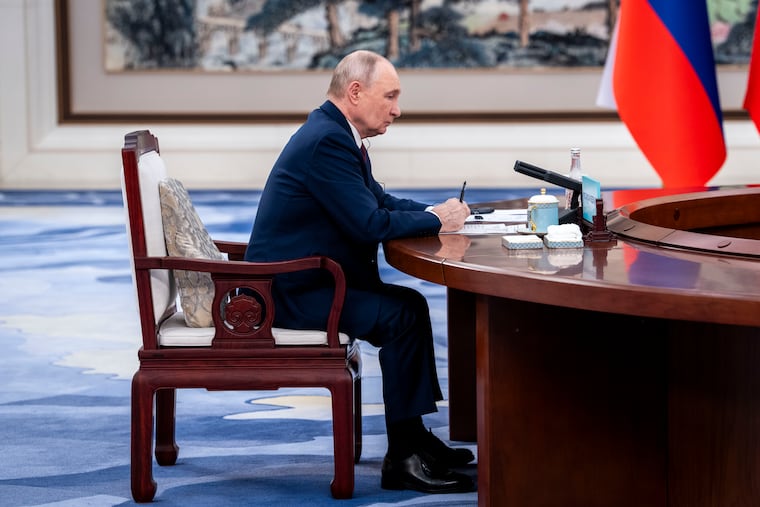
SHENZHEN, China — President Vladimir Putin of Russia stood shoulder to shoulder for the cameras with the leaders of the two global superpowers. He was publicly praised by one of them, President Donald Trump, as “my friend.” And he proclaimed, in between meetings with at least seven world leaders over two days, that efforts to isolate his nation had failed.
Putin emerged as the big winner after a meeting Thursday with Trump and Chinese leader Xi Jinping during a summit in Shenzhen, China. The Russian leader walked away with a symbolic triumph in his quarter-century battle to restore Russia’s place as a great power at the fulcrum of world affairs.
Appearing alongside Trump and Xi, the two leaders most responsible for helping him escape isolation since his invasion of Ukraine in 2022, Putin showed that he could be embraced by the powers that matter most without making any compromises on the war.
“It ends the isolation that at least the West tried to impose on him after the full-scale invasion,” said Angela Stent, a Russia expert and senior fellow at the American Enterprise Institute. “There he is. He is meeting with Xi and Trump, and so much for isolation and sanctions.”
The trilateral meeting — the first of its kind between the three countries — amounted largely to diplomatic theater that elevated Russia beyond its status. Russia lags the United States and China in economic clout, population size and most other major metrics of influence.
The big exception, apart from landmass and certain natural resources, is nuclear weapons. Russia retains the world’s largest arsenal, an inheritance from the Soviet Union, and Putin ensured that was not lost on any of the attendees.
Hours before Putin arrived at the Asia-Pacific Economic Cooperation summit, Russian strategic nuclear bombers landed in Vietnam for the first time since the Soviet era. In Shenzhen, a prominent pro-Putin commentator was filmed incredulously approaching the Russian officer carrying the “cheget,” the nuclear command-and-control device that travels everywhere with the Russian leader, and asking: “Is that the nuclear briefcase, the very one?”
Putin had not shown up in person for the annual APEC summit in nine years. The in-person event was canceled from 2019 to 2021. The United States, which played host in 2023, did not invite him because of the war in Ukraine, and an international warrant for his arrest over the transfer of Ukrainian children to Russia complicated visits to Peru and South Korea in 2024 and 2025.
But on Thursday, the Russian leader was granted a place on a red-carpeted stage with his American and Chinese counterparts, even as he has escalated his war against Ukraine, killing record numbers of Ukrainian civilians and playing hardball during the Trump administration’s renewed efforts to end the conflict.
During the meeting and afterward, the Russian leader and Trump railed against the International Criminal Court, which issued the arrest warrant for Putin. Trump called the institution, which his administration has punished with sanctions, an out-of-control “rogue globalist organization.”
While Russia basked in the diplomatic pomp and pageantry, Ukraine brought a reality check. Just hours before the trilateral meeting, Ukrainian forces for the third time in a week struck the bridge connecting Russia with Crimea, the peninsula that Putin illegally annexed from Ukraine in 2014.
Past American presidents have been wary of conferring legitimacy on autocrats actively opposing U.S. interests, but Trump agreed to the summit with Putin without forcing any prior commitments regarding Ukraine.
In a news conference afterward, Putin said he and Trump shared a common approach to “civilization values” and had a “similarity of views,” citing a recent discussion about democracy.
“What exactly is democracy? What is it?” Putin asked. “Is it the liberal order that certain circles have sought and are still attempting to impose on the entire world, fashioned according to their own blueprint? Is that democracy or is that a liberal attempt to monopolize power — in fact, liberal dictatorship?”
The formal statement that the three world leaders issued after their meeting made no mention of the conflict in Ukraine, though Putin and Trump discussed the topic in talks before the trilateral summit.
During his news conference, Putin said that, in response to the attacks on the Crimea bridge, he was ruling out any maritime or energy infrastructure truce with Ukraine, and would mete out a painful retaliation.
There had been few signs that such limited ceasefires were in the offing, anyway. At peace talks last week in Abu Dhabi, United Arab Emirates, led by Trump’s special envoys, Jared Kushner and Steve Witkoff, the Russian negotiating team reissued hard-line demands from five years before.
Putin said that, at the insistence of the United States, he had invited European officials to Russia “through diplomatic channels” to ascertain their position and decide if they should be included in talks. The negotiations up until now have included only the United States, Russia and Ukraine.
Ukraine and European nations have said repeatedly that they must be involved in any discussions about their security. In an interview with NBC News ahead of the summit, President Volodymyr Zelenskyy of Ukraine said that “big countries always think that they can make decisions about the future of all the world, but it’s a huge mistake, absolutely.”
Trump and Putin, however, appear to share the opinion that “there are only a few really serious players” in world affairs that matter, said Stent, the American Enterprise Institute fellow.
“Trump is obviously a completely different president,” she said. “He is happy to be seen with these authoritarian leaders. He really is not interested in being seen with American allies, either European or Asian.”
(BEGIN OPTIONAL TRIM.)
Asked whether Thursday’s summit amounted to a new Yalta — the World War II conference where Franklin D. Roosevelt, Winston Churchill and Josef Stalin brokered the fate of postwar Europe — Putin replied: “What was so wrong with Yalta?”
He said Yalta finalized the victory over Nazism and paved the way for the United Nations, skipping over how the negotiation set the stage for millions of Europeans to be swept behind the Iron Curtain.
(END OPTIONAL TRIM.)
For years, a leading raison d’être of Putin’s rule has been to reverse the decline of Russian power that came in the aftermath of the Soviet Union’s collapse, which he famously called “the greatest political catastrophe of the century.”
“We showed ourselves to be weak, and the weak get beaten,” Putin remarked in a 2004 speech after a terrorist attack at a school in Beslan. He seethed with disgust at how vulnerable Russia had become and set the wheels in motion to consolidate domestic political control.
Putin viewed Moscow’s loss of power as demeaning and humiliating, chafing at the way he was treated as a second-tier leader by American officials. For much of the 1990s and 2000s, U.S. leaders did not regard Moscow as a force to be reckoned with or feared in global affairs.
Over the years, the Russian leader tabulated the slights, growing more intent on ending what he has long called the “unipolar world,” his chosen term for a world he said was unfairly dominated by the United States. Those politics of grievance fueled his increasingly bold and deadly drive to restore Russian might.
Even after Thursday’s summit accorded him the trappings of a superpower leader, Putin spent part of his news conference saying he was not responsible for invading Ukraine, instead blaming prior Western elites.
“They didn’t give a damn about our opinion, because they believed that there was nothing left to negotiate with Russia. You just have to push,” Putin said during his news conference Thursday. “Well, they brought this pressure to the point of hostilities and war.”
This article originally appeared in The New York Times.