A bridge replacement’s new repair timeline prompts concerns over increased traffic in Downingtown and other delays
A section of Boot Road that has been closed since September 2025 will remain so until spring 2027.
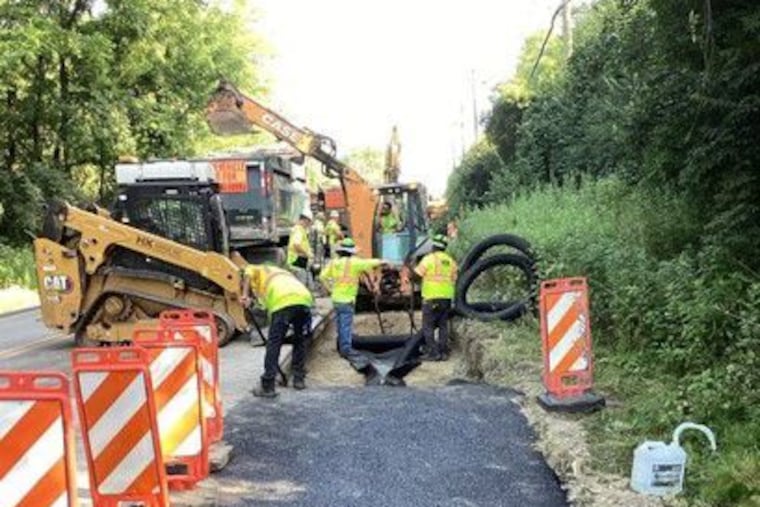
A bridge replacement near Downingtown will stretch into next year, prompting a call to Gov. Josh Shapiro’s administration about the extended closure’s impact on traffic flow through the borough and the sequencing of other projects — including another bridge replacement.
Replacing the nearly 60-year-old, three-span bridge that carries Boot Road over Amtrak in East Caln Township will now wrap up in early 2027, rather than in fall 2026 as initially projected.
The elongated timeline is, in part, thanks to a change in the foundation design. After the original bridge was demolished, the Pennsylvania Department of Transportation found a different type of rock from what was anticipated, which required a new design, said Helen Reinbrecht, community relations coordinator for the department.
The department expedited a redesign, which was completed in June. Construction is anticipated to be a bit slow into early August, as PennDot awaits proprietary materials, Reinbrecht said.
In Downingtown, the delay will have ripple effects — prompting Mayor Erica Deuso to call on state leadership to approach this project with the “same urgency, accountability, and focus here” as when Gov. Josh Shapiro’s office quickly reopened I-95 in Northeast Philadelphia after a tanker crashed and a section of the bridge collapsed in 2023, and with the early completion of another bridge in Pittsburgh in July.
Deuso said in a news release Tuesday that the public was prepared for a one-year closure of the Boot Road bridge, but that the extended timeline is “a serious failure with real consequences for everyone forced through Downingtown each day.”
“Our roads, intersections, emergency routes, business district, and residents are paying the price,” she said.
She requested a review of whether additional crews, work shifts, equipment, and engineering support could make up for the lost time, and asked for help addressing traffic signal adjustments, detour enforcement, pavement and bridge condition monitoring, emergency-response planning, “and assistance with extraordinary local public safety and infrastructure costs.”
Following Deuso’s letter, PennDot press secretary Alexis Campbell said that the department “understands how vital the Boot Road Bridge is to the community and is expeditiously working to reopen the bridge as soon as possible.”
“The Department expedited the new design of the bridge and is working with the contractor to accelerate construction by adding additional crews and working through the winter so long as the weather permits,” she said.
The delayed bridge replacement has trickled down into the sequencing of other Downingtown projects, including the rehabilitation of the borough’s Lancaster Avenue bridge, which crosses the east branch of Brandywine Creek, due to its poor condition.
That will not get underway until the detours from Boot Road and another effort — relocating the Downingtown train station half a mile to the east, where the Keystone Corridor crosses U.S. Route 322 — are completed, borough officials said. Deuso was concerned the Boot Road delays would also hamper the train station relocation.
The Boot Road bridge replacement is a $13.3 million project that replaces the 193-foot three-span bridge with a 105-foot single-span structure. It carried roughly 12,000 vehicles a day before its closure, officials said.
The full closure of the road, between Quarry Road and Southwind Lane, began in late September 2025. Motorists are being detoured to U.S. Route 322, Business U.S. Route 30, and Quarry Road. That is expected to continue until the work is fully completed next spring.
The bridge was structurally deficient, Reinbrecht said.
“I know it can be frustrating and time-consuming to have to use the detours. But this really will be safer and more efficient when the construction is completed,” she said.

Want to get Inquirer Chester County straight to your inbox every week? Sign up here for our guide to the news, stories, and events shaping life in your community.
This suburban content is produced with support from the Leslie Miller and Richard Worley Foundation and The Lenfest Institute for Journalism. Editorial content is created independently of the project donors. Gifts to support The Inquirer’s high-impact journalism can be made at inquirer.com/donate. A list of Lenfest Institute donors can be found at lenfestinstitute.org/supporters.