Amid data center disputes, East Whiteland hired a PR firm, while its residents hired an attorney
East Whiteland approved an agreement with Ceisler Media & Issue Advocacy.
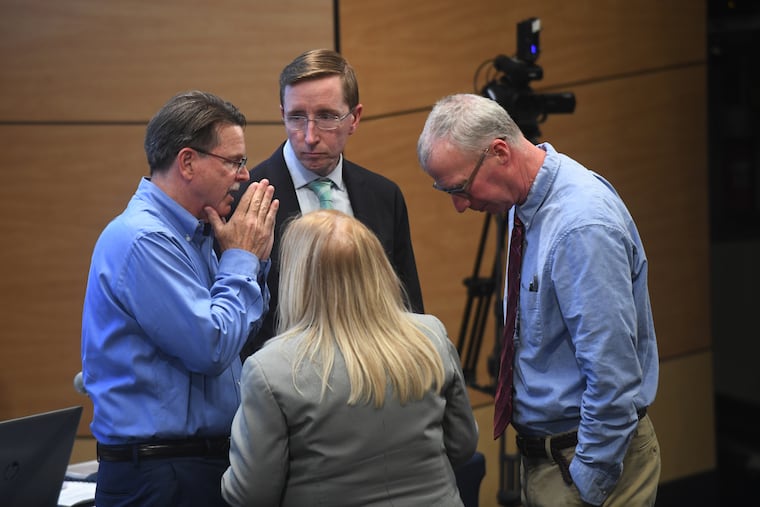
East Whiteland Township this week hired a public relations and communications firm, coming on the heels of a community group retaining an attorney to challenge the controversial 1.5 million-square-foot data center project.
The township’s three supervisors on Wednesday unanimously approved an agreement with Ceisler Media & Issue Advocacy, a communications firm that works with businesses, nonprofits, and government agencies, including as a consultant for Chester County.
It will cost roughly $6,800 a month, and was a “short-term” agreement “to see how things work out,” board chairman Scott Lambert said.
Officials didn’t directly link the hiring of Ceisler Media & Issue Advocacy to the pushback it has faced with the data center project, but township manager Steven Brown told residents it was necessary due to “a significant volume of inquiries and information requests.”
But residents assumed it’s related to the data center, raising concerns about the hiring limiting their ability to reach the township directly and “gaslighting” the community.
Brown said that the firm would not replace township officials “as spokespersons or decision-makers” and said residents would still “communicate directly with the township.”
“Because the township does not have a dedicated staff person or public information officer for communications, we view this as a cost-effective way to add communication support, improve responsiveness, and help ensure information is shared accurately and efficiently without creating an additional layer or barrier between residents and township officials,” he continued.
In a statement Thursday, Larry Ceisler, founder of the firm, reiterated Brown’s comments nearly beat-for-beat: The agreement was due to a “significant volume of project-related inquiries and information requests” and that the firm was “brought on board to help support the timely collection, review, and distribution of public information.”
Ceisler said also said the firm “will not replace Township officials as the spokespersons or decision-makers, and residents will continue to communicate directly with the Township.”
Without a public information officer, he continued, “this is a cost-effective way to add communications support, improve responsiveness, and help ensure information is shared accurately and efficiently without creating an additional layer or barrier between residents and Township officials.”
A representative did not answer whether Ceisler provided the comments to Brown, saying the statements closely paralleled each other because “it’s informed by the agreed-to scope of work that our firm worked out collaboratively with the township.”
Community members, who have doggedly pursued information to challenge an approved data center project planned for the 79-acre Cyprus Foote Mineral Co. property, found the hiring alarming.
Ginny Marcille-Kerslake said she was “gobsmacked” when she saw it on the agenda, worried that it would be used to “gaslight” the community.
“I really wish that you guys would ... start doing what’s right by your community,” she said.
Others raised concerns about using taxpayer funds.
“At $6,800 a month, that’s $81,000, roughly, a year,” resident Tim Caban said. “... I would ask you to, before you hire a spokesmouth, have a list of things that you’ve done and have them come out and communicate what you’ve done, but don’t hire them to spin a failure to do your job.”
The hiring of Ceisler Media & Issue Advocacy comes roughly a week after citizen group East Whiteland United retained attorney Philip S. Rosenzweig to represent them in their opposition of the project and how the data center was allowed to continue.
The project has been a flashpoint in the community for months.
At the Wednesday meeting, the board limited the time for public comment to 30 minutes and requested non-residents sign up to speak, which drew pushback from attendees and led to a charged back-and-forth from the crowd to the supervisors. Attendees denounced the cutoff.
After further shouting continued from the crowd when supervisors declined to continue public comment at the podium, police requested supervisors end the meeting.
For months, residents have turned up in large numbers — at one point prompting a meeting to end because the room exceeded capacity — to decry it. It served as the impetus for residents securing a November ballot question about adding more supervisors to the board to bring more voices to the table.
The data center is in early construction, and has faced two work stoppages over concerns with its permits. Recently, developers Green Fig LLC and Sentinel Data Centers dropped another bid to amend the project to update the 2024 approved plan.
Brown said Wednesday that the township was no longer considering the developers’ request to change the cooling technology, and the developers are “expected to move forward in accord with the approved 2024 plan, unless any future changes are formally proposed and approved through the required approval process.”
Several permits are under review, he said.

Want to get Inquirer Chester County straight to your inbox every week? Sign up here for our guide to the news, stories, and events shaping life in your community.
This suburban content is produced with support from the Leslie Miller and Richard Worley Foundation and The Lenfest Institute for Journalism. Editorial content is created independently of the project donors. Gifts to support The Inquirer’s high-impact journalism can be made at inquirer.com/donate. A list of Lenfest Institute donors can be found at lenfestinstitute.org/supporters.