How Democrats can curb Trump’s destructive foreign policy even before 2027
U.S. Sen. Chris Coons, next chair of key committees on foreign policy and defense, sees a path despite the president’s veto power.

U.S. Sen. Chris Coons’ phone has been blowing up nonstop ever since the Election Day blue tsunami. Bing, bing, bing go the incoming text messages.
No wonder. On Jan. 3, the Delaware Democrat will become chairman of both the Senate Foreign Relations Committee and the Senate subcommittee that allocates funds for the military and national security agencies.
Foreign capitals are anxious to decipher how the U.S. public’s rebuff of President Donald Trump will affect his foreign policy, especially on tariffs and the Iran war. “I think my count is 27 ambassadors, two foreign ministers, and one head of state in the last 48 hours,” Coons said.
American voters, even those who don’t ordinarily focus on foreign policy, told pollsters they (rightly) blame Trump’s incoherent Iran war and his tariffs for the rise in fuel and food prices. They are linking affordability to foreign policy and expect the Democrats to change course.
I asked the senator whether a Democratic-controlled Congress had the tools to revamp the president’s destructive foreign policy. His response was quick: “Congress always has the power of the purse.” His caveats came later.
As we spoke, Coons laid out a scenario about how that power, wielded by Democrats and disgruntled Republicans, might be brought to bear in the upcoming lame-duck session of Congress, even before the Democrats take charge next year.
This gets a bit complicated, but please read on.
By Dec. 11, the Senate must authorize overall spending for military and security programs for fiscal year 2027, which includes the Pentagon. The White House is also seeking a supplemental $350 billion for defense, over which Congress would have no future say.
“There are a number of Republican senators who are deeply unhappy about Trump for ending their careers, who support Ukraine and question the war with Iran, and now you’ve had a stinging rebuke of the Republican Party,” Coons told me. “So why would they vote for the $350 billion and not fight for funding for Ukraine and for a change in direction on the war with Iran?”
» READ MORE: U.S. oligarchs who act at Trump’s behest do so at their peril | Trudy Rubin
Thanks to those GOP senators — a group that includes John Cornyn, Thom Tillis, Bill Cassidy, Mitch McConnell, and others — Coons does not think this supplemental will be passed this year.
As for Ukraine, he believes there will be much stronger support when Democrats take over, and perhaps even in this session, for releasing limited funds already appropriated for Kyiv before Trump cut off all funding. The senator would also like to hold hearings on who was responsible for recently degrading vital Starlink services to Ukraine.
“It should be our priority that we help Ukraine get through the winter both by more actively coordinating the transfer of PAC3 Patriot missiles and authorizing transfer of technology to NATO partners to manufacture more of them,” Coons said.
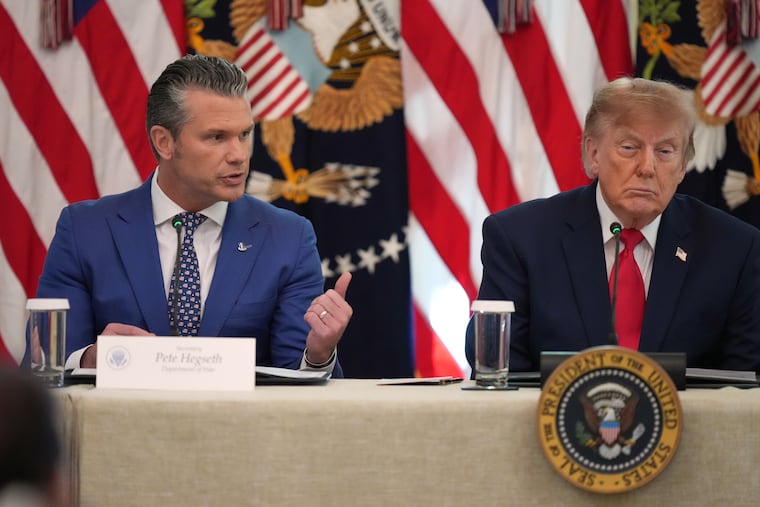
So far, Defense Secretary Pete Hegseth has refused to release a tranche of missiles to Ukraine already paid for by European governments.
“We should say to the Europeans, ‘If you are willing to buy [the missiles], we are willing to sell them,’” he said.
So can Democrats influence foreign policy before the end of the year? “Yes, in partnership with disaffected and retiring Republicans,” Coons said. Can Democrats influence foreign policy next year? “Likely yes, through the defense authorization bill,” he added.
Coons emphasized that Trump wouldn’t be able to get any ambassadors or senior policy people or judges confirmed “without working with us.”
The senator also stressed that voters have clearly connected tariffs and the Iran war with the rising cost of living. GOP senators who are running for reelection in two years may not wish to be associated with support for either, even if Trump still backs both.
As for whether the president might launch another major attack on Iran this year, Coons offered, “My hunch is that you will pretty quickly see enough Republicans abandoning support for the war to give Trump the opportunity to say, ‘I am not going to launch a renewed war in partnership with [Benjamin] Netanyahu.’” Of course, Israel’s recent inconclusive elections, which may not produce a new government for weeks, also figure in the calculations.
Another wild card is that departing Kentucky GOP congressman and Trump antagonist, Thomas Massie, has pledged to force a vote this week on impeaching Hegseth. Coons believes there are so many resentful Republicans that Massie could succeed.
Although he doesn’t think impeachment is a good use of the new majority’s time in 2027 (and wouldn’t succeed with Trump, anyway), he believes that Hegseth’s case is different. “It’s focused on one of the main drivers of the costs that voters are upset about,” he explained.
An impeachment process would also inform the public of how deeply Hegseth has undercut the American military and weakened U.S. security abroad.
And the hearings Coons intends to hold — including on the tightening links between Trump favorites Xi Jinping, Vladimir Putin, and Kim Jong Un and their aid to Iran — may finally break through the public’s blindness about Trump’s love of dictators who wish America ill.
The senator also wants to examine the dangers to America posed by the gutting of the U.S. Department of State and international development aid. Yet, Coons is not naive about the powers Trump retains, nor his threat to become “Mr. Veto” and sink bills Democrats get passed.
Coons noted that he was “in an optimistic mood because my party just had the biggest night in my adult life. It is entirely possible that Trump’s id will not allow him to accept his loss, and he’ll use his powers to overthrow the government in Cuba, return to bombing Iran, and continue threatening the Canadians and the Europeans.
“I mean, of course he could. I mean, he’s Trump.”
Yup. But given the incredible events on Election Day, I prefer to put aside skepticism and focus on the new opportunities the Delaware senator laid out.
After Tuesday, there are possibilities for change that may begin to rescue American foreign policy from the nightmare of the last two years.
About our columnists
In contrast to news reporters, who operate within an independent, nonpartisan framework, columnists are charged with including their perspectives, opinions, and viewpoints when presenting their reporting. Inquirer columnists include Jenice Armstrong, Will Bunch, Luis F. Carrasco, Paul Davies, Daniel Pearson, Trudy Rubin, and Sabrina Vourvoulias.