Justice Dept. targets another Philly ‘ICE Out’ ordinance after a court win on masking ban
The amended complaint takes aim at a new Philadelphia ordinance that codifies the city's long practice of not honoring immigration detainers.
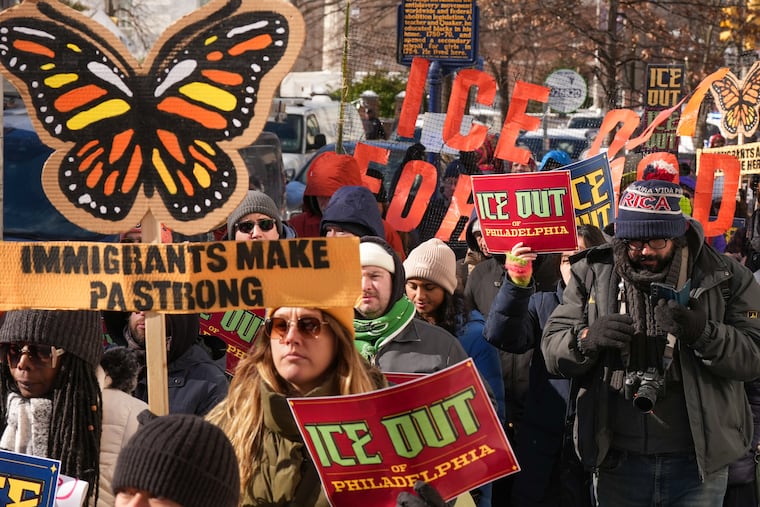
When President Donald Trump’s administration sued Philadelphia over one of seven new local restrictions on U.S. Immigration and Customs Enforcement — a ban on law enforcement officers from wearing masks or concealing their identity — the federal lawsuit included a footnote.
“The United States has grave concerns over the constitutionality of other parts of the Bill as well as other components of the ‘ICE Out’ legislation and reserves the right to bring additional challenges in the future,” the June complaint said.
The U.S. Department of Justice did so Monday evening, expanding its lawsuit to challenge a second ordinance.
The “ICE Out” legislation package that took effect July 6 codified the city’s long-standing practice of not honoring immigration detainers, which are requests by ICE that a local law enforcement agency keep a person in custody long enough to be handed over to federal agents.
The ordinance makes it illegal for a city agency or employee to comply with a detainer by keeping people otherwise eligible for release in custody because of an immigration detainer, an administrative warrant, or suspicion that they violated immigration law.
The ordinance imposes a “blanket refusal” by the city to cooperate with the federal government, the suit says, and amounts to a “standing assurance that the federal handoff Congress built into federal immigration law will never happen within Philadelphia, whatever the circumstances.”
The amended complaint does not mention Philadelphia’s history of not cooperating with ICE jail detainers. But with the local law, the city “foreclosed” the prospect of using the mechanism to deport people who were arrested, the suit says.
Since the ordinance took effect, ICE’s Enforcement and Removal Operations office in Philadelphia sent the city 26 detainers, the suit says. Fifteen were not honored and the city released the people from custody, the complaint says, while the subjects of the remaining 11 are incarcerated and the detainers remain active.
The detainers were for people arrested for crimes that include violent assaults, harassment, and drug distribution.
“Without these detainers being honored, ICE was only able to arrest a fraction of the aliens, with the remaining criminals ending up at-large,” the suit says.
A spokesperson for the city’s law department declined to comment. District Attorney Larry Krasner, who is also named as a defendant, did not respond to a request for comment.
The Justice Department beefed up its lawsuit nearly two months after a judge ruled Philadelphia could not enforce a ban on law enforcement agents concealing their identity or using an unmarked vehicle, with some exceptions, finding it was an unconstitutional attempt by a city to regulate how federal agencies operate.
» READ MORE: Philly can’t force ICE agents to unmask, federal judge rules
Mayor Cherelle L. Parker allowed the mask bill to become law without her signature in May, following the advice of City Solicitor Renee Garcia that signing the bill “would send an inaccurate signal to the public that the Administration can legally or practically enforce” its provisions.
Parker signed the ban on honoring immigration detainers.
The case against the mask ordinance also benefited from a ruling by the U.S. Court of Appeals for the Ninth Circuit that a California bill requiring agents to “visibly display identification” was unconstitutional.
But courts so far have been unconvinced that the federal government can force cooperation with ICE.
For example, last year a federal judge in Illinois dismissed a Justice Department lawsuit challenging Cook County and Chicago’s sanctuary city policies that included a ban on honoring immigration detainers.
Detainers offer localities and states “the opportunity to assist in civil immigration enforcement,” U.S. District Judge Lindsay C. Jenkins wrote. But policies that ban honoring these requests “don’t make ICE’s job more difficult; they just don’t make it easier,” the Joe Biden appointee said.
And last month, Eric C. Tostrud, the Trump-appointed chief judge of the federal district court in Minnesota, issued a similar ruling finding that immigration detainers were requests, not mandates.