Philly has 100-year-old stormwater infrastructure and 72,000 easily clogged inlets
Increased rainfall in July and August has overwhelmed some of the city's stormwater drains.
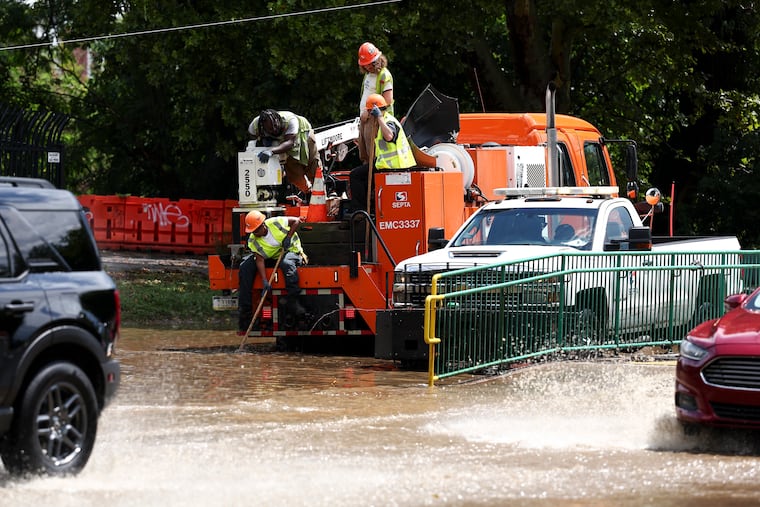
Helplessly watching stormwater fill the basement is among the most frustrating experiences for Philadelphia homeowners. It is especially bad if you are waiting for the city’s help to do something about it.
In West Mount Airy, Arielle Wolfson, 37, said roads by her home “become a river” when it storms. She and her wife live at the bottom of a hill near the intersection of Mount Pleasant Avenue and Cresheim Road, where five stormwater inlet drains are responsible for keeping rainfall from growing into rapids as it sloshes downward. But for years, only one of the drains has been fully functioning, Wolfson said. The others have been mostly sealed shut by city repaving projects that raised the level of the street, but not the inlets built into the curb.
When ankle-deep water slopes down into an alleyway that connects Wolfson’s home and nearly 30 others, it often floods her basement. Every rainstorm is nerve-racking, she said, and her efforts to alert the city, the water department, and City Council members had not resulted in change beyond an occasional inlet cleaning.
Kelsey Hensley, Wolfson’s wife, said their frequent flood calculus is: “Do we go out with some friends, or do we stay home to monitor the basement?”
Their anxiety is common in Philadelphia, where the city’s century-old sewer and stormwater infrastructure struggles to handle modern surfaces and roofs, increased rainfall, and a Delaware River that has risen by roughly a foot since the sewer system was built. And after 16 consecutive months of lower-than-normal precipitation, regular rainfall returned to Philadelphia in July and August, and brought flooding along with it.
Philly has about 72,000 stormwater inlets, and it does not take much to clog them up — ordinary objects like tree leaves, dirt, trash, and other street debris can all be culprits, according to the Philadelphia Water Department. Last year, residents submitted almost 3,000 requests to the city’s 311 line for inlet cleanings, an Inquirer data review found, and the city is asking for help.
“Across the city, The Water Department regularly checks all sewer drains and clears those that are clogged. … If they are able, we encourage residents to take part in the cleanup process before a storm comes,” city spokesperson Sharon Gallagher said in an email.
As the planet continues to warm, the stress on Philadelphia’s flood-prone system only figures to increase, leaving more residents like Wolfson with dread when clouds gather overhead. As she spoke to The Inquirer, an afternoon rainstorm had just passed through.
“I’m going down to the basement every hour just making sure it’s OK. So just the anxiety that’s pervasive among me, my wife, and other community members, it’s pretty unbearable,” she said.
A frustrating wait
Despite having roughly one stormwater inlet for every 20 Philadelphia residents, the city has generally responded to 311 requests for clogged stormwater inlets quickly. Since Mayor Cherelle L. Parker came into office in 2024, the city has closed inlet cleaning requests in under four days on average.
But 311 data may not capture the complete scope of the issue. Some residents may report their issues directly to the water department.
And clogged inlets are just one part of the Philadelphia flooding experience. Mary Catherine Doyle, 56, has been in the middle of a Sisyphean ordeal at the hands of the water department’s slow, antiquated system of hard-copy paperwork.
She and many of her neighbors along the 2900 block of Pennsylvania Avenue in Fairmount experienced significant basement flooding following storms on July 5. Doyle’s basement was ruined, she said; rainfall, debris, and sewage had destroyed her home office, bathroom, and furniture.
Her insurance covered the cleanup, but her policy requires she install a backwater valve to prevent future flooding. The valves let wastewater out of homes, but seal to prevent other water from coming back up through pipes.
The water department has a basement backup protection program where residents can apply for free backwater valve installation. Doyle and over 10 of her neighbors applied after the storm, but a contractor did not show up until Aug. 12.
Doyle said the water department explained the delays at different points by telling her it lost her physical paperwork, was understaffed, or could not sign off on one approval until a commissioner returned from vacation.
“I don’t understand where I’m living. I can buy a house in Arizona electronically, but I have to wait … days for someone to come here,” Doyle said.
While the city’s water department is ready and willing to perform routine maintenance to prevent flooding, residents with more complex, systemic concerns often end up waiting for fixes while at the mercy of the atmosphere. Gallagher said the city is doing what it can to modernize the city’s flood infrastructure and ready itself for the demands of the future.
“Teams are constantly working to design and construct additional projects that will increase capacity and help manage water from the increased intensity of seasonal storms,” she said.
Luckily for Wolfson, she discovered earlier this month that the asphalt had finally been removed from the front of three of the closed inlets, plus some others further up on Cresheim Road.
Wolfson and Hensley are happy there is finally some progress. But they wish the city would be more communicative and at least give them a timeline for the fix, they said, instead of relative silence or ambiguity.
“You obviously want a city government to work for its citizens. … It’s extremely, extremely stressful,” Wolfson said. “It’s expensive, and it’s just frustrating because, in my mind, this is a pretty easily solvable issue.”
Staff writer Joe Yerardi contributed to this article.