After 9/11, these Pennsylvanians went to war. Here’s how their lives changed.
The stories of these four military veterans, who served in Iraq and Afghanistan, offer a glimpse into the experience of countless others whose lives were altered by the wars that followed Sept. 11.
Within weeks of the Sept. 11 terror attacks, the U.S. government launched airstrikes and sent American troops to Afghanistan. In March 2003, spurred by claims that Iraq possessed weapons of mass destruction, the U.S. bombed and invaded the country.
In the two wars that followed, hundreds of thousands of Iraqis and Afghans died, with civilians making up a significant number of the dead.
On the U.S. side, more than two million American military personnel served in Iraq or Afghanistan, and over 7,000 died in these conflicts. Hundreds of thousands more live with service-related disabilities, and according to Brown University research, more than 30,000 post-9/11 veterans have since died by suicide.
Over 117,000 Pennsylvanians served in the military since 9/11, according to 2023 state data, and 295 died in Iraq and Afghanistan. At least 50,000 hailed from New Jersey, including 163 who died.
“I think it’s important, regarding the veteran population, to understand the diversity of experience,” said West Chester University historian Robert Kodosky, who has interviewed hundreds of post-9/11 veterans. “Some struggle. Some don’t. Some look back on their experience with pride. Some don’t want to talk about it at all.”
As the nation marks the 25th anniversary of the Sept. 11 attacks, the stories of these four military veterans from the Philadelphia region offer a glimpse into the experiences of countless others whose lives have been shaped by the wars that followed.
‘I can’t believe I made it home’
Benjamin Napier was 25 and living in Drexel Hill when 9/11 happened. The following evening, Napier and his younger brother, Brian, were gathered with friends in Upper Darby to attend a candlelight vigil, and Napier remembers noticing that the normally steady flow of air traffic had completely ceased. The skies were empty. That’s when he shared his thoughts with Brian.
“And I kind of turned to him, and I was like, you know, I think I’m going to do it. I’m going to join. And he was like, if you do it, I’m going to do it,” Napier said.
They enlisted in the Army on Sept. 13. Both were stationed at Fort Hood, Texas, and deployed to Iraq in 2004.
After riding in a convoy for three days from Kuwait to Baghdad, Napier, whose specialty was setting up computer and telephone networks, was sent to Abu Ghraib Prison.
The prison was not yet known for the horrific mistreatment of prisoners by Americans. But the squalid, cinderblock-walled compound, which had been a site of mass killings and torture under the Saddam Hussein regime, felt like “pure evil” to Napier.
“The place just had a vibe to it,” Napier said. “And we’re thinking, we don’t have running water. We don’t have toilets. I’m sleeping on a cot. And you’re just thinking to yourself, what in the world is going on over there.”
Soon, Iraqi insurgents began launching ferocious mortar attacks on the prison, Napier said.
Only when the U.S. soldiers got access to a TV did they learn that Abu Ghraib had become infamous. Widely shared photos of tortured Iraqis, flanked by smiling American soldiers, had became a rallying cry for war opponents.
The news also made the prison a target, and for the rest of Napier’s deployment, he said he witnessed sniper fire, shelling that killed and wounded prisoners, and the intervention of U.S. Apache helicopters that saved the prison from a hostile Iraqi takeover.
“I can’t believe I made it home,” Napier said.
It took him three years of intensive therapy to process his trauma, as well as extensive support from his wife and family, he said. Brian survived an improvised explosive device blast that left him disabled from the military due to post-traumatic stress disorder. The brothers now live in Delaware County and remain close.
Napier said despite all that he and Brian went through, he’s still glad they enlisted.
“A lot of the veterans that I talk to have that same sort of feeling. You raise your hand for something bigger than you. You’re kind of doing something for the greater good. And I think we still kind of feel that way,” Napier said.
‘I wanted to do something positive’
Keshina Bouie, 43, remembers being sent home from South Philadelphia High School on Sept. 11. Ironically, she said, her junior ROTC class is what got canceled.
Bouie’s parents had been in the Air Force, but Bouie hadn’t planned to follow their path. However with no college scholarships lined up, she enlisted in the Pennsylvania Army National Guard to pay for school.
“At that point in my life, I wanted to do something positive. And I wanted to get a degree and break generational cycles, and I was determined to be successful,” Bouie said.
Bouie earned her degree at Cheyney University in 2007. One day before her college graduation ceremony, she received deployment orders to Iraq.
Bouie was stationed at Balad Air Base, about 40 miles north of Baghdad. There, she guarded a secret Special Forces base that was embedded within the military installation. Exploding mortars and the rush of incoming wounded soldiers became part of her routine.
“When I was in Iraq, I just wanted to focus on doing my job and getting home safe,” Bouie said.
While on deployment, Bouie met Anthony, a soldier who grew up just blocks away from her Point Breeze home.
A romance blossomed in the spare hours, though they remained separated by their jobs. When they returned home, they got married. They’ve since had two children.
Bouie stayed in the Guard for 16 years, earned a master’s degree from La Salle University, and worked for the Department of Veterans Affairs and the Defense Logistics Agency. Her military service, she said, ultimately helped her provide a better life for her son and daughter.
She said there are things she’s not proud of about her country, but she’s always proud of the people she served with in Iraq and glad she enlisted.
“It was literally the best decision I made in my life. And I know not everyone can say that.”
‘What are we protecting?’
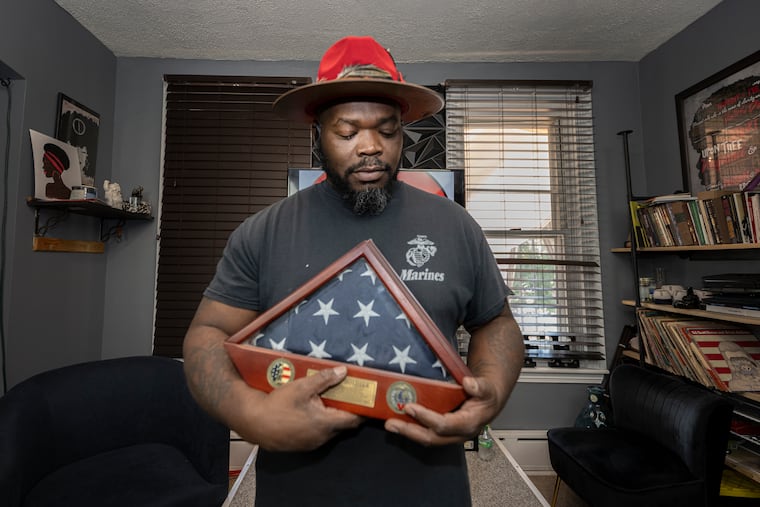
Michael Miller, 52, grew up in City of Chester with seven brothers and one sister.
“We grew up pretty poor. But being a child, you don’t know that you’re poor. We had fun. We did all the things that kids do,” Miller said.
Already a father at 19, Miller joined the Marine Corps in 1994 to provide for his family. He returned home after eight years, but missed military life. He joined the Army National Guard in 2007 and deployed to Bagram Air Base, Afghanistan, in 2010.
“For the first six months, it was like being on a weird vacation,” Miller said. “But let me tell you something: When the snow melted off those mountains, things totally changed.”
Three of his comrades died in an IED blast that summer, and of the 370 people serving with him, about 300 returned home with Combat Action Badges, a designation given to soldiers involved in ground combat.
Miller’s main job entailed driving a large truck known as a wrecker and using it to retrieve destroyed Army vehicles and cargo.
But it was while on a mission delivering supplies that an IED detonated under his truck, launching it into the air “like it was a piece of paper.”
A doctor told Miller he had a concussion, he said, and he finished his deployment. It was only when he returned home that the extent of his traumatic brain injury and PTSD became clear. Panic attacks made him a “frequent flyer” at local emergency rooms.
“I used to go to sleep fully dressed, because I wanted to make everything convenient for the paramedics, because I was sure I was dying,” Miller said.
Miller joined Warrior Writers, a group of veterans who process their experiences through writing.
“Honestly? I do poetry. I learned to express myself,” Miller said.
What he struggles with now, Miller said, is that despite his efforts, three people he served with have since died by suicide. That’s left him feeling that the war wasn’t worth fighting.
“Because, honestly, what are we protecting when the wealth gap gets so much larger? What are we protecting, when we have so many homeless? It’s a bunch of stuff that in the grand scheme of things wasn’t worth the blood that was left there.”
‘Shona ba shona’
Milan Moncilovich, 62, said he learned about the Sept. 11 attacks while on duty at Methodist Hospital in South Philadelphia. By then, the pharmacist and hospital administrator was also a seasoned officer in the U.S. Navy Reserves.
“My first thought was, this is the beginning of something that’s going to be big, and that’s going to take a while, and most likely I am going to be part of this, and be deployed at some point,” Moncilovich said.
In 2010, the Navy sent him to Afghanistan to train Afghan medical personnel. He recalled seeing a stunning sunrise as his plane performed a tactical landing in Kandahar to avoid rocket attacks.
“To me it was like a personal, spiritual kind of sign that said, ‘Hey, anything that’s going to come in the future, just take this in, take this beauty in, and remember where your inner soul is,’” Moncilovich said.
In the northern Afghanistan city of Mazar-i-Sharif, Moncilovich and other American medical professionals worked closely with Afghan doctors and nurses, he said. As they got to know one another, their motto became “shona ba shona,” a Dari phrase that meant “shoulder to shoulder” or “together.”
In this advisory role, Moncilovich’s team supervised treatment of Afghan soldiers and civilians who had been struck by IEDs or gunfire.
“I can close my eyes at any time, and I can see those soldiers in that trauma bay and on those tables,” he said. “It’s not ever going to go away. I won’t say I’m OK with it. It’s just going to be there.”
Moncilovich said he saw the positive side of the U.S. missions there, such as the construction of schools and medical facilities.
The U.S. exit from Afghanistan in August 2021 angered him, he said.
“Just to see 13 more American lives lost, it really, really upset me. That’s probably the only thing that really probably brought my rage up pretty high. Especially seeing everything we left behind,” he said.
Moncilovich, who now works for Shriners Children’s hospital in North Philadelphia, said he would jump at a chance to return and get closure.
“I know that it’s completely changed now, and I understand a little more how the Vietnam vets feel now. Time will kind of change things. I know how angry they were. But now, I know what our mission was, but at the end of the day, things kind of went back to the way they were.”