Judge holds Philly Sheriff Rochelle Bilal in contempt of court for ‘flagrant and repeated’ violations of her duties
The ruling came about six months after Judge Paula Patrick ordered the sheriff's office to explain its chronic delays in recording deeds and distributing funds after property auctions.

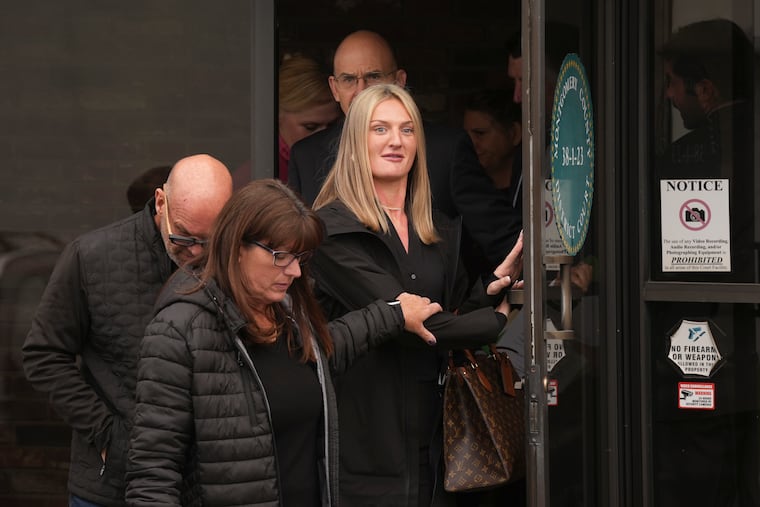
A Philadelphia judge held Sheriff Rochelle Bilal in contempt of court Wednesday, following years of bungled real estate auctions and her failure to produce records explaining how the office distributed millions of dollars in related sales proceeds.
Court of Common Pleas Judge Paula Patrick ruled that Bilal be held in civil contempt and indirect criminal contempt, citing her “flagrant and repeated” violation of her duties and deliberate obstruction of the judge’s orders to document how money was spent.
“The Court further finds beyond a reasonable doubt that, by withholding the records ... the sheriff intended to obstruct the Rule to Show Cause proceedings,” Patrick wrote. “The repeated withholding of required financial records, the failure to produce them after an express assurance, and the timing and manner of the supplemental production support that finding.”
It is the first time in 40 years that a city sheriff has been hit with such an order.
Patrick, supervisor of the court’s commerce division, ordered an outside forensic audit — which Bilal has strongly opposed — after learning that the office had failed to distribute at least $20 million in sheriff sale proceeds. The judge also cited a document the sheriff’s office produced listing about $120 million in “outstanding checks.” Neither Bilal nor her staff were able to fully explain in court what that document meant.
The ruling came two weeks after City Council authorized hearings to examine recurring problems in the sheriff’s office, including the $20 million in undisbursed sheriff sale proceeds. Some of that money should have gone to city coffers, but the checks — for reasons that Bilal has not fully explained — were never processed.
Bilal did not immediately respond to a request for comment.
Patrick’s ruling comes six months after she ordered Bilal to appear in court to explain major delays in recording deeds and distributing funds from foreclosed and tax-delinquent properties that are auctioned off.
After Bilal aides told the judge in August the office had lost track of numerous sales records, Bilal tentatively agreed to six months of court-imposed supervision of its real estate division. “It’s better that we come together and make an agreement so we can continue working together and moving forward,” she told reporters outside the courtroom.
But negotiations broke down the following month when Bilal attempted to limit the scope of the supervision or any related investigation.
Earlier this month, Bilal released her proposed changes to a draft of the agreement, showing that she’d wanted the power to reject members of an oversight committee, at least two business days’ written notice before any sheriff’s office employees could be interviewed, and the ability to revise reports submitted to the court.
Bilal has also objected to having her office pay for a forensic audit.
If an audit were to be conducted, Bilal wanted to block any information obtained by the auditor from becoming public without a court order and prior notice to her office. She added proposed language requiring that such information “be returned to the sheriff’s office or destroyed at the conclusion of the engagement” and also crossed out the word “comprehensive” before “forensic examination.”
By the time Bilal took the stand again in October, she repeatedly refused to answer whether she would permit any independent party to come into the office, arguing that the problems had been resolved.
“We are in compliance,” Bilal said. “We got control of this.”
The sheriff’s reversal led Patrick to convene a contempt hearing weeks later, where Bilal’s lawyers argued that the judge did not have the authority to appoint a third-party auditor. Steven Wakefield, Bilal’s senior deputy undersheriff, interrupted Bilal’s attorney midsentence to reiterate the office’s continued opposition to a forensic audit.
“We are not here to agree to an independent audit,” Wakefield said.
At a press conference on Nov. 5, Bilal reiterated that position, arguing that only City Council can authorize her office to spend money on an audit. She said the oversight deal fell apart because plaintiffs in the underlying lawsuit refused to negotiate.
“You just going to dictate to us and we’re not gonna talk about it?” Bilal asked. “They refused our revisions.”
Ultimately, Patrick was unpersuaded.
A costly problem
Bilal and her staff have for years insisted that there aren’t any major problems with processing deeds.
“You insist there is a widespread delay, but that is incorrect,” her spokesperson Teresa Lundy said in July 2024, after The Inquirer first reported on the issue.
This spring, Bilal told City Council that the delays had been resolved, even as buyers across the city said they were still waiting for deeds.
Patrick, supervisor of the court’s commerce division, began delving into the real estate operations of the sheriff’s office in May. The court’s action followed years of litigation from winning bidders who said Bilal’s staff refused to hand over deeds —sometimes for a year or longer — to properties won at auction.
The judge’s initial court order instructed Bilal to turn over a detailed accounting of every sheriff sale conducted since she took office in 2020. The office released a batch of documents in August, but some of the financial records cut off in 2023 with no explanation.
Lawyers for Bilal later acknowledged in court that the records submitted were incomplete and that some of the requested records could not be located.
In her ruling Wednesday afternoon, Patrick said Bilal’s response to her request for documents was “late, incomplete, inadequate, and incomprehensible.”
Wakefield, who was hired in June to fix the sheriff sales, told Patrick in September that an ongoing internal audit had recently found $20 million in undisbursed funds from the auctions, including delinquent taxes and utility bill payments that should have been turned over to the city, as well as money that was owed to banks.
When Bilal was finally compelled to testify under oath at that two-day hearing, she acknowledged that she was “starting to find out” that the office had not been fulfilling its obligations for years.
However, she conceded that she knew as early as 2024 about post-sale problems because she’d been receiving emails from real estate agents and City Council members, asking about the backlog of deeds.
“It was like Spidey senses,” Bilal testified on the witness stand. “I’m getting more than one. Then every week.”
She has blamed the problems on staffers who no longer work there.
In a last-ditch attempt to avoid the contempt finding, Jonathan Rardin, a lawyer hired by the city to represent Bilal, argued last month that the delays have already been addressed. Wakefield previously testified that he had processed hundreds of old deeds, that buyers are now getting them promptly after settlement, and that the office is tracking money more closely.
Patrick indicated that she was concerned these improvements would cease without ongoing court scrutiny.
In addition to the recent $20 million discovery, other problems with sheriff sales under Bilal have also contributed to a $76 million increase in delinquent property taxes owed to the city since 2020, according to the city revenue department.
Without a deed, new owners cannot rent or resell the properties. Banks have also experienced major delays in reclaiming properties that have gone to sheriff sales following mortgage foreclosures, leaving them vacant and vulnerable to squatters, trash and weather damage.
Mayor Cherelle L. Parker said last month that it has been “frustrating” to see homes sitting vacant after they have been sold at auction.
“The sheriff’s office and what they do with sheriff sales significantly impacts the city of Philadelphia’s ability to address our housing affordability crisis,” Parker said during an NBC10 interview about her first 1,000 days in office.
A long history
The Philadelphia sheriff’s office, a relic of the city’s now-defunct 19th-century county government, is funded by city taxpayers, but the sheriff is independently elected and operates with limited outside oversight.
The city’s last five sheriffs have been involved in scandals large and small, including FBI investigations, a federal bribery conviction, sexual harassment allegations, and even questions about why fees from sheriff sales were being directed to a politically connected deli in Northeast Philly.
In 1986, then-Sheriff Ralph C. Passio III was held in contempt of court and fined $500 because his deputies failed to bring a prisoner to a courtroom for trial.
Bilal ran in 2019 as a reformer. But her administration has repeatedly stumbled, giving fodder to critics who have argued that the office should be abolished.
A contract dispute halted auctions of tax-delinquent properties between 2021 and 2024, delaying the collection of an estimated $35 million in tax revenue.
In 2023, Bilal attempted to double her own salary to $285,000, in violation of the City Charter, while paying $200,000 a year to an undersheriff who violated city ethics rules by moonlighting as a defense attorney.
Bilal was hit with two prior court orders in 2024 and 2025 as security incidents in city courthouses surged due to a deputy shortage.
A 2022 City Controller audit found major accounting deficiencies in the sheriff’s office, including the continued use of millions in fee revenue for “off-budget” discretionary purchases from a bank account Bilal’s former chief financial officer described as a “slush fund.” More recently, that same fund covered a $600,000 advertising contract with Bilal’s former campaign manager, who doubles as a spokesperson for the office.
In six years, Bilal has run through four undersheriffs — the No. 2 job in the office —with the last departing in September after just three months on the job. She recently fired the co-director of the real estate division, and an internal audit is being headed by a pastor who filed for bankruptcy last year and was recently held in contempt himself for not responding to a Wisconsin bank’s attempts to collect $89,000 from him.
City Council has the legal authority to initiate the abolition of the office, but has shown little interest in doing so.
Despite Philadelphia’s long history of wayward politicians, civil contempt findings involving an elected official are nearly unprecedented in modern times.
The city of Philadelphia itself was found in civil contempt by a federal judge in 2024 for failing to improve conditions in city jails, although the only individual described in the order was the appointed prisons commissioner. Over the years, other unelected officials have also been found in contempt, including a school superintendent and police commissioner in the 1990s, and a city managing director and water commissioners in the 1980s.
This is a developing story. Check back for updates.

The Inquirer’s journalism is supported, in part, by the Lenfest Institute for Journalism and readers like you. News and editorial content are created independently of The Inquirer’s donors. Gifts to support The Inquirer’s high-impact journalism can be made at inquirer.com/donate. A list of Lenfest Institute donors can be found at lenfestinstitute.org/supporters.