The Case for Impeachment: In a sea of graft, the gift of a $400 million aircraft stands apart
The founders were crystal clear that accepting gifts from foreign governments was constitutionally prohibited and should lead to impeachment.
This essay is part of a series called “The Case for Impeachment,” which illuminates how Donald Trump has trampled the rule of law and is a clear and present danger to the republic.
That Donald Trump corrupts everything he touches has become a cliché. But clichés earn their status by containing truth.
Most calls to impeach the president follow a familiar pattern of allegations that he has converted public office into private gain through his businesses, finances, and dealings with parties seeking government favors. Those controversies may warrant scrutiny in their own right.
Violation of the Constitution
Yet, the gift of a $400 million aircraft from Qatar’s royal family stands apart because it involves a transgression the framers identified by name and for which they prescribed impeachment as the remedy: violation of the Constitution’s foreign emoluments clause.
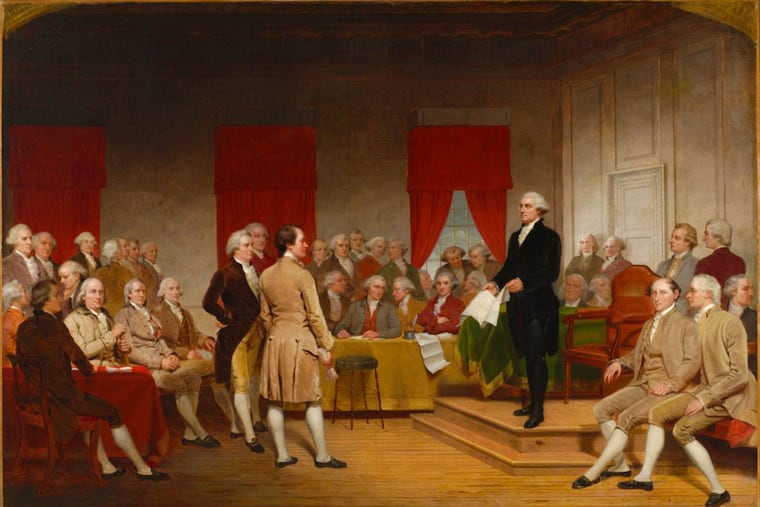
To guard against foreign corruption of American officials, the delegates to the Constitutional Convention of 1787 unanimously adopted a provision prohibiting federal officeholders, including the president, from accepting anything of value from a foreign state without the consent of Congress. “Foreign influence,” Alexander Hamilton warned, “is truly the Grecian horse to a republic.”
As Fordham law professor Zephyr Teachout, author of Corruption in America, has written, the foreign emoluments clause was no afterthought. It expressed “the animating spirit of the Constitutional Convention” that “goes to the heart of the fears at the Convention” — fears that have no less relevance today, several centuries later.
American taxpayers are expected to spend hundreds of millions, by some estimates as much as $1 billion, to retrofit the plane to presidential specifications.
The clause contains no enforcement mechanism because the framers had already provided one. Gov. Edmund Randolph of Virginia, a delegate to the Constitutional Convention, explained to his state’s ratifying convention that the Constitution guards against “the president receiving emoluments from foreign powers. If discovered, he may be impeached … I consider, therefore, that he is restrained from receiving any present or emoluments whatever. It is impossible to guard better against corruption.”
The foreign emoluments clause itself was born of a gift. After King Louis XVI of France presented the American Minister Benjamin Franklin with a diamond-encrusted snuff box, Americans worried that foreign monarchs might exert influence through gifts to American officials. That history brings us to Qatar.
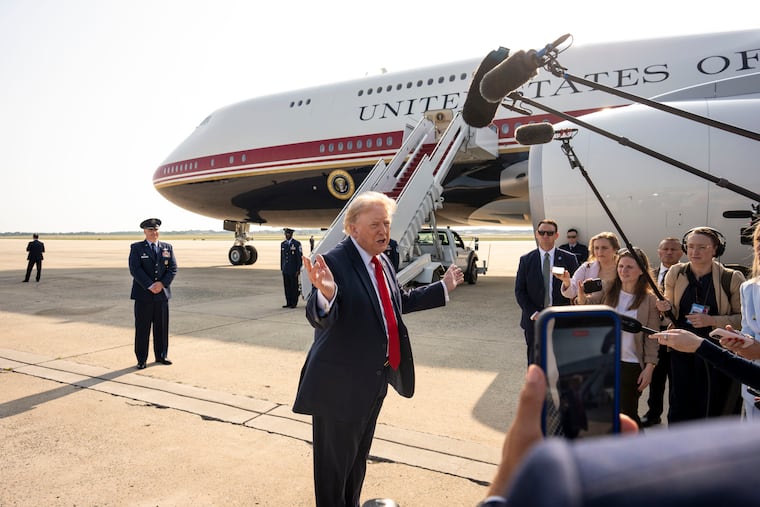
Trump has accepted a luxury aircraft from Qatar’s royal family, reportedly valued at about $400 million. The plane is intended to serve as Air Force One while American taxpayers are expected to spend hundreds of millions, by some estimates as much as $1 billion, to retrofit it to presidential specifications.
Although nothing is certain with this administration, under the original agreement, the government would not keep the plane. It would go to Trump’s presidential library foundation, and Trump has said it would sit in the lobby of what will “most likely” be a hotel. A jet widely valued at $400 million and refurbished at public expense would become the showpiece of a Trump-branded property.
A gift routed through the Pentagon on its way to the recipient is still a gift.
Any unauthorized benefit from a foreign government is itself the constitutional violation, with impeachment as the remedy the founding generation prescribed.
The conflicts do not end there. The Trump Organization has announced business dealings in Qatar involving a company owned by the Qatari government. At the same time, Qatar has substantial interests at stake in American policy. It hosts the largest U.S. military base in the Middle East, plays a central diplomatic role in negotiations involving Gaza, and seeks favorable outcomes on matters ranging from security cooperation to trade and arms sales.
Even a leader more selfless and introspective than Trump would be hard-pressed to separate public policy from private gain. Yet, Congress and the American people need not untangle every conflict of interest or prove that any particular decision was bought. That is precisely why the framers made the prohibition absolute.
The foreign emoluments clause sets no minimum value threshold. It requires no showing of quid pro quo. It demands no proof of corruption. Any unauthorized benefit from a foreign government is itself the constitutional violation, with impeachment as the remedy the founding generation prescribed.
A 1994 memo from the U.S. Department of Justice’s Office of Legal Counsel affirmed that the “drafters [of the clause] intended the prohibition to have the broadest possible scope and applicability.” It ruled that “The decision whether to permit exceptions that qualify for the Clause’s absolute prohibition or that temper any harshness it may cause is textually committed to Congress,” not the executive branch.
Congress should act
The House of Representatives should therefore open an inquiry into the administration’s claim that this arrangement complies with the Constitution’s plain command. The current Congress is unlikely to act. Yet, constitutional violations do not disappear because they are politically inconvenient, and the Constitution’s requirements do not expire with the news cycle.
The framers feared that foreign rulers would seek influence through gifts and favors. Their response was simple: prohibit such gifts and empower Congress to impeach those who accept them. If a diamond-encrusted snuff box raised alarms in the 18th century, a $400 million flying palace should do so today.
Allan J. Lichtman is a distinguished professor of history at American University in Washington, D.C., and the author of “Great American Presidents: The Twelve Who Transformed the Nation.”

Inquirer Opinion Newsletter