The day Larry Krasner’s office was put on trial — by his own prosecutors
Three lawyers who still work in the district attorney’s office testified about the sloppy handling of a bid to overturn a 2009 murder conviction — and accused their boss of a cover-up.
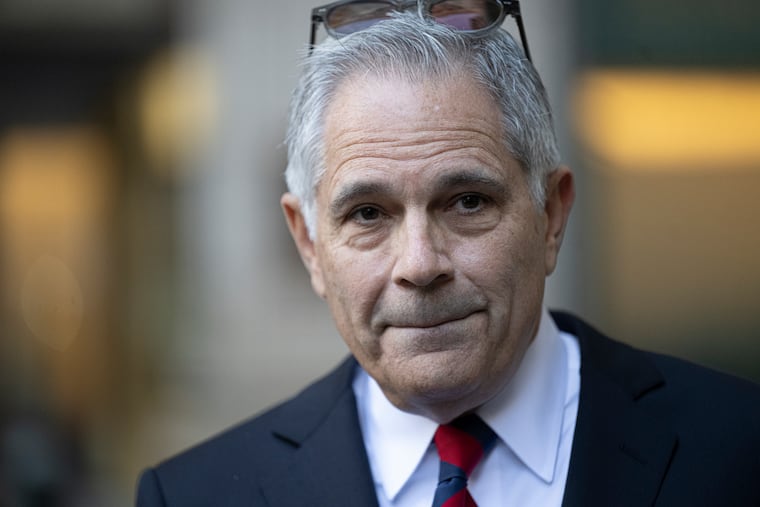
There were so many jaw-dropping moments in U.S. District Court Judge Paul S. Diamond’s courtroom on Thursday that it is hard to know where to begin.
For starters, I had a stint covering courts in the mid-2000s, and have never seen a courtroom packed with so many lawyers — including lawyers representing lawyers — for a hearing in an exoneration case. An overflow room was needed to handle the rapt onlookers.
The hearing grew out of efforts by Philadelphia District Attorney Larry Krasner’s office to overturn the conviction of Dennis Johnson, who was found guilty of second-degree murder in the 2007 shooting of a man at a North Philadelphia convenience store. While Johnson’s future was ostensibly on the line, it quickly became clear that so was Krasner’s.
By the end of the day, the future for both men looked bleak.
While Johnson was in court with his attorneys, the hearing focused on the machinations within Krasner’s office.
The office has already run into a heap of legal trouble over previous efforts to overturn other convictions or reduce sentences, mainly for those convicted of murder.
Federal courts have disbarred and suspended prosecutors in Krasner’s office for lying to the court. The state Supreme Court found more lies and, in an unprecedented move, appointed the state attorney general to review future efforts to undo prior convictions.
So essentially, Krasner’s office now has a court-appointed babysitter because it can no longer be trusted.
It was easy to see why after three prosecutors — who still work for Krasner — provided damning testimony about their own office’s sloppy handling of efforts to vacate Johnson’s conviction. They accused Krasner of conduct that bordered on paranoia and cover-up, and painted a picture of an office that seemed less focused on the pursuit of justice than on shielding itself.
Katherine Ernst, the chief of training in the law division, went first, followed by colleagues Steven Wildberger, an assistant district attorney in the appeals unit, and David Napiorski, the head of the law division.
They came with receipts, providing meeting times, memos, and emails documenting conversations with Krasner about how to handle errors in court filings by the DA’s office related to an attempt to undo Johnson’s conviction.
Krasner did not respond to a request for comment, but in an earlier filing his office said the prosecutors were “ill informed.”
The three prosecutors provided alarming testimony detailing how Krasner avoided using his official office email and threatened them.
“DA Krasner typically didn’t use that email,” Ernst said about his office email. “He wouldn’t check it. And so, if you wanted to email him, then you typically had to email his private address.”
Napiorski backed that view: “He always prefers oral, in-person conversations.”
In late June, after the three prosecutors drafted a memo to Krasner detailing the office’s conflict of interest in handling the Johnson matter, he responded with an email sent from the account of his chief of staff, Jennifer Lin, which began, “This response is not from Jen Lin, it is from Larry Krasner.”
At another point, Wildberger testified that when they presented Krasner a letter turning the Johnson case over to the state attorney general, he went “apoplectic.”
“He said something about having already told us not to bring him printed-out material, things in writing,” Wildberger said.
‘Paraguay’
The prosecutors pushed for the attorney general to take over, because their self-interest had become a focus rather than the merits of the case. In their view, they had conflicts, and so did Krasner.
But Krasner wanted to hire an outside lawyer to handle the matter, and repeatedly resisted efforts to turn the case over to the state Office of Attorney General, or OAG.
Ernst testified that Krasner “hated” everyone in the OAG. Wildberger said Krasner “referred to the Office of the Attorney General as Paraguay” and “the people that work there as Nazis.”
Adding to the drama was the fact that the attorney questioning Ernst and Wildberger was John Boscia, a senior deputy attorney general in the OAG.
To clarify, Boscia asked Wildberger, “So that the people from the OAG’s office were escaped Nazis who had gone to Paraguay?”
“That’s my understanding,” Wildberger responded.
All three prosecutors testified that throughout the internal discussions, Krasner remained adamant about retaining control of the case in order to “protect the office” — a phrase that came up more than two dozen times during the hearing.
At one point, Judge Diamond asked if Krasner’s reference to “protect the office” meant “protect himself?”
“I think that was probably part of it,” Napiorski said.
“Protect the office” is a phrase that came up more than two dozen times during the hearing.
In another twist, Thomas Gaeta, the DA’s civil litigation supervisor, was involved in some of the internal discussion, yet he handled the brief and mild cross-examination of his colleagues on Thursday.
The roots of the DA’s conflict began after Johnson appealed the verdict, claiming his defense attorney was ineffective.
In 2022, then-Assistant District Attorney Jaclyn Mason filed a document that agreed with the arguments made by Johnson’s attorneys at the Pennsylvania Innocence Project, and that his conviction should be overturned. According to the document Mason signed, the detective’s testimony in Johnson’s trial was improper and had “tipped the scales” toward a conviction.
But this spring, following an order from Diamond, Ernst and some of her colleagues reviewed the case. Ernst said she found multiple errors in Mason’s motion and confronted her.
Ernst and her colleagues urged Mason to fall on her sword for the office, take responsibility for the errors, and withdraw the motion. Napiorski said he told Mason he had done something similar in a different exoneration case that blew up.
Profiles in courage.
‘Reluctantly but loudly’
The main hero in what is shaping up to be an unraveling of Krasner’s mass exoneration scheme appears to be Mason.
Her dramatic testimony in Diamond’s courtroom last month provided a window into the lack of independent investigation by Krasner’s office into the wrongful conviction claims. (Mason also appears to have provided some backbone to the three prosecutors who testified on Thursday.)
Mason explained that she had only been on the job a few months in 2022, and had largely taken directions from her supervisor, Matthew Stiegler, who she said told her if Johnson’s claims were good enough for the Innocence Project, they were good enough for him.
In the meeting with the prosecutors, Ernst recounted that Mason said, “This is all Matthew Stiegler’s fault.”
Mason told her colleagues that Stiegler should have to sign the withdrawal motion, as well. Apparently, that was not an option. Instead of going along with the plan to take all the blame, Mason resigned on June 2.
In a two-page resignation letter addressed to Krasner, Mason wrote that she had limited experience with federal habeas law when she was hired. Yet, the first two cases Stiegler assigned to her “involved complicated cases where he determined that it was appropriate to concede habeas relief.”
Mason said she “trusted” Stiegler, but later learned about a mass exodus of prosecutors when he oversaw the federal litigation unit.
» READ MORE: Larry Krasner’s exoneration push faces a reckoning | Paul Davies
Mason said Stiegler had “worked closely with the Innocence Project and the Federal Defenders on the [Johnson] case, deeming it worthy of a concession with little independent investigation.”
Therein lies the problem when it comes to reviewing past convictions. Under Krasner, the prosecution and defense are largely on the same team.
Mason added that Stiegler reviewed several drafts of the concession she filed in the Johnson case, but did not sign his name to it. Mason ended by writing that she “reluctantly but loudly” resigned.
After Mason quit, all three prosecutors testified that Stiegler hatched a plan to manage the fallout. He suggested combing through Mason’s past cases for errors and claiming she was a rogue operator.
Ernst testified that Stiegler asked to meet and told her, “Mason purposely inserted the false facts into the response.” Ernst explained that Stiegler wanted to make it seem as if any mistakes in the case were “100% [Mason’s] fault and 0% his fault.”
Krasner was on board with Stiegler’s plan, according to Ernst, who recounted a conversation with the district attorney.
Krasner said Stiegler “gave me this really good idea,” Ernst testified. “I think that we should go through Ms. Mason’s cases, say that this was a pattern by her, and then file something with the court saying that.”
» READ MORE: Krasner’s candor problem started with his first exoneration win | Paul Davies
Why the deference to Stiegler is unclear. He has come and gone from Krasner’s office three times and remains a lightning rod. Stiegler now oversees the Conviction Integrity Unit, a departmental name fast becoming an oxymoron.
Stiegler sat in the front row of Judge Diamond’s courtroom on Thursday as the other prosecutors testified about his role and reputation with the office.
Wildberger testified that in the meeting with Mason and the other prosecutors, he told her, “You’ll find no Matt Stiegler apologists here.” He later explained that Stiegler “was not well liked” and had chased away many prosecutors.
The internal drama and legal troubles have roiled Krasner’s office. Ernst testified that many frontline prosecutors were “angry” at Krasner for what happened to Mason. Wildberger said he had “lost faith in the administration of the Philadelphia District Attorney’s Office.”
Amid the discussions over whether to tell the court about the errors in the Johnson case came another bombshell.
Ernst testified that Napiorski warned her Krasner had threatened “to fire anyone who tells the judge about this.” She added that Wildberger clarified Krasner didn’t use the word fire, but said that “there would be consequences.”
Early on in the proceeding, Judge Diamond signaled his take on the emerging testimony.
“If what they say is true, potential wrongdoing abounds,” Diamond said. “There’s a question of whether perjury was committed, subornation of perjury was committed, criminal conspiracy was committed, and obstruction of justice was committed.”
The hearing is scheduled to continue on Tuesday. It is unclear what the judge will do next.
I left the courthouse thinking about the Watergate hearings and, in particular, a March 1973 meeting in which White House counsel John Dean warned Richard Nixon about a “cancer” on the presidency.
Has something similar metastasized in Krasner’s office?