Big Players, High Stakes
Political clout and wealth will square off Thursday to debate riverfront casinos and, by extension, Philadelphia's future. The outcome carries a huge price.
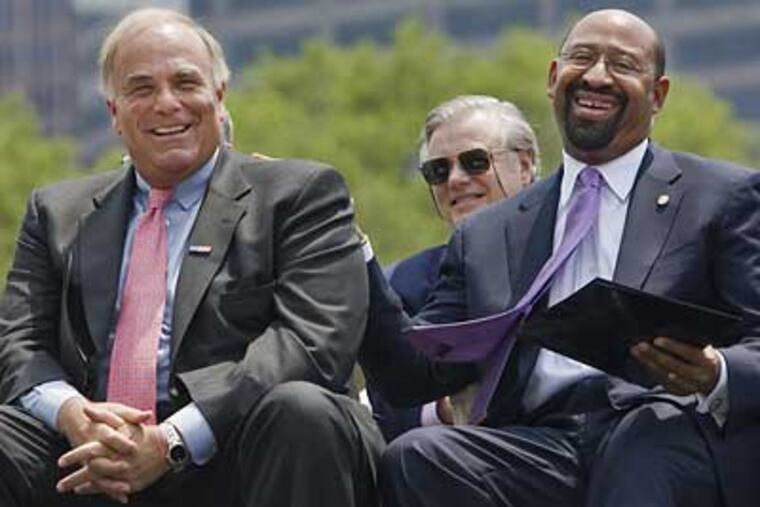
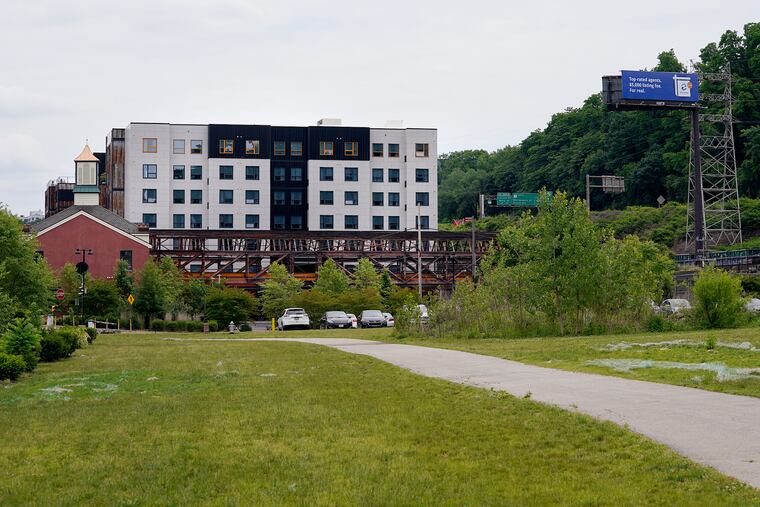
So what is the value of Philadelphia's riverfront on the Delaware?
Is it the $990,000 a day for the state of Pennsylvania and the $72,000 a day for the city as their cuts of the gaming revenue if two casinos are built there?
Or is it the recreational and aesthetic enhancements that would result from carefully weaving it into the tapestry of a world-class city?
Those are the stakes when Gov. Rendell meets Thursday with local and state officials, civic activists and at least one of the city's gambling operators to decide if the SugarHouse and Foxwoods slots casinos get built on the waterfront, as planned, or moved to less-treasured landscape, such as south of the city near the airport.
There is powerful wealth behind the casinos. There is political muscle urging that the casinos be re-sited. The casinos have the approval of the state Gaming Control Board.
The city and the state have pegged future budgets based on the revenue estimates for the two gaming palaces, which were supposed to be open and operating in 2010. The casinos' preferred locations and their licenses to build and operate there were granted in December 2006. Not a spadeful of dirt has been turned in that time.
Rendell is unlikely to be a peacemaker. There seems no middle ground.
Here are the key players and their positions:

Rendell wanted riverfront gambling when he was mayor of Philadelphia. He still wants it as governor.
Political observers here do not expect Rendell to pressure either of the casino groups to move their sites. He has repeated time and again that the two groups of developers were awarded the rights to build casinos on the riverfront.
Rendell said he believed the casinos' revenue and tax contributions were much-needed by the city and state. When he signed the Pennsylvania Race Horse Development and Gaming Act into law in July 2004, its twin aims were statewide property-tax relief and resurrecting the state's struggling horse racing industry.
Mayor Nutter, as a mayoral candidate, was hard to read on casinos.
During last year's campaign, he said he was "agnostic" on casinos. He said the process for selecting the casino sites was flawed. He said casinos were not a good form of economic development.
But Nutter seemed to leave wiggle room on the two proposed locations.
As mayor, however, Nutter has made it clear that these two sites on the Delaware River are all wrong.
In January, one of his first acts in office was to revoke a Commerce Department permit granting so-called riparian rights - or riverbed construction rights - to the SugarHouse project. That power, Nutter said, rests with the state. SugarHouse is suing.
Nutter also testified against the siting of the projects at Council hearings on zoning for the Foxwoods casino.
And in June, he embraced the "civic vision" for the waterfront advanced by Penn Praxis. Nutter went so far as to hire the consultants, who are affilated with the University of Pennsylvania School of Design, to give him a detailed explanation of why the casino projects would spoil the riverfront. They delivered that to the mayor earlier this month.
Neil G. Bluhm, the Chicago billionaire developer and chief financier of the $700 million SugarHouse Casino, has stood his ground. The team developing the casino, which includes developer and SugarHouse Casino investor Daniel J. Keating, has no interest in relocating from its chosen location at North Delaware Avenue at Shackamaxon Street. Greg Carlin, chief executive officer of HSP Gaming L.P., the company in charge of developing SugarHouse Casino, said in a recent interview: "We welcome the opportunity to meet with any elected official to discuss the merits of our project."
But it will not be Thursday. Carlin said that Bluhm would be out of the country that day and that his group would not participate in the planned meeting.
Carlin and SugarHouse Gaming declined comment on the Penn Praxis report that said their design was incompatible with the city's civic vision.
Bluhm is adamant about building in Philadelphia, where he and his three children's equity would be 60 percent, compared with 20 percent in Pittsburgh, where he now is developing another casino.
"I'm 100 percent committed to Philadelphia," Bluhm said in Harrisburg last week. "I've got a lot of money - personal money - invested in it. It will be a great project."
James L. Dougherty, the South Philadelphia-bred president and chief operating officer of Foxwoods Casino Philadelphia, is not one to shy away from a street fight. And the group financing his casino - Foxwoods Development Co. L.L.C. of Connecticut - is in for the long haul to salvage its proposed $670 million Foxwoods Casino Philadelphia.
Foxwoods says it has spent more than $100 million on land acquisition, development and design, and it is not moving.
"Reopening the siting process would only lead to further delay," Dougherty said in a statement, "resulting in the loss to the commonwealth and its taxpayers of hundreds of millions of dollars."
Dougherty and Foxwoods blasted the Penn Praxis report, claiming it was "predetermined," given Nutter's ties to the group. He said that although the state Supreme Court had ruled in support of Foxwoods' right to build and move the project forward on its chosen site on Columbus Boulevard between Tasker and Reed Streets, it has been unable to get a zoning permit from the city.
Dougherty said a Foxwoods representative would attend the meeting Thursday.
Harris Steinberg is executive director of Penn Praxis. His group issued a 62-page report Aug. 8 that found the current designs for the two waterfront casinos incompatible with the city's civic vision for the central Delaware riverfront.
Accessibility, public transportation, connections to the neighborhoods, trails, and other metrics were among the items used by Penn Praxis to analyze the plans.
The bottom line, according to Steinberg, if built as is, neither casino would contribute to the riverfront community.
"This is about pushing us toward a vision that is pedestrian-friendly and is consistent with what makes Philadelphia great," he said, "which is its walkable streets, human scale and the lively streetlife."
The flip-flop on casinos by State Sen. Vince Fumo (D., Phila.) has helped keep the matter alive in Harrisburg and shored up the efforts of casino opponents.
There are theories on why Fumo, the author of the state's gaming law, has done an about-face on Philadelphia's proposed casinos.
The official version is that Fumo listened to his constituents in the river wards, as well as to local critics like City Councilman Frank DiCicco, and State Reps. Mike O'Brien and Bill Keller.
Another version is that Fumo's public falling-out with former friend and lawyer Richard A. Sprague, one of the investors in the SugarHouse casino project, is motivating him.
Fumo goes to trial this fall on federal corruption charges.
Last June, Fumo persuaded State Rep. Dwight Evans, (D., Phila.), chairman of the House Appropriations Committee, to join him in calling for the casinos to voluntarily pick new sites. The pair also called on the governor to convene a meeting on the matter.
Evans has stayed out of the casino issue, but went along with Fumo to stop the matter from holding up other economic-development legislation.
"When a Philly-centric issue becomes a distraction from us doing legislation that has benefits for the greater good of Pennsylvania, it's time to step in," said Joanna Pro, a spokeswoman for Evans.
Mary DiGiacomo Colins is chairwoman of the Pennsylvania Gaming Control Board, the seven-member regulatory agency in Harrisburg that awarded the two Philadelphia slots licenses Dec. 20, 2006, to SugarHouse Gaming and Foxwoods Development.
The board chose the two operators among five applicants. Among the criteria used in making its decision were tax-revenue generation, job creation, traffic management, and diversity-hiring plans.
When the political ruckus heated up in early July between Fumo and Evans and the two casino operators, and the possibility of relocating their gambling halls away from the riverfront came up again, the gaming board maintained it would not take a position on re-siting them.