Market crisis puts airline shares in tailspin
ATLANTA - Airline shares and oil prices used to move together like children on a teeter-totter, with one rising while the other falls. But the financial crisis affecting the United States and other countries has thrown that conventional wisdom out the window.
ATLANTA - Airline shares and oil prices used to move together like children on a teeter-totter, with one rising while the other falls. But the financial crisis affecting the United States and other countries has thrown that conventional wisdom out the window.
Investing in airlines for the long term can be a risky and not always rewarding proposition, as four major U.S. carriers have filed for bankruptcy protection since 2002, wiping out their pre-Chapter 11 shares in the process. AMR Corp., based in Fort Worth, Texas, and parent of American Airlines, which avoided bankruptcy, has not paid a dividend to common shareholders since 1980, a spokesman said.
For much of the third quarter, some short-term investors were able to make money from big swings in airline shares that had more to do with the price of oil than with the fate of Wall Street firms. But the broad reach of the financial crisis may have severed that connection.
"In the past two weeks, it's a different story," Calyon Securities Inc. airline analyst Ray Neidl said. "The credit markets are affecting the overall market, and that's what is affecting everyone and what the impact will be for airlines in terms of demand."
As oil prices plunged about 38 percent from around $147 a barrel July 11 to about $91 a barrel Sept. 16, shares of the big-six legacy carriers soared - in US Airways Group Inc.'s case, its stock more than quadrupled over that period. The Dow Jones industrial average was nearly unchanged.
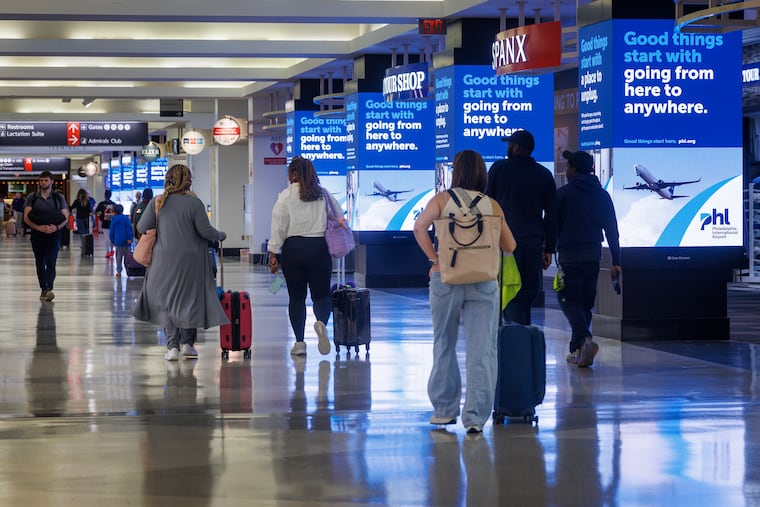
US Airways, based in Tempe, Ariz., is the dominant carrier at Philadelphia International Airport.
From mid-September through yesterday, oil prices fell an additional 5 percent, to around $87 a barrel, but shares of the six airlines sank - in the case of Chicago-based UAL Corp., parent of United Airlines, its stock has shed 62 percent of its value. US Airways lost 60 percent. The Dow, meanwhile, has fallen 22 percent.
"The old saying is, 'You can't fight the tape,' " Neidl said, "and that's what airline stocks are up against right now."
Stifel, Nicolaus & Co. Inc. analyst Hunter Keay said in a recent research note that he had seen significant upside potential for domestic airlines, particularly shares of Delta Air Lines Inc., which he said he believed were significantly undervalued. The carrier, based in Atlanta, expects to close its acquisition of Northwest Airlines Corp., of Eagan, Minn., later this year.
Several major airlines have moved aggressively to shore up their cash positions. The specter of bankruptcy that was back on airlines' and analysts' radar screens in May has seemed to diminish in the months since. Some airlines, which have benefited from significant capacity cuts and new fees charged to customers, have even been talking about posting profits in the future.
"Right now, they seem to have things pretty well controlled with their capacity reductions," Minneapolis airline expert Terry Trippler said. "The last eight flights I have been on, all but one have been filled - and this is with higher prices and fees."
For now at least, airline investors seem to be largely ignoring carriers' improved balance sheets. With the U.S. economy in deep turmoil, could investors be worried that demand for air travel will fall off in the future?
"I think the airlines have a handle on it right now," Trippler said. "Going forward, they will have to watch it very closely."
Airlines for the most part have been able to weather the problems created by the frozen credit market. That's because they have been able to tap existing credit lines or to sell assets to raise cash. But experts have said that, the longer credit markets stay tight, the longer many companies will have to draw down their reserves and credit lines.
Officials at several major carriers declined to comment or did not respond to requests for comment. Investors will get a fresh look at U.S. airlines' prospects for the future when carriers release third-quarter results starting next week.
What the future holds for long-term airline shareholders, who have been craving a return on their investments, remains to be seen.